

Audio By Carbonatix
Humans, for ages, have attempted to understand, describe and share everything in the universe, with science and art as execution tools.
Though the two disciplines share similar motivation, their conflicts cannot however be overlooked.
In the covid-19 era, Luv FM’s Kwasi Debrah examines how scientists and artists are making their existence matter.
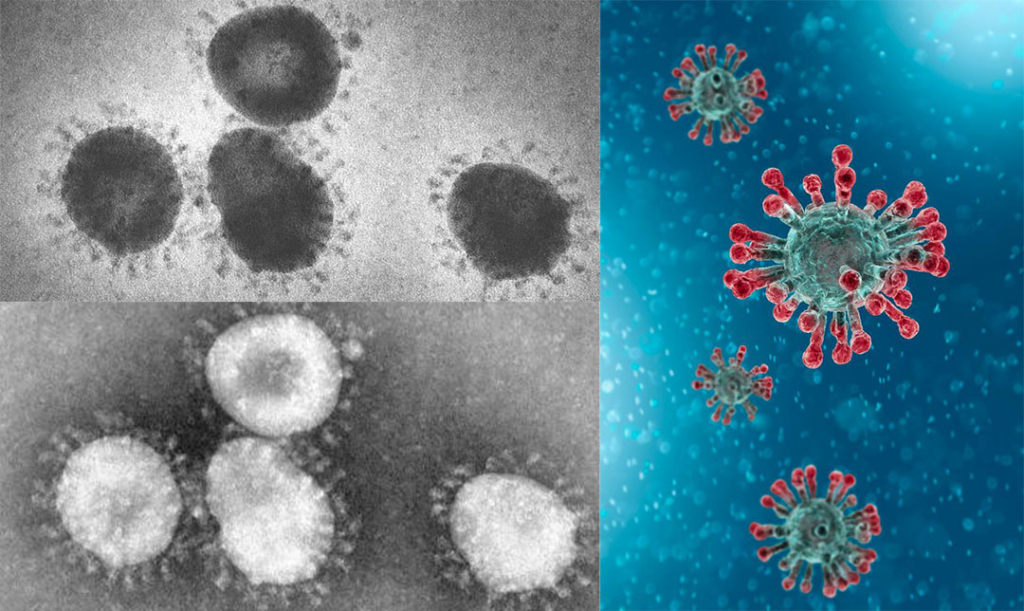
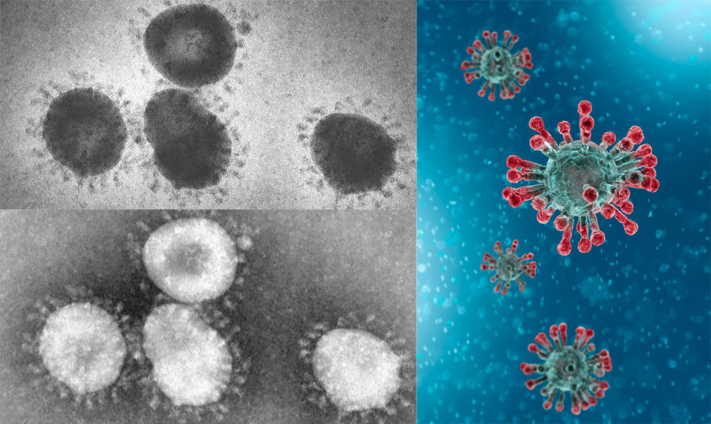
A scary, spiky ball in 3D is how the world has come to know of the physical structure of coronavirus.
However, a perusal of electronic microscopic images of the virus reveals, “a fringe of large, round bulbous surface projections which are rounded or petal shaped, creating an image reminiscent of the solar corona or halo,” as 1968 report in the journal, Nature, puts it.
“The spikes sit on a lipid layer called envelope protein. Underneath the envelope protein is another structure called the N protein that gives it a spherical shape,” KNUST virologist, Dr. Mohammed Mutocheluh describes.
Though the spherical shape of coronaviruses with spikes is undisputed, a closer look reveals it’s not a perfect one.
Studies show it differs in shape, size, and the number of spikes.
Nonetheless, graphic artists would only care about varying the size rather than have time for banging the shape or varying the number of spikes.
Blood in a test tube

When one is infected with SARS-CoV-2, the virus that causes COVID-19, the well-known test for detecting the RNA of the virus involves use of a technique called RT-PCR.
“The virus has an envelope so you have to, first, remove the envelope, extract the nucleic acid or genetic make-up, do a PCR and, then, you identify the virus,” Dr. Michael Owusu, also a virologist of KNUST, summarizes.
It’s been shown to detect as little as one virus particle in swabs taken from inside the nose or mouth.
“We normally use swab stick to take nose and throat sample and sputum for testing,” he indicates.
Test tubes are used to collect samples.
It’s therefore clear; fluids used for covid-19 test exclude blood, except for Rapid Diagnostic test, which uses a tip-of-a-spoon quantity.
“We don’t want to show blood as a molecular diagnostic sample. We only do serological test on the sample. Even that one, we show the plasma not the whole blood which detects antibodies of the virus not the virus itself,” Dr. Owusu pointed out.
With test tubes ticked positive or negative, he further states: “the test tubes are not even labeled the way they’re portrayed.”
If scientists wouldn’t show whole blood to detect coronavirus, why would artist decide to portray covid-19 with a whole blood?
Blood makes up 7 percent of the body weight; the average adult has between 1.2 to 1.5 gallons of blood in them.
Bacterial and viral diseases, such as hepatitis and HIV, have always found solace in this medium.
Artist and lecturer at the KNUST, Dr. Mantey Jectey-Nyarko, believes test tube containing blood might not be the accurate representation of the disease, but he maintains “blood is another way of talking about diseases.”
He believes the transparent nature of test tubes makes it difficult to communicate a disease which is ‘invisible’, should it house a relatively clearer substance like sputum.
“Sputum in transparent container doesn’t send that signal: it’s like pouring water in the test tube. With blood, the idea of a disease comes to mind,” he said.
Science and art have long enjoyed a good friendship. Artistic impressions have always helped in appreciating science.
Artists and scientists have similar motivation and goals, but crave for accuracy might not necessarily be shared by the artist.
Nonetheless, they both remain powerful forces driving awareness of mankind.
Latest Stories
-
Ntim Fordjour demands probe into ‘indecent’ scenes at Accra Carnival
14 minutes -
El Niño Alert: Why a possible 2027 heat record could signal droughts, floods and flood risks for Ghana
15 minutes -
UMB strengthens its leadership with appointment of Emmanuel Sackey as Group Head of Treasury
23 minutes -
Court throws out prosecution witness statements in Buffer Stock trial
29 minutes -
Police seek public help to track three fugitives after Adabraka jailbreak
32 minutes -
Electronic Communications Act not meant to regulate journalists’ conduct – Inusah Fuseini
40 minutes -
GJA heads to Supreme Court over alleged misuse of Electronic Communications Act against journalists
42 minutes -
ECG cannot operate effectively under reduced capital expenditure — Dubik Mahama warns
46 minutes -
Miracles Aboagye hints at exposing top officials in galamsey crackdown row
46 minutes -
EPA warns against excessive noise as Ghana marks International Noise Awareness Day
48 minutes -
Oti MDCEs sign contracts to kick-start 24-Hour Economy markets project
55 minutes -
Time’s up for justice? Why Ghana’s human rights “expiry date” must go
56 minutes -
GRA rolls out digital modified tax system to capture informal sector
1 hour -
The dirty secret powering some of music’s biggest hits
1 hour -
27th TGMA: Hits, heat and hard truths
1 hour