

Audio By Carbonatix
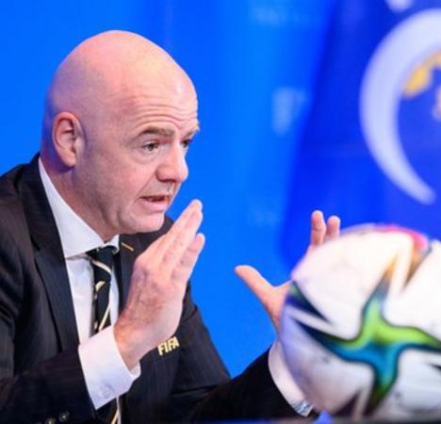
Ahead of the 2023 FIFA Women’s World Cup to be staged Australia and New Zealand, President of the association, Gianni Infantino has been speaking on television rights for the tournament.
“We are in the process of commercialising this Women’s World Cup. In terms of the preparation, everything is well on track. Beautiful stadiums, beautiful venues. We started the ticketing sales, great numbers as well.
“I think 200,000 tickets sold in the first week. So, it’s going really well. However, there is one point which we are really not very happy with, and that’s the following: We are, of course, putting a lot of effort into women’s football. We are investing in this four-year cycle USD 1 billion in developing women’s football all over the world; it’s a lot of money.
"And we are trying for the first time in FIFA’s history to commercialise the Women’s World Cup on its own, not as a ‘you buy the men’s World Cup and we give you the women’s rights’ on top, right? So, now, what we’ve witnessed, or what we are witnessing, in some countries – I don’t want to mention them, but those who are there, know it. In some countries, they are quite good at telling us – and we welcome that, I must say, because it helps us as well – that we should give more emphasis on equal opportunities, on equality, on non-discrimination, on treating men and women in the same way which is, of course, what we have to do, and we try to do that to the best of our ability. Now when these same broadcasters, often public broadcasters, but also private broadcasters, offer us 100 times less for the Women’s World Cup than what they offer for the men’s World Cup: 100 times less, even more than 100 times in some occasions, then this is not acceptable.
“We are not going to accept this, because we know that the viewing figures for these broadcasters in some big footballing countries for the men’s World Cup or for the Women’s World Cup are actually very similar, especially in the recent past we had viewing figures in the last Women’s World Cup of 1.2 billion people around the world.
“Taking only the Final, 263 million, which is more than twice the Super Bowl. And having these broadcasters, who push us to do more for equality, at the same time, however, offering us a hundred times less for the men [compared] to the women going by the viewing figures, meaning their commercial income is very similar for men and for women.
“I think this is something that needs to be seriously looked at and we are not going to accept these offers, this must be very clear and hopefully we’ll find ways to come to terms with it, but it’s important that everyone puts actions, as well, behind words and we all start to treat women’s football the same way
Latest Stories
-
UTAG-UG threatens strike on October 19 over unpaid allowance
2 minutes -
Let The Constitution direct Chieftaincy to deliver “All Development Is Local”
1 hour -
John Jinapor outlines renewable energy, nuclear power priorities for 2027
2 hours -
Ghana explores centre of excellence for hearing, communication and cochlear implant care
3 hours -
Schizophrenia-related disorders lead mental health cases recorded in Ghana
3 hours -
Dutch authorities enlist Ghana in hunt for fugitive drug lord Bolle Jos
3 hours -
Ghana housing finance conference adopts communiqué to improve affordable housing access
8 hours -
Special Initiatives Minister urges Wa Technical Institute to enrol more girls as EU-backed solar training lab opens
8 hours -
In the matter of my first year at the Bar
8 hours -
ActionAid Ghana calls for an end to child marriage, greater investment in girls’ rights
9 hours -
Newsfile to tackle World Cup visa scandal, beach demolitions, education strikes, BRICS bid
9 hours -
UK-Ghana Trade & Investment Summit: Trade Resource Centre to help businesses maximise UK-Ghana trade opportunities
9 hours -
Embassy of Denmark celebrates World Maritime Day
9 hours -
Linking LEAP to productive inclusion could cut extreme poverty by 2030 – UNICEF
10 hours -
Trade Ministry backs use of creative arts to rehabilitate prison inmates
10 hours