

Audio By Carbonatix
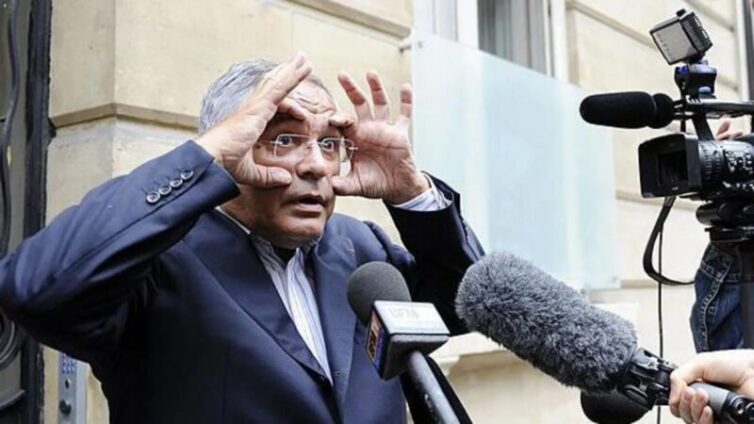
It was January 1998 and Robert Bourgi was waiting to see the Gabonese president Omar Bongo, in an antechamber at his seaside palace in Libreville.
He was there to collect funds for the approaching French presidential election on behalf of the centre-right Gaullist candidate Jacques Chirac, who was mayor of Paris at the time.
Who should then be ushered into the same antechamber but Roland Dumas, former French foreign minister and right-hand man of ruling Socialist President François Mitterrand, Chirac’s arch-rival?
“Good day, Bourgi,” said Dumas. “I believe we are here for the same purpose.”
Claiming seniority, Dumas went into Bongo’s office first. Emerging a short time later, he said to Bourgi: “Don’t worry, there’s still a bit left!”
Recounted in Bourgi’s newly-published memoirs They know that I know it all - My life in Françafrique, the anecdote says everything about the money-grabbing and mutual dependence that for so long linked French and African politics.
For four decades Robert Bourgi was at the centre of it all.
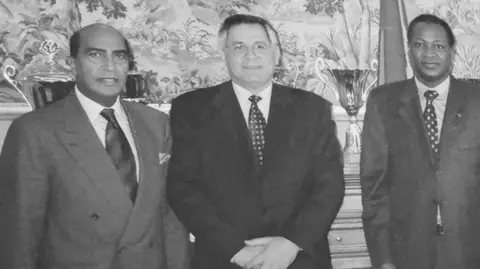
Born in Senegal in 1945 to Lebanese Shiite parents, he rose to become a confidant of a generation of African leaders – from Omar Bongo in Gabon to Denis Sassou Nguesso of Congo-Brazzaville and Blaise Compaoré of Burkina Faso.
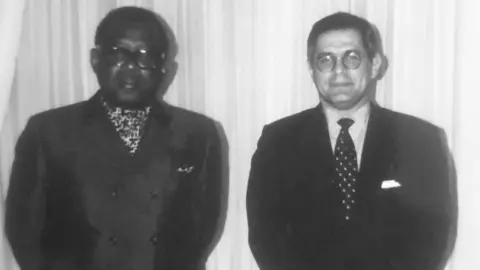
And in Paris, he inherited the mantle of the legendary Jacques Foccart – the Gaullist who oversaw the post-colonial Françafrique system, with its arrangements of influence and protection, markets, materials, muscle… and money.
From the early years after World War Two – during which it had been a centre of activism in favour of France’s post-war leader Charles de Gaulle - Africa and its former French colonies had been a source of financing for all French political parties. By the 1980s, when Bourgi came onto the scene, it was routine.
Bourgi says that he himself never imported the bags of cash.
“The procedure was simple. When there was an election approaching, Chirac made it clear that I should deliver a message in various African capitals,” he said in an interview in Le Figaro newspaper this week.
“The [African] heads of state then sent an emissary to my office in Paris with a large sum. Several million in francs or dollars.”
In each of the 1995 and 2002 presidential elections – both won by Chirac – he says around $10m (£7.5m) was given by African leaders.
The 2002 race provided Bourgi with another colourful story, when a representative of Burkinabè leader Blaise Compaoré arrived in Paris with a large sum of money concealed in djembe drums.
According to Bourgi, he accompanied the envoy to the Elysée Palace, where they were greeted by Chirac. They opened the sealed drums using a pair of scissors, upon which a rain of banknotes fell out.
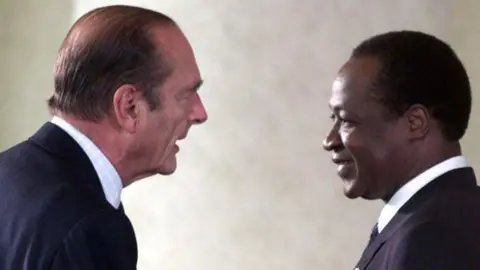
“Typical Blaise,” Bourgi quotes Chirac as saying. “He’s sent us small denominations.” The money was apparently all in fives and tens.
Handling the cash was not always easy. Remembering a big donation to Chirac from another African leader, Bourgi says: “The money arrived in Puma sports bags. I wanted to put the wads in paper so I went into my daughter’s room and took down one of her posters, and wrapped the money in that.”
The system was so widespread that it gave rise to a verb cadeauter – from the French cadeau, meaning a present.
When Bourgi’s allegations first surfaced in 2011 they were denied by officials in Burkina Faso and elsewhere, although a former presidential adviser in Ivory Coast conceded they were “historical practice”.
Chirac and his then chief of staff Dominique de Villepin also strenuously denied Bourgi’s claims.
A preliminary investigation was opened but later dropped without further action because the payments were considered too long ago.
For African leaders at the time, says Bourgi, it was normal, and they did it among themselves. Giving large sums of money was a way of establishing trust and support.
But in a changing world it was unsustainable and Bourgi says he grew disillusioned. Nicolas Sarkozy came to power in 2007 vowing not to take a single franc from Africa, and Bourgi says he kept to his word.
Sarkozy has since been placed under investigation for allegedly taking campaign funds from Libyan leader Muammar Gaddafi - which he denies. Bourgi, a Sarkozy loyalist, says he does not believe the charges.
The former lawyer, now aged 79, also reflects on his rather different role in another election - that of Emmanuel Macron in 2017. That was when Bourgi helped scupper the chances of the man who was for a time the runaway favourite, the conservative François Fillon.
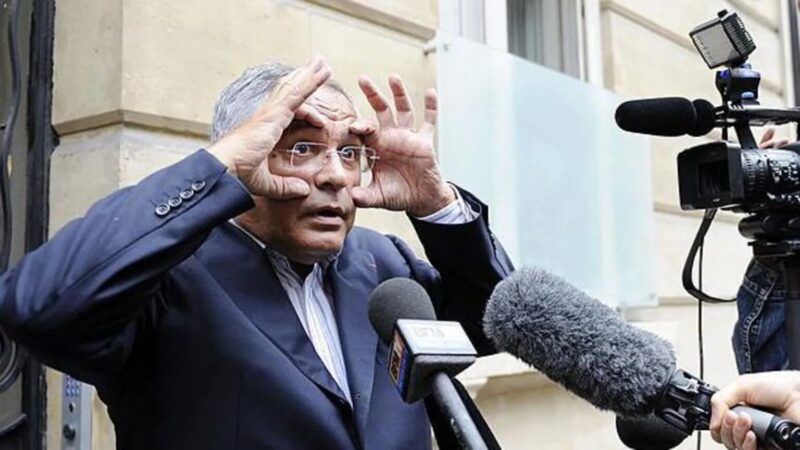
Once close to Fillon, Bourgi had become estranged: he accused the former prime minister of being rude and stingy. So he released to a journalist the fact that he had made Fillon a gift of two very expensive suits.
Campaigning on a message of probity, Fillon never recovered. Later he was convicted of giving a fake parliamentary job to his British wife.
But Africa is Bourgi’s love.
He reflects that though the corruption at the heart of Françafrique was wrong, the system at the time brought stability, and a bond - often personal - between French and African leaders.
Today, that is gone.
France has a worsening image in its former colonies, and its influence is on the wane. Witness the recent retreat from its former army bases in Mali and Niger.
“I note with sadness the disintegration of French relations with the continent,” Bourgi says.
“But it is too easy to put all the blame on Françafrique… Africa has globalised. France has been unable to adapt to this new fact. And it keeps making the same mistake: arrogance.”
Latest Stories
-
Trade Minister applauds GUTA as a pillar of economic growth; Prez Mahama honoured
50 minutes -
President’s brother’s takeover of Damang Mines is ‘untidy’ – Alhassan Tampuli
56 minutes -
It’s not true that gov’t decided not to renew the lease for Gold Fields – Bobby Banson
60 minutes -
Ghana to boost tomato production with 60-hectare irrigated farms and processing initiatives
1 hour -
E&P’s takeover process of Damang Mines was very clean – Inusah Fuseini
1 hour -
Damang takeover: There is not going to be any job loss; it is a lease change – Bobby Banson
2 hours -
Gold Fields didn’t stop mining at Damang mines; such claims are untrue – Bobby Banson
2 hours -
Engineers and Planners currently operate only in Ghana – Bright Simons
2 hours -
Lands Minister has no legal basis to restrict lease to Ghanaian firms – Bright Simons
2 hours -
Gov’t’s refusal to renew Gold Fields’ lease was simply untenable – Bright Simons
2 hours -
SOS Children’s Villages Ghana deepens partnership with Gender Ministry
3 hours -
Gender Ministry celebrates Christina Koch, reaffirms commitment to empowering girls
3 hours -
Live stream: Newsfile digs into E&P’s takeover of Damang Mines, OSP powers and Anti-LGBTQ Bill
3 hours -
Moody’s maintains Ghana’s rating at Caa1, revises outlook to positive
4 hours -
Zambia elevates tourism education to national priority as President Hichilema backs continental summit
4 hours