

Audio By Carbonatix
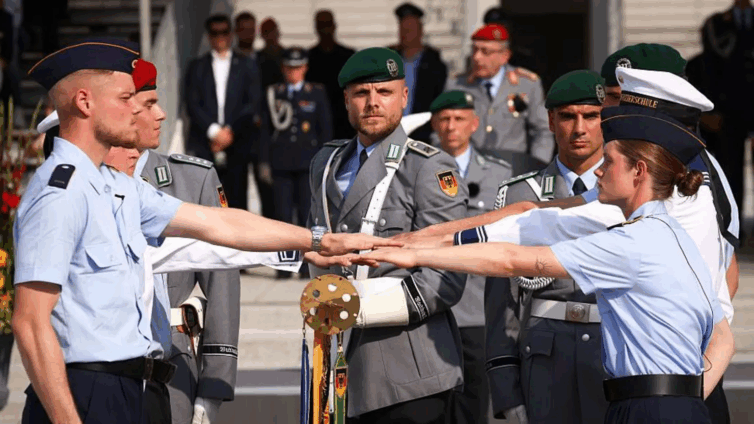
Germany's cabinet has passed a draft bill which will introduce voluntary military service. The bill could also lead to conscription if more troops are needed.
It's part of a move to boost German national defences, following Russia's full-scale invasion of Ukraine.
Compulsory military service in Germany was ended in 2011 under then-Chancellor Angela Merkel.
Chancellor Friedrich Merz has made boosting Germany's military a priority, given the threat from Russia and said "we are now back on the path to a military service army".
He summed up his thinking earlier this year, saying: "We want to be able to defend ourselves so that we don't have to defend ourselves."
Germany's plans also follow calls by US President Donald Trump for Europe to take more responsibility for its own defence.
When his coalition government came to office earlier this year, it loosened borrowing restrictions to enable a surge in defence spending and then announced plans for 3.5% of economic output to go on defence over the next four years.
Defence Minister Boris Pistorius wants to increase the number of soldiers in service from 182,000 to 260,000 by the early 2030s to meet new Nato force targets and strengthen Germany's defences.
The defence ministry also wants to increase the number of reservists to 200,000.
In future, all 18-year-old Germans, both men and women, will be sent an online questionnaire asking if they are willing to volunteer for military service. It will include questions about their physical fitness.
Men will be required to complete the form, but it will be voluntary for women.
Quentin Gärtner, 18, who heads the country's Federal Pupils' Conference, said his generation wanted to contribute to the defence of German democracy - but that young people's voices should be heard.
"We can only do our part and take responsibility for our society when we are included in every decision-making process affecting our generation," he told the BBC.
"The Ministry of Defence has not reached out to us yet... He can call me any time."
In a statement, the government said military service would be voluntary for as long as possible.
However, it said that if the security situation worsened or if there were too few volunteers who came forward, the government could decide to use compulsion with the approval of the German parliament, the Bundestag.
Pistorius told Deutschlandfunk radio he expected military service to remain voluntary.
"With attractive pay and attractive military service, I am very confident that we will succeed in attracting young men and women to the Bundeswehr," he said.
In recent years, the defence ministry has stepped up advertising campaigns and career events in a bid to recruit soldiers.
In the first six months of this year, the Bundeswehr has reported a 28% increase in the number of new recruits, compared with the same period last year.
Some members of Pistorius's Social Democrat party, the junior partner in the coalition, have criticised the plans, saying the Bundeswehr should be made a more attractive employer, rather than re-introducing compulsory military service.
Members of Chancellor Merz's conservatives have warned that the insistence on approval by the Bundestag before reintroducing conscription could delay matters too much.
Some commentators have questioned whether this is the right step for Germany.
Johannes Angermann, writing for public broadcaster MDR, said military service would rob the younger generation of "time and money". He argued for an improved professional army instead.
Meanwhile, anti-war group Rheinmetal Entwaffnen said in a post on social media: "We want nothing to do with the wars of the ruling classes and are not prepared to die for a country that is increasingly cutting back on all social infrastructure. We will not fight your wars!"
Latest Stories
-
Man City suffer as PSG masterclass sets up Champions League win
1 hour -
Customer Service Africa CEO urges business leaders to observe staff and customer interactions
1 hour -
On night of mayhem for Liverpool, Barcola arrives in style
1 hour -
Muzic Mensah finds healing and renewed love in new single ‘WayƐ Late’
2 hours -
FIFA to offer extra £2.6bn for football development
2 hours -
Government backing is no EPA permit – Authority warns GoldBod, ministries
2 hours -
Real Madrid produce stunning late fightback to down Roma
2 hours -
EPA orders immediate halt to unpermitted reclamation and dredging nationwide
2 hours -
Afenyo-Markin’s lawsuit against Sammy Gyamfi takes focus away from development – Kpebu
2 hours -
FWSC urges media to guard against misinformation in proposed IPEC transition
2 hours -
MoMo Fest 2026: Shatta Wale to Rock Accra Stadium on October 17
2 hours -
GTEC’s letter directing public universities to reopen by October 16 is unprofessional – GAUA
3 hours -
Suspect in viral video assaulting wife jailed for 3 months
3 hours -
GAUA insists strike will end only after Fair Wages addresses market premium issue
3 hours -
Kpemka seeks compensation as he sues BOST over alleged unlawful termination
3 hours