

Audio By Carbonatix
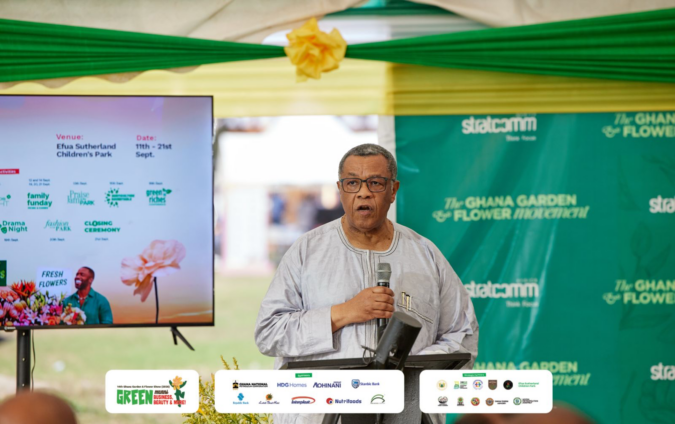
Presidential Advisor on the 24-hour Economy, Augustus “Goosie” Obuadum Tanoh, says Ghana can expand industries, create jobs and grow exports without sacrificing the environment.
He said the country must deliberately build industries around its natural resources while strengthening the systems that protect the environment.
“Ghana does not have to choose between growing industries and protecting the environment,” he said.
“We can produce more, create jobs, and expand exports while strengthening the natural systems that make that that make our environment grow and thrive.”
Mr Tanoh was speaking on Friday at the opening of the 14th Ghana Garden and Flower Show.
He said horticulture presents significant opportunities for Ghana, but production alone is not enough to build a competitive industry.
“Producing is not the same as building an industry,” he said.
“An industry exists when production connects to aggregation, processing, logistics, and markets, supported by finance, standards, skills, and technology.”
He cited the Netherlands, where the horticultural value chain generated more than €28 billion in exports in 2024, and Kenya, which earned KSh72 billion, equivalent to $556 million, from flower exports last year.
Ghana, he noted, already has evidence that its horticultural sector can compete, exporting about $75 million worth of mangoes to 42 markets in 2024.
Yet, he said, the country continues to import horticultural products it can competitively produce locally.
Mr Tanoh said the 24-Hour Economy and Accelerated Export Development Programme is seeking to address gaps across value chains by connecting production to processing, logistics and markets.
He cited the peri-urban agricultural programme, Shiqpon, which will connect greenhouses and micro-irrigated food production to aggregation, cold storage and markets.
The Tamale Air Cargo Hub, he said, is also expected to strengthen logistics for high-value agricultural exports, including cut flowers, vegetables and fruits.
He disclosed that the 24-Hour Economy Secretariat is working with a private sector investor to develop a cut-flower corridor along the Daboya-Singa pathway.
The flowers are expected to be airlifted through the Tamale Air Cargo Hub to markets in Europe, Ghana, West Africa and the Gulf.
Mr Tanoh said Ghana could replicate Kenya’s success in meeting international demand for flowers.
“We can do the same,” he said.
He also linked the growth of horticulture to environmental sustainability, warning that the industry depends on healthy soils, water, land and functioning natural systems.
He said Ghana must build an industry that strengthens rather than diminishes those systems.
“This is an approach we are putting into practice through the Volta Economic Corridor under the 24-hour economy program,” he said.
Mr Tanoh said the corridor has a net-zero ambition focused on renewable energy, climate-smart production, efficient use of land and water, ecological restoration, and reduced waste and emissions.
“Green means business, green means beauty, and when we build the systems that allow both to flourish, green can mean so much more for Ghana,” he said.
Latest Stories
-
Police blur the line between invitations and arrests – Reindorf Twumasi Ankrah
19 minutes -
Turning invitations into arrests is making citizens reluctant to assist police – Twumasi Ankrah
53 minutes -
The Traffitech-GH SMS spot-fine system: The good, the sad, and the funny – Bright Simons writes
1 hour -
Hawa Koomson pledges experienced and mature leadership of NPP women’s wing
2 hours -
Young woman found dead at Kasoa Peace Town
3 hours -
Playback: The Law examined lawful arrest in Ghana
3 hours -
Mahama urges African governments to treat healthcare as an investment, not budget cost
4 hours -
Bawumia congratulates John Boadu and new NPP executives, pledges support ahead of 2028
4 hours -
Aksa Energy delegation pays courtesy call on GRA Commissioner-General
4 hours -
‘No talent should be left out’ – Bawumia pledges inclusive NPP campaign for 2028
4 hours -
Prof. Mike Oquaye recounts how he blocked the Special Prosecutor’s attempt to arrest Bawku Central MP
4 hours -
Make health sovereignty a priority for Africa – Mahama
4 hours -
Dorimon Naa, Wa West DCE lead massive clean-up exercise; threaten sanctions against recalcitrant residents
5 hours -
Photos from Adom FM Y2K Jam
5 hours -
Praye Tiatia steals the show at Adom FM Y2K Jam [Watch]
5 hours