

Audio By Carbonatix
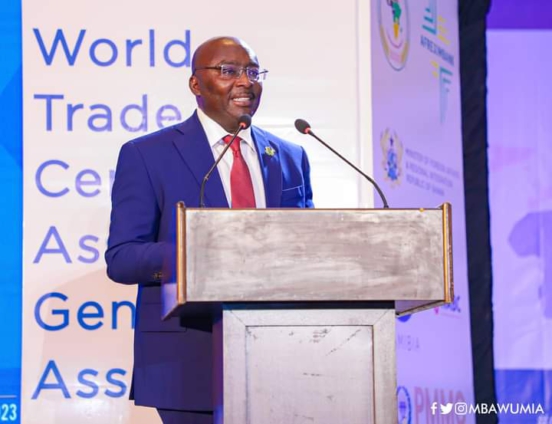
Vice President Dr Mahamudu Bawumia has underscored the government's dedication to addressing challenges within the informal economy through the implementation of the Ghana Card, a vital component of the digitalisation agenda.
Speaking at the 20th edition of the Ghana Club 100 Awards on Saturday, December 9, the NPP flagbearer highlighted the negative impacts of the informal economy, such as age cheating, identity fraud, and the proliferation of counterfeit documents like insurance, birth certificates, and passports.
Dr. Bawumia emphasised the importance of transitioning from an informal economy to a more disciplined and transparent system.
He outlined the issues faced in an informal economy, including corruption, lawlessness, tax evasion, and an unbanked society. To tackle these challenges and unlock the transformative potential of the economy, he noted that the government embarked on a formalisation process.
The Vice President explained that the digitalisation initiative played a pivotal role in this formalisation process, with the Ghana Card serving as its anchor.
He added that by digitising government services through Ghana.gov.gh and other initiatives, the government aims to enhance transparency, clarity, and efficiency in the system.
Dr Bawumia stated that these measures contribute to reducing corruption, as services can be accessed without the need for bribes.
“You look at an economy in the informal sense which turned to be undisciplined, the society is undisciplined because the economy is informal and there are no consequences for bad actions, you have a society where corruption prevails, you have lawlessness, you have a tax dodging society, you have an unbanked society, you have a loan repayment dodging society, identity fraud, people assuming identities of others, lack of address systems, age cheating, fake insurance, fake birth certificates, fake passports, no functional address systems, ghost workers on government payrolls.”
“These ills of the informal economy that we really inherited made it very difficult for the economy to transform to its potential. That is why we set out to formalize the economy to make sure that the economy works in a transparent system. In that area of formalisation of the economy we realized heavily on digitalization of the economy to formalize the economy.”
Latest Stories
-
President Mahama courts diaspora investment, highlights Ghana’s economic and energy gains at UNGA – Town Hall
31 seconds -
Hohoe floods: Volta Regional Minister assures affected residents of government support
7 minutes -
Ablakwa assures Ghanaians in New York of stronger consular support and recognition of diaspora contributions
10 minutes -
Gender Ministry prepares officers to monitor LEAP payments nationwide
14 minutes -
AMA reminds drivers of yellow-plated vehicles to obtain commercial driver’s licences from Assembly
15 minutes -
My focus is victory in 2028, those with Agenda 2032 can wait — John Boadu
38 minutes -
AK24 Entertainment wins Event Promoter of the Year at Ghana Entertainment Awards USA 2026
41 minutes -
KNUST, UNCDF host EU Ambassador to advance EU Pact for skills development initiative agenda
41 minutes -
Teachers’ strike: School in Wa turns ghost town; pupils forced onto ‘virtual holiday’
44 minutes -
Gov’t should not see bipartisan probe into 3.9-tonne cocaine haul as attack – Akuapem North MP
55 minutes -
The foundation of every boy’s upbringing is important – Kobby Kyei
58 minutes -
Middle East conflict pushed Ghana fuel prices higher in first half of 2026 – COMAC
1 hour -
President Mahama puts mining firms on notice over 2030 raw mineral ore export ban
1 hour -
Ghana’s fuel consumption rises 12.24% to 4.06 billion litres in first half of 2026
1 hour -
Global oil shock tests Ghana’s shift towards domestic fuel production
1 hour