

Audio By Carbonatix
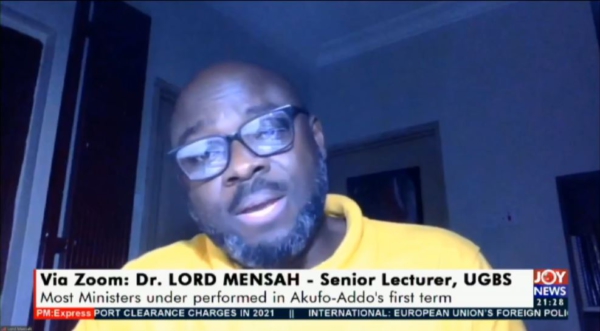
A Finance Lecturer at the University of Ghana Business School (UGBS), Prof. Lord Mensah says the country’s economy is not insolvent contrary to suggestions by some financial analysts that the economy is broke.
According to him, the government is not prioritising its expenditure which is creating a scenario of an insolvent economy.
Speaking on the AM show on Monday, January 17, 2022, Prof. Lord Mensah noted that a country like Ghana with the ability to generate revenue of about 70 billion Ghana cedis cannot be described as broke.
“Ghana is never broke, a country that is broke has no ability to generate revenue. Now if you look at Ghana as a country, I would say that we are not broke but we are not able to prioritise our spending that is what is making it look as if the country is broke. We are not broke because a country that would be able to generate revenue of about 70 billion Ghana cedis, what makes it a broke country?” he asked.
Prof. Lord Mensah said that over the past years, the government has instituted measures to generate revenue without managing its expenditure.
He explained that the government’s expenditure has not been efficient stressing that the country spends money in sectors that do not generate revenue.
“Government tries to put in measures that enhance revenue but then the only difficult thing is that government has not got the political will to look at the expenditure side. If you look at the expenditure side carefully, you will realize that there are some key areas that you may not want to touch and at the end of the day if you relate that to our revenue you may realize that more or less what we generate is not what we can spend, we are not doing that.”
“What we are doing in this country is that we are spending more than is necessary. All our expenditure is going into areas which are not necessarily generating revenue back into the system,” he stated.
This, he said is what has accounted for the increase in the country’s debt burden; adding that the downgrading of Ghana’s Long-Term Foreign-Currency Issuer Default Rating (IDR) from ‘B’ to ‘B-’ is not surprising.
“If you take the last budget that we read, it looks like all the revenue-enhanced policies that the government tends to roll out are falling on rocks because if you take the e-levy, the plan was that it had to kick off in January 2022 but look at where we are now; and also if you take the benchmark value reduction, it also has a problem.”
“Clearly, it tells you that the government is struggling when it comes to the ability to implement its revenue-enhanced policies. So if you are to create an economy of this nature, you’re going to downgrade it because if you’d be able to pay your debts, it has to do with your ability to raise money,” he said.
Fitch pointed out in its ratings that Ghana’s effective loss of market access to international bond markets increases risks to its ability to meet medium-term financing needs.
The downgrade of Ghana’s IDRs and Negative Outlook reflect the country’s loss of access to international capital markets in the second half of 2021, following a pandemic-related [COVID-19] surge in government debt.
“In our view, Ghana has sufficient liquidity and other available external financing options to cover near-term debt servicing without Eurobond issuance.”
“However, there is a risk that non-resident investors in the local bond market could sell their holdings, particularly if confidence in the government’s fiscal consolidation strategy further weakens, placing downward pressure on its reserves,” Fitch said.
Latest Stories
-
NPP’s new executives will not alter our 2028 preparations – Tanko-Computer
31 minutes -
Tema East MP urges men to take active role in breast cancer awareness
36 minutes -
Hawa Koomson vows to bring experience and maturity to NPP women’s wing
40 minutes -
Opare Addo cautions NDC against adopting NPP’s aggressive politics
42 minutes -
NPP has 35 months to prepare for 2028 after early reorganisation – Political strategist
47 minutes -
All six passengers presumed dead after plane went missing off US coast
58 minutes -
Teachers’ promotion arrears to be paid by Oct. 30 – Education Minister
1 hour -
Stop talking too much on stage – Kafui Dey warns MCs
1 hour -
Government has Ho, Volta Region at Heart — Warlord of Asogli
1 hour -
Mahama reaffirms commitment to Volta development at Asogli Te Za
1 hour -
REGSEC orders immediate demolition of fire-ravaged building at Koforidua Jackson Park
2 hours -
Ambassador Boateng congratulates new NPP leadership, urges reconciliation, rebuilding
2 hours -
50 vetted to contest Effutu NDC executive positions
2 hours -
GACL enhances security screening at Accra International Airport
2 hours -
COCOBOD raises GH¢3.39bn at 11% in first Commercial Paper tranche
2 hours