

Audio By Carbonatix
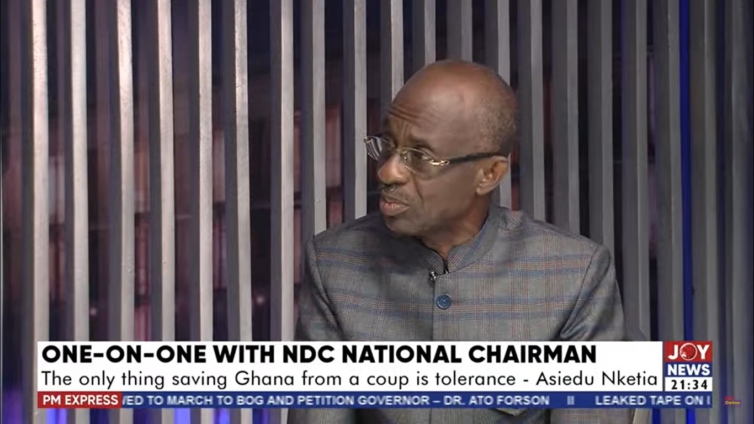
The Chairperson of the National Democratic Congress (NDC), Johnson Asiedu Nketia, has raised concerns about the state of Ghana’s democratic stability due to the ongoing economic crisis.
According to him, although time is long overdue for the seizure of power and the return of autocratic governance, what is keeping Ghana from descending into chaos is the remarkable tolerance of its Ghanaians.
He believed that citizens have reflected on the nation’s history, a history marred by various coups that had been triggered by circumstances less severe than the ongoing incidents.
Mr Nketia made this assertion in a one-on-one interview on JoyNews’ PM Express on Monday.
“Ghana is more than ripe for a coup d’état but the only thing that is saving us is the tolerance of Ghanaians."
“If you look at our history, you will see that the things that have led to previous coup d’états in this country were even less than what is happening now. But the only thing that is saving us is the tolerance and our collective history,” he told host Evans Mensah.
While acknowledging the steadfastness of the populace, Mr Nketia cautioned against succumbing to the temptation of disruptive actions, which might offer temporary relief but could ultimately plunge the nation into an even deeper crisis.
He emphasised that a coup d’état could potentially lead to new leaders who were equally intransigent, perpetuating a cycle of instability.
“There may be situations that you don’t like and you may be tempted to think that nowhere can be worse than where we are now, so let us disrupt. You’ll disrupt, you will have some relief, but the relief will be short-lived and the relief can lead you into another problem where the new leaders may equally be intransigent. So it will mean that you’ve not solved the problem and that knowledge by Ghanaians is what we’re hanging on to now.
Instead, Mr Nketia proposed an alternative path to safeguard Ghana's democracy.
He encouraged the use of available tools such as peaceful protests, constructive criticism of state institutions, and ensuring that these institutions uphold their responsibilities with integrity. These actions, he believed, were the key to preserving the democratic fabric of the nation.
Latest Stories
-
Young woman found dead at Kasoa Peace Town
28 minutes -
Livestream: The Law examines lawful arrest in Ghana
53 minutes -
Mahama urges African governments to treat healthcare as an investment, not budget cost
1 hour -
Bawumia congratulates John Boadu and new NPP executives, pledges support ahead of 2028
1 hour -
‘No talent should be left out’ – Bawumia pledges inclusive NPP campaign for 2028
2 hours -
Prof. Mike Oquaye recounts how he blocked Special Prosecutor’s attempt to arrest Bawku Central MP
2 hours -
Make health sovereignty a priority for Africa – Mahama
2 hours -
Dorimon Naa, Wa West DCE lead massive clean-up exercise; threaten sanctions against recalcitrant residents
2 hours -
Photos from Adom FM Y2K Jam
2 hours -
Praye Tiatia steals the show at Adom FM Y2K Jam [Watch]
3 hours -
Boakye Agyarko congratulates John Boadu, pledges support for NPP leadership
3 hours -
Antwi HiMight thrills fans with Antwi ne Antwi hits at Adom FM’s Y2K Jam [Video]
3 hours -
Amb. Edward Boateng congratulates Boadu, Kodua on election wins
3 hours -
John Boadu pledges to rebuild NPP from grassroots and restore ‘winning machinery’
3 hours -
Ashaiman Assembly deploys monitoring system to curb dumping in storm drain
4 hours