

Audio By Carbonatix
Ghana's nuclear energy ambitions must go beyond the construction of nuclear facilities to developing the scientists, engineers, technicians, regulators and entrepreneurs needed to sustain the sector.
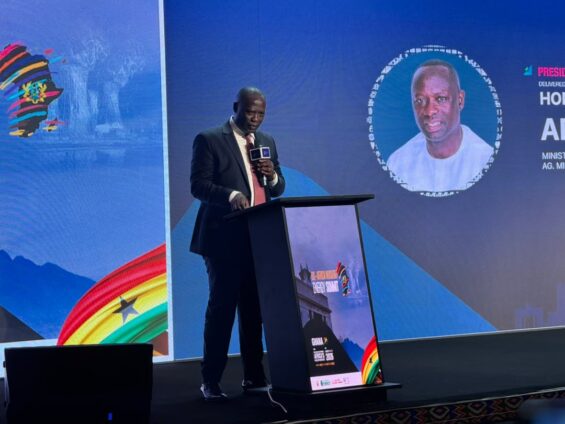
Minister for Lands and Natural Resources Emmanuel Armah-Kofi Buah says Africa's youthful population gives the continent a major advantage in developing the human capital required to participate meaningfully in the global nuclear industry.
Mr Buah was speaking at the US-Africa Nuclear Summit, where he called for a deliberate strategy to build Africa's nuclear talent base alongside its physical infrastructure.
“The nuclear program is not simply a reactor; it is the people,” he said on Wednesday, August 19.
He said the continent could not afford to construct nuclear infrastructure today and wait until tomorrow to develop the professionals capable of operating and regulating it.
“We therefore cannot build the physical infrastructure today and hope to find the people tomorrow. We must build both now.”
The Minister said Africa's demographic profile could become one of its greatest advantages in developing a sustainable nuclear energy sector.
He noted that by 2050, Africa would remain home to one of the world's youngest populations and argued that the continent must deliberately create opportunities for young people to apply their talents in science and technology.
According to him, the nuclear sector will require expertise across a broad range of disciplines, including scientists, engineers, technicians, researchers, regulators, cybersecurity professionals and construction specialists.
He therefore called for greater investment in STEM education, universities, research institutions and postgraduate training.
“Our responsibility is to make sure that their talent has somewhere to go.”
He said the development of nuclear infrastructure should simultaneously create employment opportunities and build expertise that remains within African economies.
“Our industries must create African jobs. Our investors must produce African expertise, and our research institutions must help solve African problems.”
Mr Buah also called for the deliberate involvement of African professionals living and working abroad in the continent's nuclear development.
He said Ghanaian and African scientists, engineers, academics, researchers and technology professionals working in advanced institutions across the United States, Europe and elsewhere should be viewed as part of Africa's human capital.
“They are not lost to Africa; they are part of Africa's human capital.”
He said governments and institutions must create mechanisms through which the expertise of the diaspora can flow into African universities, research institutions, industries and young professionals.
The Minister called for a shift away from discussing brain drain solely as a problem towards creating systems that encourage the circulation of knowledge, expertise and opportunities between Africa and its diaspora.
He proposed stronger access for young African scientists to laboratories and centres of excellence around the world while allowing them to build careers and institutions at home.
Mr Buah said international partnerships would remain critical to Africa's nuclear development but argued that their success should ultimately be measured by the capacity they leave behind.
He said partnerships should result in technology transfer, knowledge transfer, skills development and stronger African institutions.
“The partnership between the United States and Africa should increasingly be measured not only by what is built in Africa, but also by what Africa becomes capable of building for itself.”
He also called for the creation of an African nuclear talent and diaspora network that would bring together governments, universities, technical institutions, regulators, industry, development partners and African professionals across the world.
According to him, African countries could achieve more by developing interconnected talent ecosystems rather than pursuing nuclear programmes in isolation.
“Universities should collaborate. Our regulations should share experiences. Our research institutions should work across our borders, and together we can create a pool of knowledge far greater than any one country could develop independently.”
Latest Stories
-
Customs intercepts assault rifle, two pistols and 610 rounds of ammunition at Tema Port
5 minutes -
PKO boxers secure wins at Odwira Festival
19 minutes -
South Tongu Records Rise in Teenage Pregnancy
36 minutes -
Cabinet threw out US health compact faster than anything I’ve seen – Mahama
38 minutes -
MoFA urges Finance Ministry to reverse World Bank food programme withdrawal over GH¢643m commitments
42 minutes -
NAGRAT demands signed timelines before calling off strike
56 minutes -
National Investment Quiz: West Africa SHS, St. Louis SHS advance to semi-finals
1 hour -
Shatta Wale appeals to Mahama for balanced framework to tackle social media abuse without stifling free speech
1 hour -
Education Ministry urges data-driven talks to resolve teacher impasse
1 hour -
‘What we wanted was money to buy medications’ – Dr Nawaane on US health support
1 hour -
Osman Ayariga leads NDC team to vet constituency aspirants in Central Region
1 hour -
‘We shouldn’t allow their drugs in just because they’re giving us $100m’ – Dr Nawaane
2 hours -
US health deal medical records are a ‘no-go area’ – Parliament health committee
2 hours -
Teachers’ strike: Gov’t has shown no seriousness on Collective Agreement – GNAT
2 hours -
GES to submit more data to CAGD to process outstanding teacher promotion arrears – Education ministry
2 hours