

Audio By Carbonatix
A former Canadian Minister of Industry in charge of digitalisation, Science, and Technology and President of the Treasury Board, Canada, Tony Peter Clement, has advised developing nations to adopt Ghana's ambitious digitalisation agenda.
According to him, the government of Ghana has succeeded in using the digital revolution, ensuring accountability and transparency in all sectors of the local economy.
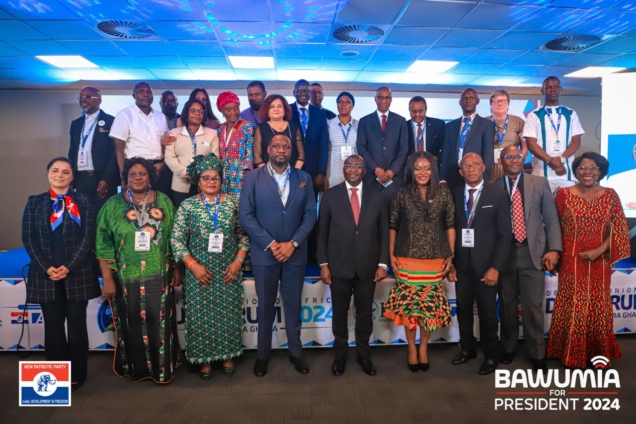
Mr Clement was addressing the Democrat Union of Africa (DUA) Forum 2024, held in Accra, where he spoke on the Topic "Leveraging AI as a tool to build stronger campaign coalitions."
He referenced the Mobile Money Interoperability and the biometric national identification systems as some of the prudent measures that have strengthened Ghana's economic growth.
He underscored the need for developing nations to go the extra mile and bridge the rural and urban digital divide and also enhance cyber security.
Tony Peter Clement further pushed for effective public-private partnerships in accelerating Ghana's digital revolution.

Mobile Money Interoperability
Vice President Dr Mahamudu Bawumia in May 2018 officially launched the Mobile Money Interoperability system through the Ghana Interbank Payment and Settlement Systems Limited (GhlPSS).
The system deepens financial inclusion and promotes cashless transactions in Ghana, which serves as a viable vehicle for financial intermediation, through which businesses and individuals can accept mobile money from other network users seamlessly.
The system is eliminating the complexities and inconveniences associated with transfers across the various mobile money networks operating in the country.
These challenges include difficulties in opening bank accounts, high costs in maintaining a bank account relative to customers’ income levels, and financial literacy.
The system creates convenience and ropes mobile money users into the financial ecosystem and further enables customers to transfer funds from one mobile money wallet to another across all networks.
The system reduces the cost of initiating transactions across networks as customers no longer need the services of a third-party payment provider.
Customers can send and receive money directly from each other irrespective of the network they are on; allowing them more convenience and security.
Latest Stories
-
Photos: Housing solutions take centre stage at Day 2 of the 3rd Republic Bank-JoyNews Habitat Fair
18 minutes -
Video: Immunity should be exercised without creating classism – Inusah Fuseini on cocaine bust
51 minutes -
Ghana Air Force passes out 293 recruits after six months of intensive training
59 minutes -
EOCO vrs Baffour Awuah: EOCO should have secured warrant before arrest attempt at court – Inusah Fuseini
1 hour -
Triple fibre cuts disrupt telecom services across Northern, Oti regions – Sam George
1 hour -
Politicisation could undermine parliamentary probe into cocaine seizures – Dr Osae-Kwapong
1 hour -
EOCO chases MP: Can Section 41 cure lacuna in EOCO Act? – Inusah Fuseini asks
1 hour -
GNFS, GWL inspect fire hydrants in Ministries enclave; 23 found faulty
1 hour -
Gov’t directs release of 50,000 bags of grain to ECOWAS
1 hour -
Ghana, Germany deepen cooperation on railways, labour mobility
1 hour -
Huge crowds greet Pope in Paris for open-air Mass
2 hours -
‘I never said I’ll declare a state of emergency’ – President Mahama on galamsey
2 hours -
Bobby Banson condemns EOCO’s attempted arrest of Nana Agyei Baffour Awuah
3 hours -
When Kumasi begins to look like somebody is in charge
3 hours -
Parliamentary probe into cocaine seizure would be a waste of time – Inusah Fuseini
3 hours