

Audio By Carbonatix
Ghana’s economy expanded by 4.5% in July 2025, according to the latest Monthly Indicator of Economic Growth (MIEG) released by the Ghana Statistical Service (GSS).
The figure represents a slowdown from the 8.3% growth recorded in July 2024, signaling a moderation in the pace of economic activity despite continued expansion across key sectors.
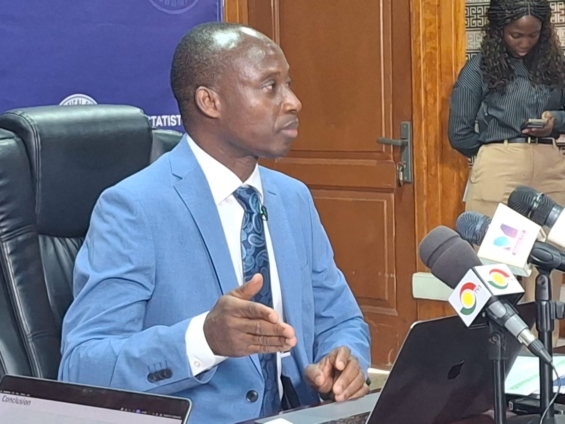
Speaking at a media briefing, Government Statistician, Dr. Alhassan Iddrisu, explained that the MIEG serves as a high-frequency measure of economic performance, providing an early signal on the direction of Ghana’s economy.
Built on the same framework as the quarterly GDP, he said the MIEG tracks monthly changes in the country’s economic activity to support timely policy and investment decisions.
“The economy continued to expand in July 2025, though at a slower rate compared to the same period last year,” Dr. Iddrisu noted.
The data showed that the Services sector maintained its strongest performance recording 6.4% growth in July 2025, up from 4.5% in July 2024.
The sector contributed the largest share (58.4%) to the overall MIEG growth, underlining its sustained dominance in Ghana’s economic structure.
The Agriculture sector also posted an impressive growth, expanding by 8.0% in July 2025, a significant rebound from 2.4% in July 2024.
This acceleration, according to the report, reflects increased output and productivity in crop and livestock production, contributing 37.1% of the total MIEG growth for the month.
In contrast, Industry slowed sharply, with growth of just 0.1% in July 2025, down from 17.7% a year earlier.
The sector’s contribution to overall growth stood at 0.9%, suggesting a marginal expansion driven largely by modest performance in manufacturing and construction.
According to the GSS, the latest figures point to continued resilience in services and agriculture, but also highlight structural weaknesses in Ghana’s industrial base, which remains vulnerable to high production costs and reduced external demand.
It emphasised that the MIEG will continue to serve as a vital tool for tracking short-term shifts in the economy and informing policy interventions aimed at stabilising growth and supporting sectoral recovery.
Latest Stories
-
Obuasi SHTS case: Eduwatch calls for sex offenders’ register and mandatory background checks for teachers
2 minutes -
GloMeF CEO urges intensified public education on new road traffic regulations
13 minutes -
‘Any tax on ChatGPT is an attack on education and innovation’- Akim Swedru, MP
17 minutes -
Obuasi SHTS sexual abuse scandal exposes systemic failure in child protection – Moving Masculinity
17 minutes -
Hubtel CEO calls for national data-sharing framework to boost AI development
20 minutes -
Twelve Golden Rules of real estate development in Ghana, Africa
24 minutes -
Five new telephony cell sites in Ashanti Region to be activated in October 2026 – Sam George
25 minutes -
Mahama cuts sod for Afienya Industrial Park, targets 120 enterprises
30 minutes -
Rush for fuel from accident tankers is stealing, punishable by law – NPA boss, Edudzi Tamakloe
35 minutes -
GhIG pushes for legislation to regulate geoscientists’ activities
41 minutes -
Mfantsipim @150: Ace Anan Ankomah leads project to preserve school’s musical heritage
45 minutes -
Gov’t launches rCOMSDEP in Ahanta West, Mpohor Fiase to promote responsible community mining
47 minutes -
AI is forcing professionals to rethink how they deliver value – Hubtel CEO
50 minutes -
Daily Insight for CEOs: Strengthening the CEO’s Leadership Legacy
51 minutes -
Jimmy Aglah’s ‘When the River Testified’ approved by NaCCA as Supplementary Reader
60 minutes