

Audio By Carbonatix
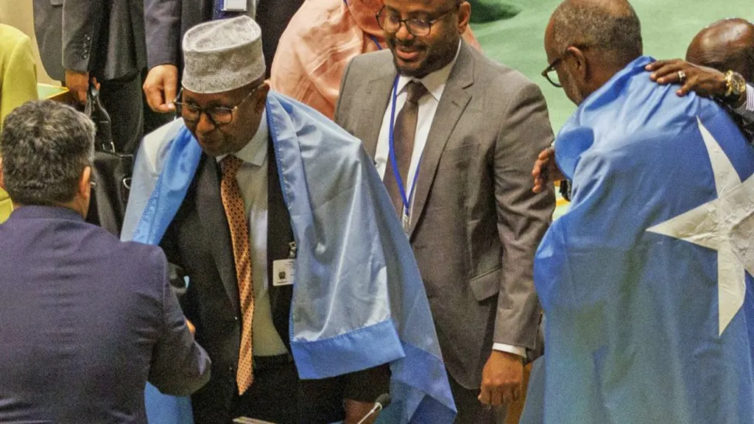
Somalia has won a non-permanent seat on the United Nations (UN) Security Council - hailed as a significant step for the worn-torn nation.
It will be the first time the country, which descended into civil war more than 30 years ago, has held the position since the 1970s.
The top table at the UN determines how the organisation should respond to conflicts around the world.
Analysts say Somalia’s battle to bring an end to its turmoil and its fight against Islamist militants will help inform the UN’s decisions.
There are 10 rotating non-permanent members on the council, along with the five permanent members - the US, the UK, France, China and Russia.
To win a seat, which carries much influence in world affairs, a country needs to secure the support of at least two thirds of the General Assembly delegations that are voting.
Somalia was elected along with Denmark, Greece, Pakistan and Panama to serve for two years from January next year.
It bagged the seat allocated to the East Africa region unopposed and went on to win 179 votes in a secret ballot in the 193-member General Assembly.
Following the vote, Somalia's Foreign Affairs Minister Ahmed Fiqi, who led a delegation of Somali officials to New York, said his country would now take up “its position on the global stage".
"We stand ready to play a vital role in promoting peace and security in the world," he said.
The ousting of Mohamed Siad Barre as Somalia’s president in 1991 sparked a decades-long civil war between rival clan warlords.
Over the years, the UN and African Union (AU) have played key roles in helping to re-establish a central authority.
Somalia has also been battling the Islamist militant group al-Shabab, which still controls large parts of the country.
The al-Qaeda-allied fighters want to topple the central government and establish their own rule based on a strict interpretation of Islamic law.
In recent months, the government has intensified its fight against the group as foreign troops withdraw and pass the baton on to the Somali army.
James Swan, the UN secretary general’s acting special representative for Somalia, said the country's experiences placed it in a unique position to contribute to the Security Council's deliberations on international peace and security.
“Somalia has come a long way over the past three decades on its path to peace, prosperity and security," Mr Swan said.
Security expert Samira Gaid told UK-based Warpod podcast that Somalia was "no longer the poster child for problems in the Horn of Africa".
The UN Security Council has significant responsibilities and can authorise peacekeeping operations and impose international sanctions.
Last December, it lifted a longstanding arms embargo on Somalia.
Non-permanent members of the council are allocated by region, but unlike the five permanent members, they do not have the power of veto.
The AU has been pushing for Africa to have two permanent representatives on the council and an additional two seats as non-permanent representatives.
Latest Stories
-
Nearly 400 sentenced in Nigeria for links to militant Islamists
16 minutes -
Ghana’s recovery supported by gold strength despite global oil price pressures – Standard Bank Research
23 minutes -
Kwaku Azar writes: A-G vs OSP
56 minutes -
Mfantsipim–Adisadel rivalry built excellence, not division – Sam Jonah
1 hour -
Vice President launches Mfantsipim’s 150 years of shaping Ghana’s greatest mind
2 hours -
I assure Otumfuo, Mahama will join him to commission KNUST Teaching Hospital by end of this year – Haruna Iddrisu
2 hours -
Barcelona dominate derby to extend La Liga lead
3 hours -
Gov’t to roll out free special education for persons with disabilities from July 1 – Education Minister
3 hours -
Importers and Exporters Association declares full support for Publican AI port system
3 hours -
“We used it to test our officiating officials’ readiness” – Bawah Fuseini after CAA Athletics event
3 hours -
Volleyball emerges as Ghana’s fastest rising sport
3 hours -
National Sports Fund needs strong leadership from the top – Administrator David Wuaku
4 hours -
JoySports Exclusive: Steve McLaren in talks with GFA after expressing interest in Black Stars job
4 hours -
Fire guts auto parts warehouse at Bubuashie, one fire officer injured
4 hours -
I owe my victory to coach Ofori Asare – Allotey after winning WBA Africa Gold Super Flyweight belt
4 hours