

Audio By Carbonatix
The Minority in Parliament has accused the Mahama administration of recklessly expanding the Gold-for-Reserves programme, blaming the government for what it describes as a US$214 million loss recorded within nine months.
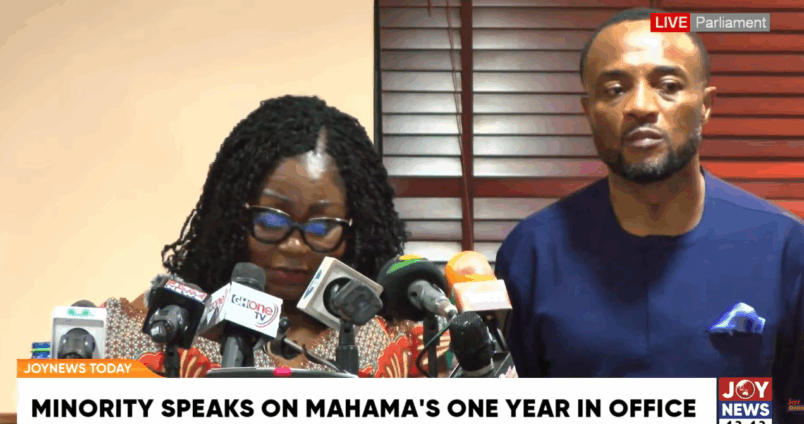
Briefing the press on Thursday, January 8, the Deputy Minority Leader and Member of Parliament for Asokwa, Patricia Appiagyei, said the development represents a major failure in economic governance and oversight.
Describing the situation as a “US$214 million scandal,” Madam Appiagyei argued that the amount, equivalent to about GH¢2.6 billion, could have been used to build hospitals, equip schools and provide storage facilities for farmers, but was instead lost through what she termed a politically connected gold scheme.
She stressed that the Gold-for-Reserves programme was originally conceptualised, designed and implemented by the New Patriotic Party (NPP) government under former President Nana Addo Dankwa Akufo-Addo, and was managed with discipline, transparency and accountability.
“The programme as we designed and implemented it did not lose US$214 million in nine months,” she said, questioning what changed after President John Mahama returned to office.
According to the Deputy Minority Leader, President Mahama inherited a functioning programme but politicised and expanded it recklessly, placing it in what she described as “unprepared and potentially conflicted hands,” with the results now evident.
She cited the International Monetary Fund (IMF) report which, she said, documents losses of US$214 million within nine months, attributed to the operations of GoldBod and the Bank of Ghana.
Madam Appiagyei acknowledged that GoldBod and the Bank of Ghana have denied making any losses, with GoldBod issuing a response on January 3, 2026, emphatically rejecting the claim.
However, she maintained that statements by the Chief Executive Officer of GoldBod, who has said the institution generated over GH¢960 million in revenue against GH¢120 million in expenditure, projecting a surplus of between GH¢700 million and GH¢800 million do not address the core concerns raised in the IMF report.
“These are bold claims, but they do not answer the central issue,” she said, insisting that the government must provide clarity on how a programme once managed without losses has allegedly deteriorated under the current administration.
Latest Stories
-
Why disaster risk reduction must connect early warnings, preparedness and financial protection to household-level resilience
10 minutes -
The AI Gold Rush: Who strikes gold and who gets left behind?
33 minutes -
What Is Wrong With Us: We queue for the Colosseum while our own Castles crumble
1 hour -
Dangote IPO fever could deepen Africa’s capital markets, Citi Bank executive says
1 hour -
US hopes diesel deal can ‘soften’ Moscow on peace talks, sources say
2 hours -
Oil falls as Russia diesel supply prospects counter Gulf supply risks
2 hours -
Moroccan centrist party agrees to form coalition government with three other parties
2 hours -
IMF cites AI slowdown, spiking yields as looming global market risks
2 hours -
Nvidia’s China AI-chip share falls as Huawei closes gap, report finds
2 hours -
Trump says he does not believe China and Russia are helping Iran ‘at all’
2 hours -
One dead and several hurt after rollercoaster incident at Six Flags
4 hours -
Afrobeats singer Ayra Starr on making history at her NFL half-time show
4 hours -
South Africa’s deputy police chief resigns after being charged with sexual offences
4 hours -
Boardroom feud tests trusted Indian business empire, Tata
4 hours -
Bumble shares soar after report dating firm in $1bn takeover talks
5 hours