

Audio By Carbonatix
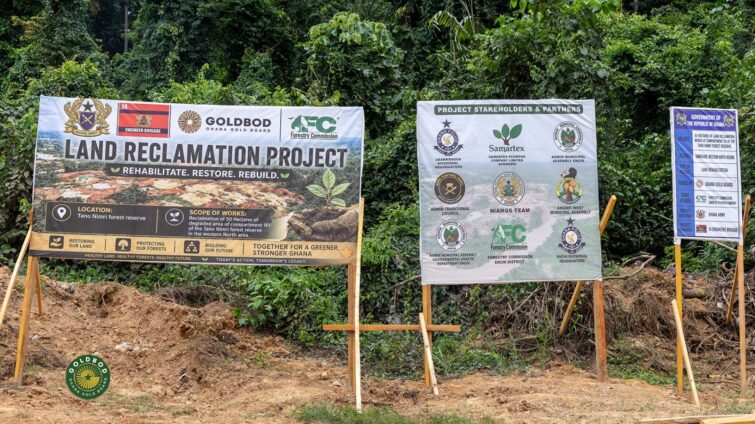
The Ghana Gold Board (GoldBod) has committed GH¢35 million to reclaiming land ravaged by illegal mining (galamsey) in the Tano Nimri Forest Reserve, with military engineers undertaking work to make the degraded area suitable for ecological restoration.
The project covers 60 hectares in Compartment 161 of the reserve, where mining activities have left deep pits, destabilised the ground and damaged vegetation.
The engineering works are intended to prepare the site for reforestation under the supervision of the Forestry Commission.
About 192.4 hectares of woodland were destroyed between 2021 and 2024, according to the project information provided by GoldBod.
Military engineers tackle damaged terrain
The Ghana Armed Forces (GAF) Engineer Regiment is responsible for the heavy earthmoving and civil engineering works under the partnership.
The team is operating under the command of Major Shem Adolinama.
The work involves filling abandoned mining pits, stabilising the soil and reshaping the terrain to make it suitable for vegetation to grow. Engineers are also constructing drainage channels to regulate water movement and minimise the risk of sediment entering the Tano River.
Sustainability Manager at GoldBod, Samuel Danso, said the extensive excavations and unstable ground left by illegal mining made natural recovery difficult without significant engineering intervention.
The reclamation works are intended to address the physical hazards created by mining and improve the condition of the land before the next phase of restoration begins.
Forestry Commission to lead reforestation
With the major engineering works nearing completion, the site is undergoing final grading and preparation for handover.
GoldBod and the military engineering team are expected to transfer the reclaimed area to the Forestry Commission in the coming weeks.
The Commission will then lead the reforestation phase, including tree planting and the nurturing of indigenous vegetation.
The handover will mark the transition from engineering rehabilitation to efforts to re-establish vegetation across the affected land.
The longer-term recovery of the site will depend on the establishment of vegetation and the protection of the reclaimed area against renewed illegal mining.
Reclaiming the terrain is an important step, but it does not, by itself, restore the ecological functions of a damaged forest.
Joint response to galamsey damage
The partnership combines GoldBod's environmental restoration initiative with the engineering capacity of the Ghana Armed Forces to address damage caused by illegal mining in the protected reserve.
GoldBod says the initiative reflects its commitment to environmental responsibility and coordinated national action to reverse the effects of galamsey.
The Board says it is focused on preparing the reclaimed land for sustainable restoration and ensuring that the transition to reforestation supports the long-term recovery of the Tano Nimri Forest Reserve.
Latest Stories
-
We must account for every cedi entrusted to us as public officials – Ato Forson
56 seconds -
Supreme Court rejects Solomon Asamoah’s bid to overturn Sky Train ruling
16 minutes -
Nungua Traditional Stool, WT Plastics partner to establish factory, create 1,400 jobs
18 minutes -
Mahama describes Ghana’s religious diversity as its greatest treasure, defends fairness to all faiths
23 minutes -
Police to arrest motorists who use pedestrian footbridges – ACP Obeng
24 minutes -
KNUST announces revised reopening dates, lectures begin October 19
38 minutes -
GoldBod, military engineers partner to reclaim galamsey-damaged Tano Nimri Forest
38 minutes -
NACOC educates 450 Koforidua SHS students on dangers of drug abuse
38 minutes -
First-year students stranded as Obuasi SHTS remains closed over misconduct probe
40 minutes -
Court halts promotion of 40 police officers pending IGP’s appeal
43 minutes -
Gender Ministry deploys teams nationwide to monitor LEAP cash grant payments
48 minutes -
GNFS contains Somoco warehouse fire; bushfire near TTU in Takoradi
49 minutes -
Recurring teacher-student sexual abuse cases give cause for worry – Salaga South MP
52 minutes -
D-Black shocked as only 16 radio and TV stations pay music royalties
57 minutes -
Former SIC Savings and Loans MD Amma Frimpomaa Dwumah honours EOCO invitation
1 hour