

Audio By Carbonatix
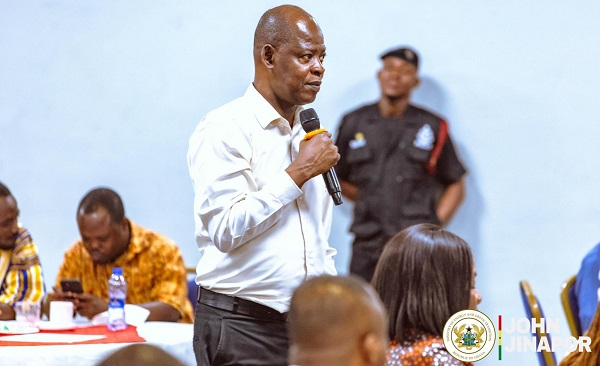
Co-Chair of the Ghana Extractive Industries Transparency Initiative (GHEITI), Dr Emmanuel Steve Asare Manteaw, says the $1.7 billion loss incurred by the Ghana Gold Board (GoldBod) is justified by the foreign exchange gains and wider economic benefits generated by the programme.
The policy analyst argues that the losses should not be assessed in isolation because previous governments also incurred high costs through gold purchase programmes.
Dr Manteaw said Ghana recorded losses in 2022, 2023, 2024 and 2025, but those losses did not attract the same level of concern.
“We make it look like this is the first time Ghana is making losses in its gold purchase program. I’ve looked at the data. 2022, we made a loss. In 2023, 2024, and 2025, we’ve made losses all those years. Why didn’t that become a problem?” he asked.
He said the scale of GoldBod’s operations must be considered alongside the foreign exchange it has brought into the economy.
Dr Manteaw cited 2024 as an example, saying Ghana incurred a total loss of ¢5.7 billion through gold-related programmes.
“So let’s say, for instance, in 2024, we made a total loss of ¢5.7 billion. $1.8 billion from Gold for Oil and then $3.8 billion from our domestic gold for reserves, total of $5.7 billion,” he said.
He said the comparison becomes more important when the amount of gold export revenue generated is considered.
“And so if you had to incur a loss of $1.7 billion to bring in $10 billion, that for me shouldn’t be a problem,” he said.
Dr Manteaw described such losses as transaction costs that must be weighed against the economic benefits of securing foreign exchange.
“It means that we should accept that incurring losses, what we call losses, for me, they are transaction costs, and all the governments over the years have been incurring transaction costs, and that has not become a problem,” he said.
He said the key issue should be the value generated from the expenditure rather than the loss figure alone.
“We don’t even consider the quantum of forex that GoldBoard has brought in, and so you need to look at the relativity, relativity. How much did you spend to bring in what, and what has been the impact?” he said.
According to Dr Manteaw, the programme's wider impact outweighs its financial cost.
“The impact, the economy-wide impact for me, exceeds the cost,” he said.
He said that improved foreign exchange stability has helped businesses plan better, while lower import costs have created investment opportunities.
“Oh yes. You have forex stability, so a business can plan properly. Your imports have gone down. I mean, in terms of cost of your imports, have gone down,” he said.
Dr Manteaw said the stability could also support the government’s 24-hour economy if incentives are used to encourage businesses to import machinery.
“Now, that gives you the opportunity if you use incentives to get people to import machinery, so that your 24-hour economy can benefit from the stability,” he said.
He also linked the stability to lower inflation and interest rates.
“Now, again, you have low inflation, you have low interest rates, and all these get to establish the foundation for economic growth,” he said.
Dr Manteaw acknowledged concerns about the sustainability of the losses but said GoldBod’s initial strategy must be understood in the context of the conditions it faced when it entered the gold market.
He said established foreign buyers already had strong relationships with Ghanaian miners.
“The Indians were providing money, the Chinese were providing equipment, the Turkish, they were all providing resources for Ghanaian miners in exchange for the gold,” he said.
He explained that GoldBod had to offer competitive prices to penetrate a market where other buyers were already established.
“The only way they can do that is to ensure that they offer a better price,” he said.
Dr Manteaw said this created an unrecovered cost because GoldBod was buying at market prices while some foreign buyers were purchasing gold at a discount.
“So, for instance, for the Indians, the Chinese, and the foreigners, they were actually buying their gold at a discount. Gold Board was buying at market price, in fact, using the forex rate, I mean the forex bureau rate, which was far higher than the Bank of Ghana rate,” he said.
He said the losses should therefore be viewed in light of the circumstances surrounding GoldBod’s entry into the market.
“So, we need to actually just situate the conversation within the context in which Gold Board found itself when it was given the mandate to regulate gold trade,” he said.
Latest Stories
-
Striking teacher unions to meet Fair Wages and Salaries Commission on October 6
7 minutes -
EOCO working with AG to arraign Nana Baffour Awuah before weekend court
10 minutes -
Duraplast reassures customers after fire, announces October 5 reopening
18 minutes -
Call off strike, gov’t will not renege on promotion arrears pledge – Haruna Iddrisu appeals to teacher unions
20 minutes -
Committee set up to validate teachers eligible for 20% deprived-area allowance – Education Minister
24 minutes -
Five-member committee to search for new Black Stars coach after Sports Ministry-GFA meeting
59 minutes -
Pinktober: Breast cancer survival exceeds 90% when detected early – Breast Society of Ghana
1 hour -
TCDA to adopt Upper West’s MATCO mango farm as northern prototype, issues warning against felling shea trees
1 hour -
‘Fear delegates’ tag: Afoko touts genuineness among delegates ahead of NPP delegates conference
1 hour -
John Boadu: The leader our party needs at this time – Amb. Edward Akwasi Boateng
1 hour -
Baffour Awuah: EOCO arrested, detained MP after hours of waiting, questioning – Afenyo-Markin
2 hours -
EOCO court warrant authorised search of Baffour Awuah’s law firm, not residence – Afenyo-Markin
2 hours -
NPP delegates conference: 3,000 to 4,000 police personnel deployed for security in Kumasi – Anthony Karbo
2 hours -
KGL Foundation commits $200,000 to support juvenile football for the next two years
2 hours -
UNDP invites Mahama Ayariga to Northern Peace Conference in Tamale
2 hours