

Audio By Carbonatix
The government has expressed disappointment by rating agency, S&P’s, decision to downgrade Ghana despite the bold policies implemented in the 2022 to address macro fiscal challenges and debt sustainability which have been significantly exacerbated by the impact of these global external shocks on the economy.
In a statement from the Finance Ministry, it said government will continue to be proactive in addressing the impact of these external and domestic headwinds on the economy and on the lives and livelihoods of Ghanaians.
“Government has implemented key revenue and expenditure measures, including the 30% cut in discretionary expenditures. The delays in the passage of key revenue measures introduced in the 2022 Budget affected revenues performance in the first half of the year. However, all the revenue measures introduced in the 2022 Budget, including the review of the MDA Fees and Charges Bill, the Tax Exemption Bill, the E-Levy Bill, have all now been promulgated by Parliament”.
“These fiscal measures are now in full implementation mode to support our fiscal and debt sustainability policies”, the statement explained.
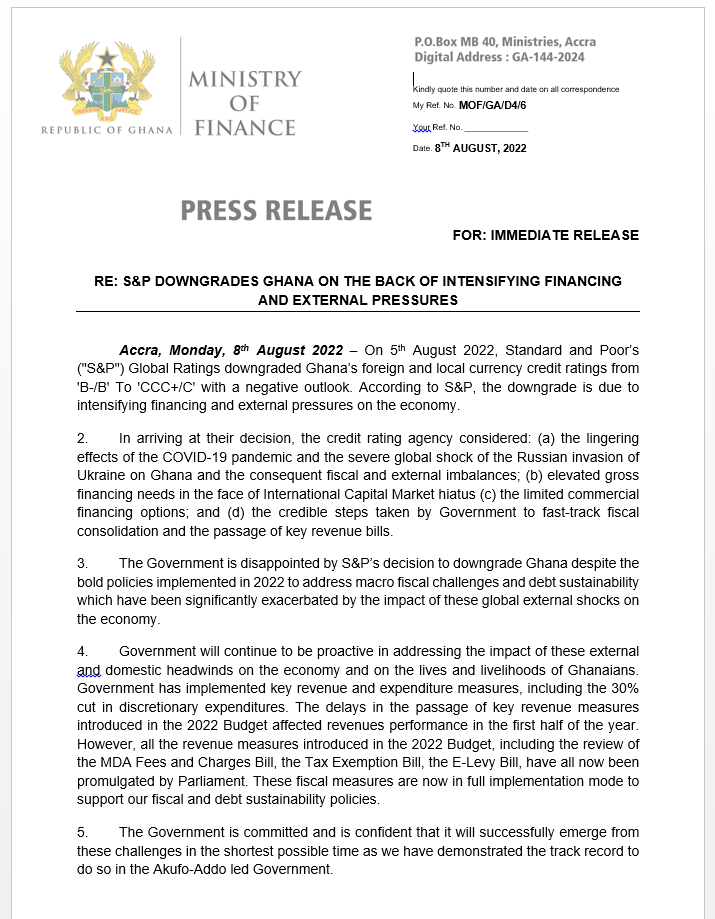
Furthermore, it said the government is committed and is confident that it will successfully emerge from these challenges in the shortest possible time as “we have demonstrated the track record to do so in the Akufo-Addo led government”.
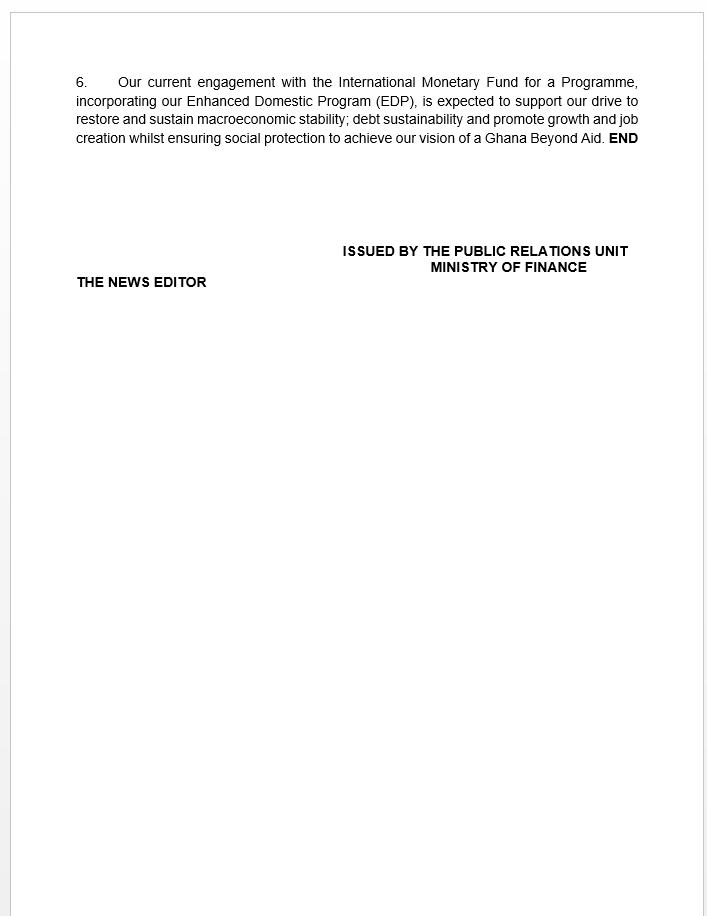
“Our current engagement with the International Monetary Fund for a programme, incorporating our Enhanced Domestic Program (EDP), is expected to support our drive to restore and sustain macroeconomic stability; debt sustainability and promote growth and job creation whilst ensuring social protection to achieve our vision of a Ghana Beyond Aid”, it concluded.
Standard and Poor’s ("S&P") Global Ratings on Friday August 5th, 2022 downgraded Ghana’s foreign and local currency credit ratings from 'B-/B' To 'CCC+/C' with a negative outlook.
According to S&P, the downgrade is due to intensifying financing and external pressures on the economy.
In arriving at its decision, the credit rating agency considered the lingering effects of the COVID-19 pandemic and the severe global shock of the Russian invasion of Ukraine on Ghana and the consequent fiscal and external imbalances; elevated gross financing needs in the face of International Capital Market hiatus; the limited commercial financing options and the credible steps taken by government to fast-track fiscal consolidation and the passage of key revenue bills.
Latest Stories
-
SEC to develop Social Bond Guidelines; over half of listed firms report on ESG indicators
10 minutes -
Insurance firms have up till January 2027 to incorporate ESG in financial reporting
15 minutes -
High Court throws out Afenyo-Markin’s GH¢15m defamation suit against Sammy Gyamfi
27 minutes -
Rollover cost of T-bills reduced substantially, one-year bill yield drops 19% since December 2024
27 minutes -
Daily Insight for CEOs: Preparing for 2027 Board and Executive Conversations
49 minutes -
World Cup Visa Scandal: There is no ‘justification’ to dismiss me – Kofi Adams
60 minutes -
2028 Olympic Games qualification ‘really tough’ – Black Queens coach Björkegren
1 hour -
GRFU, GOC Women’s Commission hold breast cancer awareness, expresses gratitude to Sunda International Ghana
1 hour -
COCOBOD raises GH¢3.4bn as Cocoa Capital PLC lists inaugural commercial paper on GFIM
2 hours -
No Party Card, just a Party Microphone! A Ghanaian story of Elections, Referees and Convenient Amnesia
2 hours -
Minority welcomes suspension of teachers’ strike, demands timely payment of promotion arrears
2 hours -
Customary ownership accounts for 80% of land; it complicates land administration – Lands Commission
2 hours -
NRSA to auction vehicles of non-subscribers who fail to pay towing charges within 21 days
2 hours -
WAFU B U17: Black Starlets target AFCON slot after booking semi-final place
2 hours -
Ghana faces $6.1bn debt-service burden from 2027 to 2029 due to Akufo-Addo’s DDEP – Haruna Iddrisu
2 hours