

Audio By Carbonatix
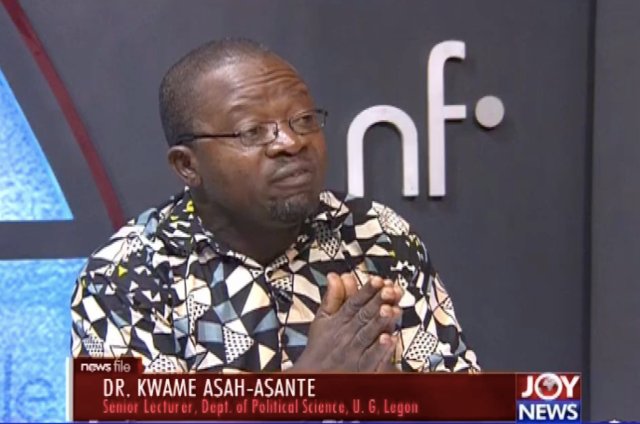
A Senior Lecturer in the Political Science Department at the University of Ghana, Dr. Kwame Asah-Asante, has urged the government to implement pragmatic policies to curb the continuous hike in fuel prices in the country.
According to him, the prices which have been on a steady rise in recent times, pose hardships for the populace, thereby affecting their standard of living.
Speaking in an interview on the AM Show on Wednesday, Dr. Asah-Asante asked the government and relevant stakeholders to find an intervention to mitigate the impact of the rising cost of fuel products.
“Once you begin to have prices going up, then it’s a worrying situation, because the ordinary man is going to suffer. Those who are able to afford and they are in businesses, will pass it on to consumers with regards to the services they render and the products they supply to the public.”
“Government must find careful balance in handling this situation. Any time prices go up, you see workers are up in arms, because transport is an important aspect of the political life of people, without which you cannot function,” he observed.
Fuel pricing in Ghana is deregulated, meaning prices at the international market directly impact prices locally.
That notwithstanding, currency depreciation and taxes also significantly impact fuel prices.
In a statement dated January 10, 2022, the Concerned Drivers Association of Ghana (C-DAG) announced a 40% increment in transport fares across the country from Monday, January 17, 2022.
They cited reasons including what they described as the unbearable hardships facing drivers, as well as fuel price at the pumps, the increase in vehicle prices, and the increment in cost of spare parts and lubricants.
“Ghanaians agree with us that, fuel commodities have seen a consistent upward increment and will even soon see another increment as predicted by the Chamber of Petroleum Consumers (COPEC),” they said.
It will be recalled that barely a month ago, commercial transport operators embarked on nationwide sit-down strike to protest cost of fuel products, a situation which affected commuters.
Dr. Asah-Asante believes pragmatic measures can be taken to lessen the plight of the ordinary Ghanaian.
He, however, cautioned against the politicisation of issues pertaining to fuel prices.
“Over the years, what we have seen is the politics of it. People tell stories about it, all manner of calculations with all manner of arguments. But if you are building a state, we are not interested in the rhetoric but things that really work.”
“It is about time we ended this journey and chart a new path that will bring smiles on the faces of the ordinary man,” he suggested.
Latest Stories
-
Kojo Bamba, Henry Nana Boakye and Nana Akomea elected NPP Vice Chairmen
3 minutes -
From Delta Force to NPP First Vice Chairman – Kojo Bamba’s political journey
8 minutes -
Police restore calm at Larteh following Odwira festival disturbance
1 hour -
‘All the camps will dissolve’ – Bawumia demands one NPP for 2028
1 hour -
There is no time to waste – Bawumia orders NPP to begin 2028 work
1 hour -
Sarkodie visits MobileMoney Fintech LTD
1 hour -
John Boadu unveils new NPP strategy to win back youth and modernise party
1 hour -
Hawa Koomson elected NPP National Women’s Organiser
1 hour -
John Boadu begins NPP rebuild from grassroots ahead of 2028 election
1 hour -
Titus Glover wins NPP National Organiser race on second attempt
1 hour -
Winning 2028 election won’t be easy; we must work harder – Bawumia
1 hour -
You’ll be part of 2028 campaign; there’s enough work for all of us – Bawumia to NPP aspirants
2 hours -
John Boadu moves to unite NPP after heated leadership contest
2 hours -
Today is not a day of victory but a day of responsibility and great unity – John Boadu
2 hours -
Let us choose unity over division – John Boadu to NPP
2 hours