

Audio By Carbonatix
The Public Interest and Accountability Committee (PIAC) has said Ghana's finance ministers breached the law between 2021 and 2025 by setting the cap on the Ghana Stabilisation Fund at $100m, far below the $584.22 million required under the country's petroleum revenue rules.
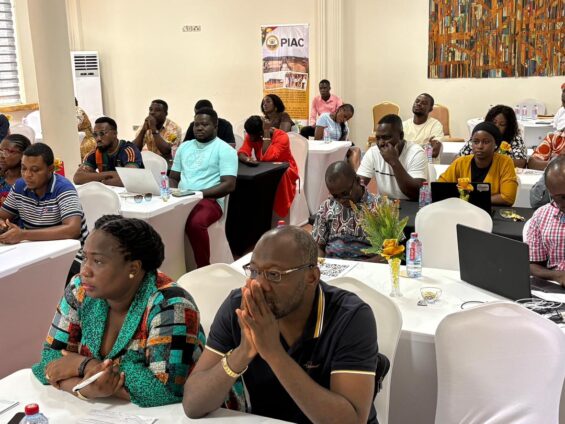
Speaking at a media event over the weekend on PIAC’s 2025 Annual Report, the Chair of the Public Interest and Accountability Committee, Richard Ellimah, said the law requires a much higher cap of $584.22m for 2025.
He said the correct amount should be calculated by averaging the expected oil money for 2024, 2025, and 2026. Using that method, the total comes to $1.75bn, giving an average of $584.22m.
Mr Ellimah said both the finance ministers and Parliament acted unlawfully by setting and approving a lower cap.
He called on the Finance Minister to use the correct figure and urged Parliament to make sure the law is followed when passing the budget.
He said PIAC also wants the government to put into law how money meant for the Big Push programme can be moved from the Annual Budget Funding Amount to the Ghana Infrastructure Investment Fund.
Mr Ellimah pointed to the fund’s investment in the Accra International Airport as proof that it works.
He said the Ghana Infrastructure Investment Fund put in $30m between 2017 and 2025 and earned $17.9m in interest and fees, almost 60 per cent of the original amount.
PIAC recommends bringing the fund back under the Petroleum Revenue Management Act so it can receive money from the Annual Budget Funding Amount for commercial projects.
On changes to the Petroleum Revenue Management Act, Mr Ellimah said the law has been amended many times since it started in 2011. A full review with public input that began in 2018 and 2019 stopped between 2020 and 2024.
He said Parliament passed two amendments in 2025 alone. The March amendment made the Annual Budget Funding Amount go only to infrastructure under the Big Push programme. It also removed PIAC’s guaranteed funding from that money and cut the Ghana National Petroleum Corporation’s share from 30% to 15%.
A second amendment in December expanded the types of investments allowed for the Ghana Petroleum Fund.
Mr Ellimah said the finance minister explained this would allow money from the Heritage Fund to be used for energy projects in Ghana and for the 24-Hour Economy Programme.
Mr Ellimah warned of risks ahead, saying that 2026 will be 15 years since the law started, which is when Parliament can first review the rule that limits transfers from the Ghana Heritage Fund. Under the current rule, only some of the interest can be withdrawn, not the main amount, but the law does not say how much, which creates uncertainty.
He called for one full review of the Petroleum Revenue Management Act instead of many small changes. He said the law should set clear rules for choosing projects, improve how money is spent, and require independent checks on performance.
Mr Ellimah also urged the government to publish full details of projects, follow the rule to give 5% to the District Assemblies Common Fund, restart the 2019 review, and create a long-term national development plan that Parliament approves.
Latest Stories
-
Ghana to bid farewell to Aps Kwadwo Safo as funeral rites set for July 30
22 minutes -
Video: Moment Arsenal players found out they were Premier League 2025/26 champions
25 minutes -
GSA shuts down 5A Homes for allegedly producing substandard mattresses
55 minutes -
Heads of SHSs cite Buffer Stock Company over missing cost details of food supplies
56 minutes -
Gov’t breached oil fund law for 5 years, kept $100m cap instead of $584m – PIAC report
56 minutes -
Buffer Stock Company says SHS food prices are agreed by stakeholders, denies lack of transparency
57 minutes -
Future Athletics stars ready to shine at UG Invitational meet
59 minutes -
Asantewaa Empowerment Initiative launches campaign against drug abuse and teenage pregnancy in Juaben
60 minutes -
PAC orders Anlo-Afiadanyigba SHS to pay GH₵10k arrears to casual workers
1 hour -
Rockefeller Foundation awards over US$350m, reaching 731 million people amid global aid decline
1 hour -
Women bear the heaviest burden after climate disasters – GreenFaith Africa
2 hours -
APN calls for urgent mobile money interoperability across Africa
2 hours -
Portugal’s Ronaldo set for record sixth World Cup
2 hours -
Cedi depreciates by 8.4% against dollar in interbank market
2 hours -
Arsenal are 2025/26 EPL champions after Man City draw at Bournemouth
2 hours