

Audio By Carbonatix
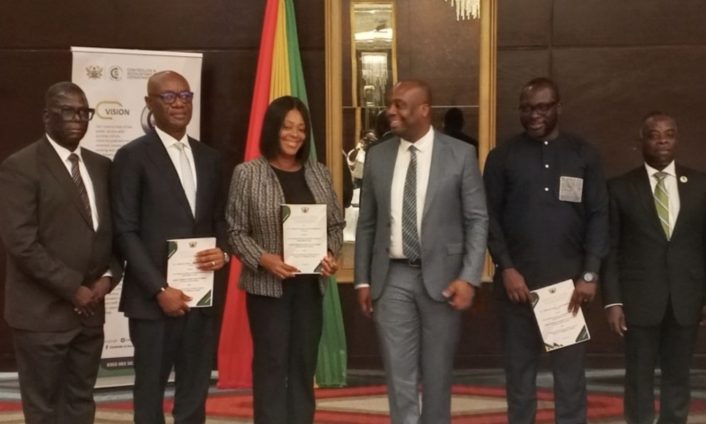
The Government has taken a decisive step to modernise public financial management with the signing of a Service Level Agreement (SLA).
The agreement is to integrate the Ghana Interbank Payment and Settlement System (GHIPSS), the Ghana Integrated Financial Management Information System (GIFMIS), and the Electronic Funds Transfer (EFT) platform, making electronic payments compulsory for all public sector entities.
The agreement, signed on Tuesday, establishes the GHIPSS platform as the sole authorised channel for payments by Covered Entities, marking a definitive shift away from manual cheque systems.
The entities include Ministries, Departments, and Agencies (MDAs) as well as Metropolitan, Municipal, and District Assemblies (MMDAs).
Speaking at the signing ceremony in Accra, the Controller and Accountant-General, Mr Kwasi Agyei, described the move as a fundamental shift in the handling of public funds.
He said for far too long, the public sector had relied on slow, difficult-to-reconcile manual cheque systems that were prone to inefficiencies and misuse.
“This agreement is not just ceremonial; it signifies a fundamental shift in the handling of public funds, moving us decisively from outdated manual systems to a modern, controlled, and fully traceable electronic payment system,” he said.
Mr Agyei explained that through collaboration between the Corporate Responsibility Unit and the Accountant-General’s Department, a secure, efficient, and fully interoperable electronic funds transfer system had been created.
The system, he noted, would manage how Covered Entities made payments to suppliers and third parties across the banking sector.
Mr Agyei emphasised that electronic funds transfer was now compulsory, offering speed, transparency, auditability, and reduced leakages and corruption.
He added that while the shift away from manual cheques would be gradual, it would be firmly enforced, with Government providing clear guidelines, structured training, and effective change management to support the transition.
He expressed appreciation to Dr Cassiel Ato Forson, the Finance Minister, the Bank of Ghana, the technical teams from the CAGD and GHIPSS for their efforts in developing the Service Level Agreement.
Mr Thomas Ampem Nyarko, the Deputy Minister of Finance, underscored Government’s commitment to fiscal discipline, noting that the reform rested on three key pillars: accountability, efficiency, and control.
He explained that digital payment systems created auditable footprints that strengthened oversight and safeguarded public funds.
Mr Nyarko said the reform would enhance Government’s ability to manage liquidity, monitor commitments in real time, and enforce expenditure discipline – a critical element of the fiscal consolidation programme.
He provided a timeline for the rollout, explaining that the gradual process would follow a strict schedule.
“Agencies will be rolled on this first week, the next week, until we complete the process. That is what is meant by a gradual process. We are doing this alongside automatic withdrawal of manual cheques,” he said.
The Deputy Minister also announced the Finance Minister’s intention to declare, in the next budget presentation, that all manual cheques would be withdrawn, with Government payments fully digitised by the end of the year.
Mr Nyarko revealed that the commitment control mechanism had already proven effective, preventing the purchase of over one billion Ghana cedis worth of vehicles last year by ensuring procurements stayed within budget.
He said the reform had also reduced the time lag between raising an Internal Purchase Order (IPO) and payment.
Mr Aggrey Darko, the Head of Civil Service, described the reform as a critical step towards improving governance and public sector efficiency.
He called on public sector workers to comply with the new system, describing it as a “safety valve” to promote responsible financial management.
“We want to govern ourselves better. There is no way to do so without paying attention to governance and transactions,” Mr Darko said.
He pledged the Civil Service’s commitment to the initiative, stressing that strong policies must be matched with effective implementation to avoid common implementation challenges.
The reform integrates GIFMIS with the GHIPSS platform, enabling end-to-end electronic payments.
It builds on recent amendments to the Public Financial Management Act, which introduced commitment controls requiring MDAs to obtain approval from the Finance Minister before committing the state to expenditure.
Mr Darko noted that such mechanisms were necessary to ensure accountability, emphasising that institutional controls were essential in public financial management.
Latest Stories
-
Ablakwa: Ghana’s Embassies, High Commissions to support World Assemblies of God Congress
2 minutes -
Joyce Bawah Mogtari cites infrastructure, healthcare reforms as evidence of Mahama’s development agenda
3 minutes -
Ghana had no single gadget to detect narcotics when we took office – Muntaka
9 minutes -
GES to consult stakeholders on academic calendar adjustments
16 minutes -
Mahama reaffirms commitment to equitable development across Ghana
17 minutes -
Youth employment must remain central to Ghana’s economic reset – Joyce Bawah Mogtari
19 minutes -
Ethnic conflicts, land disputes and illicit drugs remain major security concerns – Muntaka
25 minutes -
Mahama Ayariga visits Kumasi Central Market fire scene to assess damage
28 minutes -
Ghana has 48 legitimate entry points but over 300 illegal crossing points – Interior Minister
42 minutes -
Ghana is much safer now than in 2025 – Muntaka
57 minutes -
Bawku has gone 150 days without gunfire – Interior Minister
1 hour -
It still surprises me GAUA is on strike after signing MoU – Fair Wages CEO
1 hour -
Kumasi Hospital removes 880-gram bladder stone in rare surgical case
1 hour -
Ghana lacks sufficient power generation redundancy – Energy Minister
2 hours -
CPA assures consumers of safety of registered sanitary towels on the Ghanaian market after complaints
2 hours