

Audio By Carbonatix
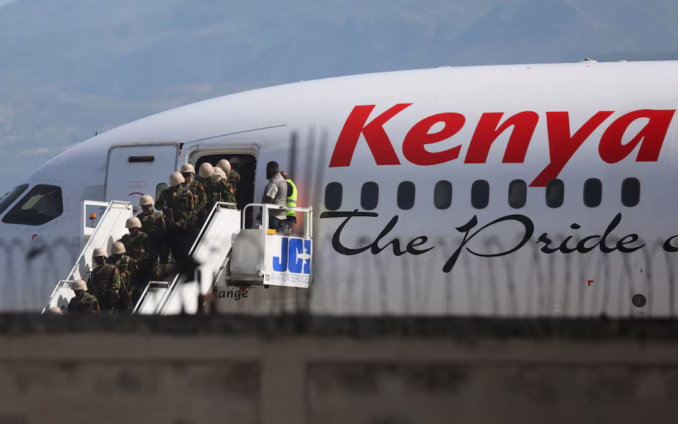
The first contingent of Kenyan police arrived in the Haitian capital on Tuesday to launch a long-awaited peacekeeping mission in the Caribbean country that has been ravaged by gang violence, even as deadly protests back home prompted doubts.
"At last the multinational force is here to support our national police," Haitian Prime Minister Garry Conille said at a press conference, saying work to retake the country would begin "slowly, without major fights unless necessary."
"But I want no one to doubt our objectives," he said. "The state will regain power and reaffirm its authority so all Haitians can live peacefully in this country."
The mission was first requested by Haiti's previous government in 2022. But support sagged and Conille's predecessor was forced to resign in early March after travelling to Nairobi to secure Kenyan support while violence escalated back in Haiti.
The gang wars have now displaced over half a million people and nearly five million are facing severe food insecurity. Armed groups, which now control most of the capital, have formed a broad alliance while carrying out widespread killings, ransom kidnappings and sexual violence.
"Kenya's sole purpose is to serve as agents of peace," Kenyan Foreign Minister Monica Juma told the press conference, saying police would prioritize protecting civilians, opening up routes for movement of people, goods and humanitarian aid, and protecting state institutions.
Though a Kenyan security source said the Nairobi violence was unlikely to disrupt plans to send more Kenyan police to Haiti, it has led some to question Kenya's ability to lead the security mission.
"The police should be able to operate well in their own country, but they can't," said Enock Alumasi Makanga, an ex-Kenyan police officer now working in private security. "How do you think they can manage then when they arrive in Haiti?"
FORCEFUL RESPONSE
Aid groups on Tuesday expressed concern that armed groups in Haiti would respond forcefully to the mission and that children will e caught in the crossfire - including many who have been recruited into gangs.
In a joint statement, Save the Children, Plan International and World Vision called for public disclosure on the mission's training, operational plans, rules of engagement and accountability mechanisms.
Previous missions in Haiti left behind slain civilians, a devastating cholera outbreak and a sexual abuse scandal, for which reparations were not made.
As the line of Kenyan police streamed out of the plane in Port-au-Prince on Tuesday morning, a small crowd of mostly airport personnel greeted them on the tarmac.
The Kenyan police are expected to be joined by officers from some 15 other nations, including other countries in Africa and the Caribbean, as well as Canada, France, Germany, Britain and Spain. All together, the security forces will form a 2,500-strong peacekeeping mission funded primarily by the United States which has pledged $360 million, though much of this has been held up by some lawmakers.
In a statement, U.S. President Joe Biden hailed the arrival of the Kenyan police as a turning point that "will bring much needed relief" to the nation of nearly 12 million.
Kenya had volunteered to lead the U.N.-backed force last July, but deployment was repeatedly delayed by Kenyan court challenges and worsening violence in Haiti.
Willy Mutunga, the former chief judge of Kenya's Supreme Court, said the decision by President William Ruto to send police to Haiti despite security challenges at home was a sign of how his government had put the interests of its foreign backers ahead of those of the people it represents.
But at a departure ceremony on Monday for the first 400 officers to be deployed, Ruto said the mission "is one of the most urgent, important and historic in the history of global solidarity."
At the arrival ceremony, Juma said she considered the mission the start of "a very strong relationship" between two nations tied by a history of forced removals and slavery.
Conille said that while gang-controlled areas had become "hell," he believed armed groups were tired of fighting and urged members to lay down their arms so normal life can resume and ministers can prepare for long-delayed elections.
"Enough is enough," Conille said. "The government is taking responsibility to affirm itself so activities can resume freely in the country."
Latest Stories
-
GRA assures Tullow of collaboration to settle $393m tax liability without disrupting its petroleum operations
16 minutes -
South Korea demands apology from Pyongyang for landmine blasts that injured three
19 minutes -
Carlos Queiroz not the sort of coach Black Stars need – Nii Lante Vanderpuye
49 minutes -
AFCON 2027Q: ‘Our Black Stars team is gone’ – Former Sports Minister
1 hour -
Prof. Prempeh calls for public review of draft constitutional reform bills
1 hour -
AFCON 2027Q: ‘I have never seen a poor performance from Black Stars like against Gambia’ – Nii Lante Vanderpuye
1 hour -
Nigeria set to launch National Digital Address System 9 years after Ghana showed the way
2 hours -
Policy rate decision takes time to reflect in lower lending rates – BoG
2 hours -
Western Regional Minister applauds Karpowership’s role in Ghana’s power sector
2 hours -
Playback: Road safety crises: Where are we getting it wrong?
2 hours -
Enterprise Life celebrates 25 years of protecting families and building trust
3 hours -
ICC London rules in favor of Ghana against Tullow over $400m tax charge
3 hours -
We are disappointed in ICC’s ruling over our corporate income tax assessment in Ghana – Tullow Oil
3 hours -
Cost of building inflation for August 2026 increases to 4.6% – GSS
3 hours -
Today’s front pages: Wednesday, September 30, 2026
3 hours