

Audio By Carbonatix
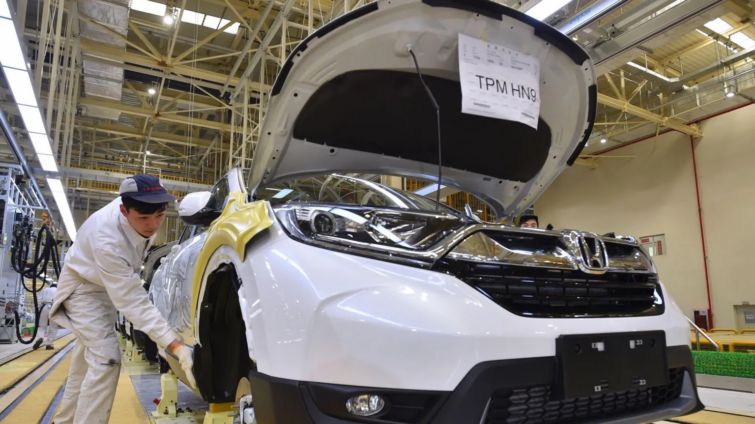
Japanese car giant Honda made its first annual loss in 70 years as its investments in the electric vehicle (EV) market failed to pay off.
Demand for EVs has not been as strong as the company forecast, with Honda reporting a total operating loss for the year ending March 2026 of ¥423bn ($2.68bn: £1.99bn.).
The firm said it was scrapping some of its EV production targets and would source parts from China, where prices are lower, to keep costs down.
It cited changes in US policy as adding to its losses, including tax incentives having been taken away for US consumers purchasing EVs, and the imposition of tariffs.
US consumers could previously receive up to $7,500 (£5,500) in tax credits if they purchased a new EV, but this was scrapped by President Donald Trump in September 2025.
His tariffs on imported cars and auto parts in 2025 also bruised profits at several major auto manufacturers, despite a reduction in the tariffs from 25% to 15%.
Honda, which was first listed on the stock market in 1957, has grown over the years to become Japan's second largest car firm. Analysts said its huge size and legacy nature make it difficult to adapt quickly to fast dips and rises in EV demand.
Honda said it was now going to focus on growing its successful motorcycle business, its financial services and its hybrid vehicle manufacturing.
It cited North America, Japan and India as "priority markets for its future growth" - although it suspended its plans to build EVs and batteries in Canada.
Chief executive Toshihiro Mibe said Honda would scrap its aims for EVs to make up a fifth of new car sales by 2030.
He added that Honda was also scrapping its target for all of its vehicles to be EV by 2040.
Honda expects ¥512bn in EV-related losses in the next financial year ending March 2027.
'Bleak milestone'
"It's a bleak milestone for Honda but not a surprising one," said Danni Hewson, head of financial analysis at AJ Bell.
"Like many legacy automakers it gambled on motorists making a quick move to EVs - and lost as the world shifted."
She said that politics, the cost of living and competition from Chinese companies forced Honda to roll black EV plans and "swallow the costs".
Hewson added that even though demand for EVs has risen in the last few months because of rising petrol costs from the US-Israel war with Iran, "companies like Honda are having to adapt on the fly which is tough for businesses of this scale".
She said things could get tougher with more "twists and turns" on the horizon for the market.
Latest Stories
-
Power restoration fault suspected in Kumasi Central Market fire
3 hours -
The 7-foot giant of Ngleshie Amanfro: Seven-foot Ghanaian Ephraim Saawa dreams of joining the national basketball team
3 hours -
Government promises support for Kumasi Central Market fire victims
4 hours -
Vibes The Movie: Big Ghun’s Ghanaian film earns five nominations at 2026 REFFA
4 hours -
MamaCare CEO warns unresolved conflicts among health workers could undermine maternal and neonatal care
4 hours -
Health professionals urged to translate medical knowledge into practice to save mothers
5 hours -
Conflicts among care providers linked to maternal, neonatal deaths – Expert
6 hours -
GIS marks 10th TIME conference, champions improved teaching practices
6 hours -
BRICS Or Balance? What Ghana’s bid really means
7 hours -
GPRTU wants full TRAFFITECH-GH implementation to start in 2027
7 hours -
Mahama announces plans to import electric wheelchairs for PWDs
7 hours -
KGL U17 Colts 2026: Western beat Prempeh Elite Academy to set up final final with Greater Accra Region
7 hours -
Late Solanke strike salvages 10-man Spurs draw at Man United
8 hours -
Gender Ministry to monitor welfare of Nana Akua Addo’s children amid domestic violence case
8 hours -
Benedict Okyere Yeboah: Ghana’s football problem goes beyond sacking a coach
8 hours