

Audio By Carbonatix
Private student hostel operators have strongly criticised the Rent Control Department’s attempt to enforce price caps on student accommodation, warning that price controls are an economically failed policy that risks crippling Ghana’s higher education sector.
The response comes amid recent moves by the Acting Rent Commissioner to regulate hostel fees and impose blanket restrictions on rate increases around the Kwame Nkrumah University of Science and Technology (KNUST) campus.
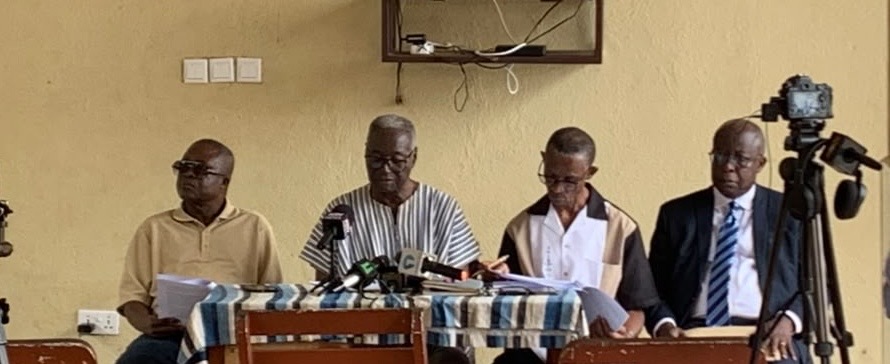
The President and Chairman of the KNUST Hostel Owners Association, Dr Akwasi Owusu-Bi, addressing the media, said controlling prices was not best for the system but could rather create artificial shortages as nobody wanted to supply at government-mandated prices, recalling how Ghana scrapped price control when it realised the damaging effects.
Emphasising the legal foundation of their operations, Dr Owusu-Bi argued that student hostels did not fall under standard tenancy laws governed by the Rent Control Department but rather operated under licensing laws regulated by the Ghana Tourism Authority (GTA).
“Hostels operate on a licensing system, operators retain the right to inspect, clean, and maintain the facility to prevent degradation.
"Our occupancy periods are strictly tied to the university academic calendar, and our facilities are already subjected to strict annual oversight by a combined team of regulators, including the GTA, Ghana National Fire Service, Ghana Police Service, and university authorities.”
Dr Owusu-Bi further explained that hostel bookings were routed directly through an official KNUST portal, and facilities exclusively house verified students.
He said managers were required to enforce university regulations, including enforcing the mandatory five-day evacuation rule following academic recesses, revoking residency if a student loses academic status, and coordinating medical emergencies with the university clinic.
The hostel owners indicated that private developers stepped in at the direct invitation of public universities to resolve critical bed-capacity shortages that the state could not address, adding that, if the Rent Control forces them to withdraw their services, universities will face accommodation deficits.
The Association suggested that the department target high-end real estate markets where rents were illegally quoted in foreign currencies and give room for private investors that are supporting students.
The operators are urging the government and university management to intervene and halt unauthorised enforcement actions, warning that reckless threats against private investments could spark an unprecedented student housing crisis across the nation.
Speaking on behalf of the Association, Barrister and ADR Practitioner of the KNUST Hostel Owners Association, Michael Gyang Owusu, clarified that the group was not seeking a legal battle, but found it worrying that the Rent Control Department did not engage them before issuing public directives.
He said that the heart of the Association’s stance was a specific legal exemption within the Rent Act of 1963 (Act 220).
Counsel for the operators noted that, while the statute applied broadly to residential premises, its interpretation section explicitly excluded properties where rent covered board and attendance.
The Property Economist and Senior Lecturer at the Department of Land Economy at KNUST, Dr Kenneth Donkor-Hyiaman, said labelling the fees as "exploitative" without proof is misleading.
He cautioned that if some hostels decide to quit the business due to pressure, over 80,000 students who depend on private accommodation could be left stranded, citing that KNUST could only accommodate about 10,000 students, leaving a huge gap for private operators to fill in.
Going forward, he noted, the government must use the land available in the universities and partner with private investors to build more hostels, urging that policymakers focus on long-term solutions rather than short-term politics.
Latest Stories
-
LA 2028: Black Queens to face Mauritius in Round Two of African qualifiers
2 minutes -
Three dead, including child, in Channel crossing attempt
6 minutes -
Woman charged with stealing from patients and staff at hospitals across Ontario
6 minutes -
Foreign tourists stay longer as domestic guests dominate Ghana’s accommodation market – GSS
7 minutes -
Ghana’s tourism accommodation market shows sharp regional disparities – GSS
12 minutes -
Ayalolo BRT to get contra-flow lanes on three major Accra corridors
16 minutes -
GH¢111bn DDEP maturity wall in 2027/2028 – Insights from Charles Adu Boahen
18 minutes -
Danlad Ibrahim on crutches after suffering injury against Aduana FC
19 minutes -
Aayalolo to operate contra-flow on three major Accra corridors
25 minutes -
Northern Region pupils left unsupervised as teacher unions begin strike
25 minutes -
Limited time forced me to contest 2024 election as independent candidate — Alan Kyerematen
27 minutes -
GES clarifies NCPTA, Prospectus Ghana Limited partnership
28 minutes -
Daily Insight for CEOs: The CEO’s role in strategic reflection
31 minutes -
John Jinapor reiterates government’s commitment to Salaga transmission project
32 minutes -
I’m not surprised Tinkler resigned because I predicted this – Kojo Addae Mensah
49 minutes