

Audio By Carbonatix
After two years of virtual gatherings, the prestigious annual AfricaCom event – Africa’s largest technology conference – made its in-person return this year.
Taking place at the Cape Town International Conference Centre (CTICC) from November 7 to 11, the event brought together African operators, industry elites, and opinion leaders. As a leading industry player, Huawei had a big presence at the event.
With the theme “Lighting up the Future,” it shared insight into cutting-edge trends in the telecom industry, including 4G/5G co-development, FMC intelligent connectivity, digital operations transformation, and green development leading the future of digital networks in Africa.
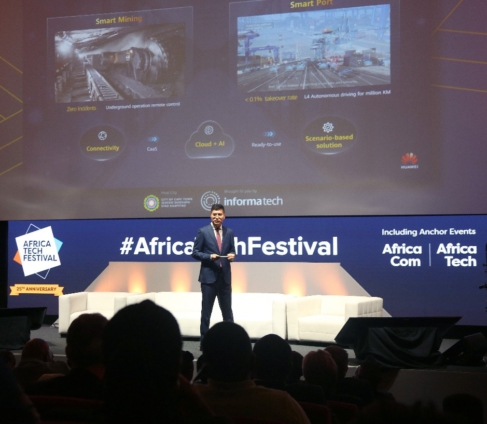
During the conference’s opening session, Leo Chen, President of Huawei Sub-Saharan Africa Region delivered a presentation entitled "Lighting up the Future with Nonstop Innovation".
In it, he outlined Huawei’s latest ICT development concepts and successful digital transformation solutions.
“The high resilience and rapid growth of the continent’s digital economy, technologies such as 5G, artificial intelligence, and cloud are evolving rapidly and the adoption of ICT in a wide range of industries is growing,” said Chen. “They are supporting Africa in advancing the technical revolution, boosting productivity and increasing jobs.”
He pointed out that over the last two decades, Africa has made significant progress in digitalization.
It has established the first-mile infrastructure, connecting countries on the continent to the global internet.
Additionally, it has tripled its middle-mile internet infrastructures that expand the connection within and between countries. However, there are still challenges to be overcome.
“Today, we still need to improve the last-mile broadband infrastructure and bridge the digital divide between urban and rural areas,” Chen said.
Whilst there is an appetite for greater uptake of digital technologies, constraints including a skills deficit, and lack of viable technology solutions are impeding the advance of ICT adoption. Chen pointed out there are three major ways to break through these bottlenecks.
“We need to further deepen connectivity to connect more people, enterprises, and scenarios; unleash digital productivity and enable digital transformation in multiple industries; increase the ICT industry’s energy efficiency and leverage ICT technologies to reduce emissions across all industries,” he added.
Of particular relevance to the African context were case studies around the digital transformation of the port and mining sectors in China which have attracted wide attention from its African counterparts.
These case studies provide a good example and reference for the potential of the development of the digital economy in Africa, as 90% of Africa’s imports and exports travel by sea, and mining is an important source of wealth creation for many African countries.
As Africa's digital ship sails into the future, it requires a strong tailwind to propel it forward. Chen called for more favourable industrial policies and more cooperation between public and private sectors.
To this end, Huawei has set up four innovation centres in Africa, launched several plans to support the development of small and medium-sized enterprises (SMEs), and will train 100 000 digital champions in Africa over the next three years.
At AfricaCom, Huawei also showcased a range of innovative technologies and solutions, including the Very Large Scale Antenna Array (ELAA), and solutions such as Ultra-Wideband RRU, that effectively and cost-effectively address some of the obstacles such as inconsistent spectrum resources and insufficient fibreoptic network reach that are holding Africa back.
Latest Stories
-
Real-Time VAT on cross-border digital services – not a new tax and does not violate double taxation principle
28 minutes -
Digitalisation, AI key to Ghana’s tourism transformation – GHATOF
40 minutes -
Stronger GTA-private sector partnership needed to grow tourism – GHATOF
50 minutes -
Amazon eyes Ghana for broadband expansion after talks with Mahama
2 hours -
National Investment Quiz 2026: Six schools qualify for quarter-finals
2 hours -
‘Do not let Russia pay for its madness with lives of your people’ – Zelensky to Ghana, 46 other countries
2 hours -
6,079 promotion cases fully processed and paid – CAGD says amid nationwide teachers’ strike
2 hours -
Teacher unions to meet government Monday over nationwide strike
3 hours -
Photo story: Republic Bank-JoyNews Habitat Fair clinic wraps up after three days of housing solutions, expert engagement
3 hours -
National Peace Council urges investment in youth to sustain Ghana’s peace
3 hours -
Afenyo-Markin urges youth to speak up against injustice
3 hours -
CAF annuls Edo Queens victory, orders WAFU B final to resume from extra time
4 hours -
Interior Minister urges traditional authorities to enforce anti-bushfire bye-laws
4 hours -
3rd Republic Bank-JoyNews Habitat Fair Clinic ends on a high note after three days of strong patronage
4 hours -
Ten climbers missing after avalanche hits Himalayan base camp
4 hours