

Audio By Carbonatix
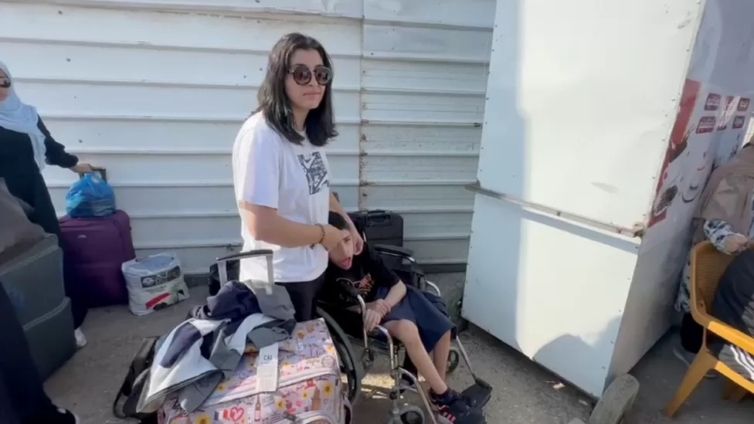
This was their third time trying to cross. But there were reasons to hope. All the news reports said the border would definitely open.
The family had been called by the Jordanian embassy and told to go to the Rafah crossing.
Tala Abu Nahleh's mother is a Jordanian citizen. Foreign passport holders were going to be allowed through. So were the wounded and the seriously sick.
Tala's 15-year-old brother Yazid is disabled and suffers from seizures. He can only move from one place to another with the aid of a wheelchair. The hospitals in Gaza have run out of the medication he needs, while the bombing has exacerbated his condition.
"Once the escalation started," Tala says, "he got very afraid, the seizures kept getting worse and worse. Every time I believe it's gotten to the worst, it just keeps getting worse."
There are six in the family and Tala is the sole financial support. She won scholarships and studied in the US and Beirut, Lebanon. Confident and articulate as she is, it is easy to imagine her guiding her family through the challenges of life beyond Gaza's borders.
"We are trying to survive. We're not sure we're going to make it, but we're trying to do everything we can to survive, because I simply don't want to die at 24."
The border is a place where the word "luck" has different meanings. It means escaping bombing, hunger and lack of water.
It also means having to leave behind those you love who don't have foreign passports, or who are not badly wounded enough to merit evacuation, or who are trapped under fire and cannot reach the border.
The number of those who have left, or will be able to leave, is only a tiny percentage of Gaza's population of 2.2 million people.
Mona - she did not wish to give her surname - is an Australian citizen through marriage. She came to the border alone and was haunted by the thought of her family trapped in Gaza.
"I'm not happy at all, because I'm leaving my other part, my brothers and sisters, my whole family is still here. I wish, God willing, they would all be in a safe place. The situation is terrible there, it's very very bad," she says.
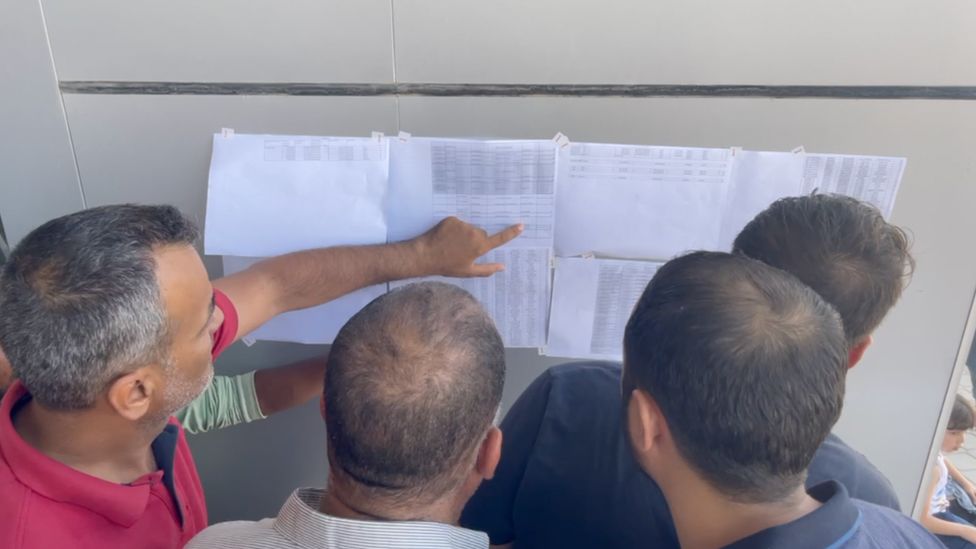
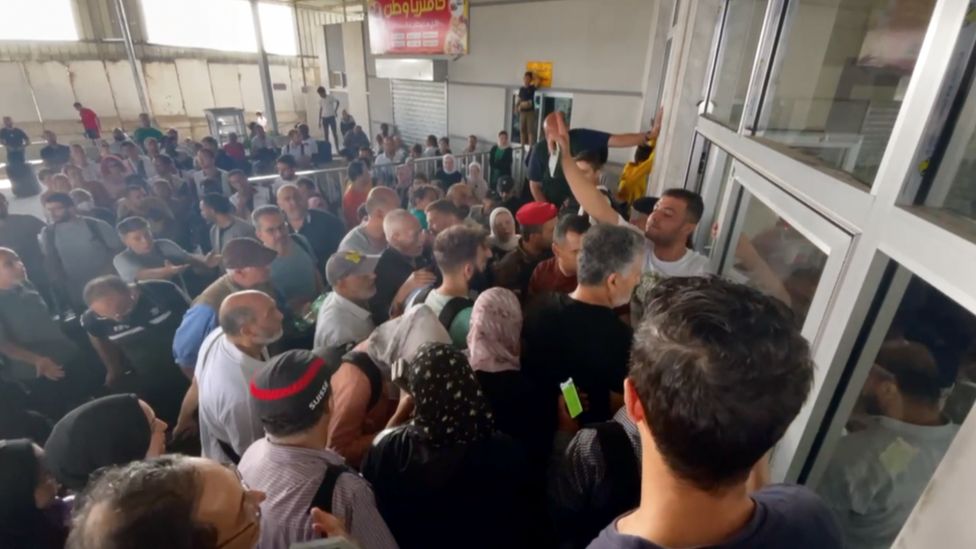
Groups of men gathered in front of paper lists posted on windows on the Gaza side of the crossing. Fingers ran down lines of names seeking out those already approved for departure. Families sat on the plastic chairs of the waiting hall, a small space into which so much hope is being funnelled.
Altogether, 400 foreign nationals and wounded people were able to leave Gaza on the first day of the evacuation on Wednesday.
By the day's end, it was clear to Tala Abu Nahleh that her family would not be so fortunate. They went home to their apartment, dark like those of their neighbours because there is no electricity.
Tala sent us a video message saying she did not know how to feel any more. She sounded and looked weary.
"We came back to no electricity, no food for today, no clean water to drink or even washing water. And one more day closer to my brother running out of medications, and we're still here. And it's night. I don't know if we will make it tomorrow, but I hope so."
Latest Stories
-
Affi Agbenyo’s EC appointment is constitutionally appropriate, but politically, people have the right to remind us – Haruna Iddrisu
3 minutes -
Education is critical to Ghana’s future and development – Haruna Iddrisu
22 minutes -
Who’s Emelia Affi Agbenyo, the 43-year-old newly sworn-in Deputy EC Chair?
55 minutes -
Haruna Iddrisu calls for limits on annual university accommodation fee increases
2 hours -
Today’s front pages: Tuesday, October 13, 2026
2 hours -
Wealth Over Water: How Galamsey Is Threatening Ghana’s Water Security
3 hours -
LA 2028: Black Queens pumped up for second leg of Mauritius tie
3 hours -
LA 2028: Black Queens hold final training session ahead of second leg against Mauritius
4 hours -
Standards are not Seasonal: What the EC appointments teach both sides
4 hours -
King Mohammed VI urges private sector to create youth jobs and spread benefits of growth
4 hours -
KGL U17 Colts 2026: Greater Accra win title after penalties win over Western Region
4 hours -
UK Investment Roadshow opens in London to advance UK-Ghana growth partnership
4 hours -
Assemblies of God requires pastors to resign before entering partisan politics – Rev. Wengam
4 hours -
Ghana targets 20% annual reduction in maternal deaths – Health Minister
4 hours -
Cyber attacks in Africa grow faster than global rate, report finds
4 hours