

Audio By Carbonatix
The IMANI Centre for Policy and Education has urged the government to move Ghana away from its heavy dependence on natural resources and raw-material exports and pursue a more productive and diversified economic model.
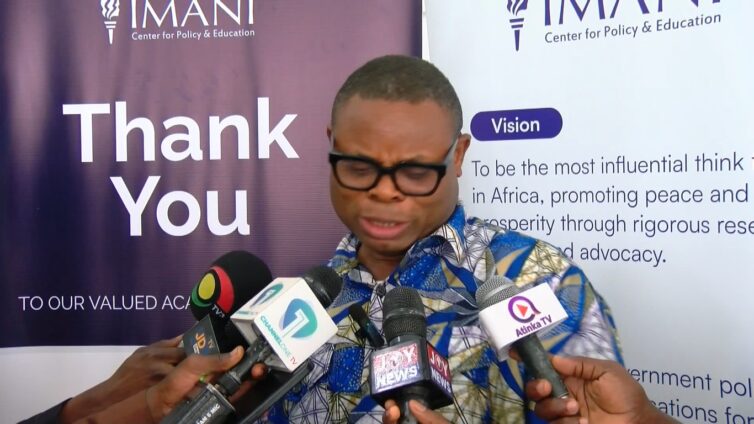
Economist Professor Godfred Bokpin said economies that rely extensively on natural resources struggle to achieve sustainable growth and development, arguing that Ghana must rethink the foundations of its economic model.
“Any growth model that relies extensively on natural resources would never deliver sustainable growth and development,” he said.
Professor Bokpin was speaking at the 2026 Students and Young Professionals African Leadership Academy, organised by IMANI to equip young Africans with skills in critical thinking, policy analysis and leadership.
He argued that there was no clear example of a country that had achieved sustainable development solely through a natural-resource-dependent growth model.
According to him, Africa’s integration into the global economy has historically left many countries focused on producing and exporting raw materials, limiting their ability to build resilient and diversified economies.
IMANI President Franklin Cudjoe also criticised what he described as “policy illogicality” in Ghana, arguing that poor coordination between government policies undermines efforts to build a resilient economy.
He cited public financial management reforms and fiscal responsibility measures as examples of policies which, in his view, have not always delivered their intended results because of inconsistencies in implementation.
“You have a policy that doesn't seem to be synchronised with another one,” Mr Cudjoe said.
He questioned how major public financial management reforms and the Fiscal Responsibility Act could coexist with the severe debt and liquidity challenges Ghana subsequently experienced.
“Those things do not rhyme. And I think it is important that, to build resilient economies, these things must be synchronised,” he said.
Mr Cudjoe stressed the need for stronger homegrown policy thinking and greater coordination across government interventions.
“The thinking around the policy itself must be done right,” he added.
Participants at the leadership academy also presented policy proposals targeting some of Ghana’s economic challenges, including unemployment, entrepreneurship and the quality of policymaking.
One participant proposed targeted tax incentives for start-ups to give young businesses time to accumulate capital and expand.
“I think we should have a policy for maybe one to five years or even one to seven years tax exemptions for startups so that they can also be able to gather some money and then they will be able to scale,” the participant said.
The proposal comes against the backdrop of Ghana’s persistent youth employment challenge and growing calls for greater private-sector participation in job creation.
Another participant called for increased investment in evidence-based policymaking, arguing that government decisions should be grounded in research, statistical analysis and reliable data.
“Evidence-based policymaking means the government has to invest in more empirical evidence, research and statistical analysis,” the participant said.
The participant said stronger research capacity would allow policymakers to better understand economic challenges and develop interventions capable of delivering measurable results.
IMANI said Africa’s future economic growth must be anchored in productivity, innovation, sound policies and the ability to transform ideas into sustainable economic opportunities.
The 2026 Students and Young Professionals African Leadership Academy therefore placed emphasis on both leadership development and economic thinking, encouraging young Africans to question existing development models and propose practical solutions.
IMANI maintained that sustainable development requires African economies to move beyond extracting and exporting raw materials towards building productive industries, strengthening institutions and creating an environment where businesses and innovative ideas can grow.
The policy think tank said a more diversified economic base would also help Ghana build greater resilience against external shocks while creating sustainable opportunities for its growing population.
Latest Stories
-
If police won’t protect you, you’ll protect yourself – Prof Mike Oquaye backs Kojo Bamba’s election
2 seconds -
Spotify makes fandom the ticket with debut Surround Sound experience in Lagos
10 minutes -
Deputy Interior Minister calls for joint action to strengthen Ghana’s cybercrime response
20 minutes -
Gov’t announces plans to create 20,000 jobs in waste management, circular economy
25 minutes -
T-bills auction: Government exceeds target by 30%, but demand to remain relatively soft at next auction
27 minutes -
Election Watch Ghana raises concern over low female representation in NPP leadership
34 minutes -
Four drinks that help manage blood sugar
34 minutes -
Ray Michael Djan Jr puts Ghanaian creativity on global stage with Chelsea anthem
44 minutes -
Matilda Dibloni Kokar elected USAG president after two-year dormancy
46 minutes -
NPP delegates wanted youthful energy with Kojo Bamba’s election – Political scientist
50 minutes -
Zenith Bank supports Childhood Cancer Unit at Greater Accra Regional Hospital
50 minutes -
KMA empowers 64 persons with disabilities; Mayor unveils plan for sustainable skills centre
52 minutes -
DJs Union urges musicians to prioritise respect, communication amid industry tensions
59 minutes -
“Ghanaian DJs deserve their flowers” – Lasmid
60 minutes -
Zenith Bank supports childhood cancer unit at Greater Accra Regional Hospital
1 hour