

Audio By Carbonatix
Many health professionals in Ghana are failing to conduct regular recalibration of medical equipment for quality healthcare delivery.
Public health experts argue that non-compliance to the standard practice of fixing uncertainties in medical devices frequently could be contributing to false diagnoses of diseases.
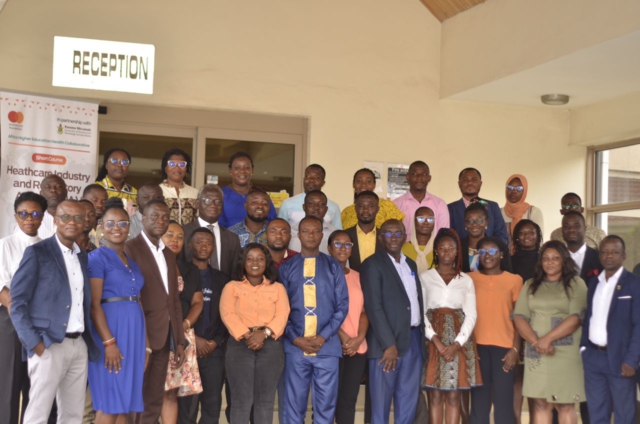
The concern was expressed at a workshop on Health Industry and Regulatory Affairs by the Mastercard Foundation Africa Higher Education Health Collaborative in Kumasi.
Speaking at the event, a lecturer at the School of Public Health, KNUST and pillar lead of Health Employment under the Collaborative, Dr. Kofi Akohene Mensah, observed some challenges in the regulation of the pharmaceutical industry and the use of medical equipment.

Dr. Kofi Akohene Mensah - Pillar Lead, Health Employment under the Mastercard Foundation Africa Higher Education Health Collaborative.
He highlighted some practices by health professionals contributing to false diagnosis of disease.
“Most health care professionals are not aware of regular calibrations. When we buy thermometers, sphygmomanometers, we don’t calibrate them. Even when they conduct initial calibrations, they don’t do it regularly. So, only God knows the number of people who have been diagnosed falsely of hypertension,” he said.
The Mastercard Foundation Africa Higher Education Health Collaborative in partnership with the School of Public Health-KNUST is organising a weeklong event on Healthcare Industry and Regulatory Affairs.

The workshop targets researchers and practitioners from varied sectors of the health industry.
Participants will undertake courses in the regulatory framework of the pharmaceutical and medical equipment divisions of the health industry.
With the emergence of advanced technology, including artificial intelligence, Professor Anthony Kwaku Edusei, a facilitator for the coursework, believes the training would apprise participants of current digital health practices.
“The participants will be equipped with knowledge and skills in technologies that can help facilitate healthcare delivery,” he said.
The workshop brought together 30 participants from across the country who are positive about grasping concepts in the coursework for application.

“We will better understand how these medical devices work. We can also collaborate with others from the industry to conduct research in these fields,” Martha Naab said.
Latest Stories
-
Who is Attijariwafa Bank, the Moroccan Group set to take over majority stake in SG Ghana?
58 seconds -
University Librarians Ghana honours past leaders for distinguished service
7 minutes -
Seychelles President leads high-level dialogue on Africa’s digital future at FALS Global Conversations in New York
8 minutes -
24-hour economy requires faster justice for commercial cases – Chief of Staff
15 minutes -
Five Agric Colleges receive digital tools to drive climate-smart farming
19 minutes -
GPL 2026/27: Kotoko face Karela test as Hamza Obeng takes temporary charge
39 minutes -
Morocco strike late to overcome 10-man Black Starlets
57 minutes -
Nyaho-Tamakloe calls on Kurt Okraku to resign amid Black Stars struggles
1 hour -
Societe Generale Group agrees to sell Ghana subsidiary to Attijariwafa Bank
1 hour -
Accra: Fire breaks out in North Industrial Area at Avenor
1 hour -
Measure food systems progress not only by productivity but also ability to deliver healthy diets – AGRA
2 hours -
Black Stars: Seven years of decline while hashtagging love
2 hours -
Today’s front pages: Thursday, October 1, 2026
2 hours -
Gov’t to suspend GH¢1 D-Levy on diesel for October and November
2 hours -
Fire destroys belongings in Akweteyman apartment
3 hours