

Audio By Carbonatix
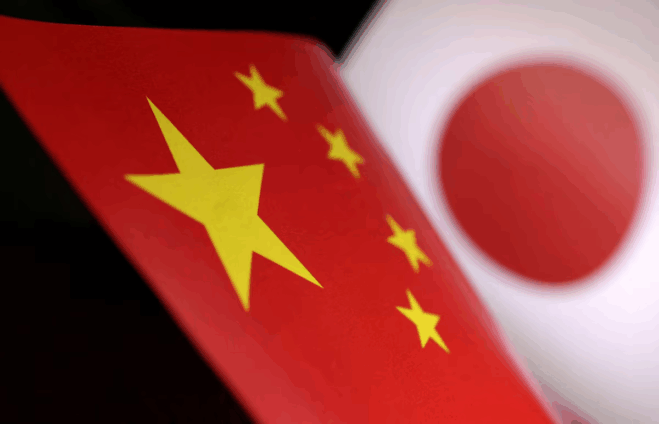
Japan has warned its citizens in China to step up safety precautions and avoid crowded places amid a deepening dispute between Beijing and Tokyo over Taiwan.
Chief Cabinet Secretary Minoru Kihara said the latest advisory is a renewed call for safety measures as sentiment towards Japan reflected in Chinese media had deteriorated after recent diplomatic events affecting the neighbours' ties.
Japanese Prime Minister Sanae Takaichi sparked the most serious diplomatic clash between the two East Asian powers in years when she told Japanese lawmakers this month that a Chinese attack on Taiwan threatening Japan's survival could trigger a military response.
"We have made judgments based on comprehensive consideration of the security situation in the country or region, as well as its political and social conditions," Kihara said on Tuesday about the safety notice.
The Japanese embassy in China had on Monday reminded citizens to respect local customs and be careful in their interactions with Chinese people. It also asked citizens to be aware of their surroundings when outside, advising them to not travel alone and urging extra caution when travelling with children.
"If you see a person or group that looks even slightly suspicious, do not approach them and leave the area immediately," the embassy notice said.
Film distributors have also suspended the screening of at least two Japanese films in China amid the deepening dispute between Tokyo and Beijing, in what Chinese state broadcaster CCTV said late Monday was a "prudent decision" that took into account souring domestic audience sentiment.
Some Japanese films, including the animated "Crayon Shin-chan the Movie: Super Hot! Scorching Kasukabe Dancers" and manga-turned-movie "Cells at Work!", originally slated for release in the coming weeks, will not begin screening in mainland China as scheduled, CCTV said, citing checks with film importers and distributors.
EFFORTS TO EASE TENSIONS
Beijing claims democratically governed Taiwan as its own and has not ruled out using force to take control of the island. Taiwan's government rejects Beijing's claims and says only its people can decide the island's future.
Taiwan sits just over 110 km (68 miles) from Japanese territory, and the waters around the island provide a vital sea route on which Tokyo depends. Japan also hosts the largest contingent of U.S. military overseas.
Japan has sought to tamp down the escalating dispute with China as Beijing retaliated in various ways, urging citizens to halt travel to Japan, and said its premier has no plans to meet Takaichi on the sidelines of this week's G20 summit in South Africa.
Kihara said nothing has been decided about bilateral meetings during G20, but that Japan remains open to conducting "various dialogues" with China.
On Sunday, Chinese coast guard ships sailed through waters around a group of East China Sea islands controlled by Japan but claimed by China. Japan's coast guard said it drove the Chinese ships away.
The U.S. does not formally recognise the islands, known as Senkaku in Tokyo and the Diaoyu in Beijing, as Japanese sovereign territory but since 2014 has said it would be obliged to defend them if attacked under the Japan-U.S. security treaty.
"In case anyone was in doubt, the United States is fully committed to the defense of Japan, which includes the Senkaku Islands. And formations of Chinese coast guard ships won’t change that," U.S. ambassador to Japan George Glass said on X.
Despite the Chinese measures, there were no particular changes in China's export control measures on rare earths and other materials, Japan's Trade Minister Ryosei Akazawa said. Japan is heavily dependent on the minerals for everything from electronics to cars.
The heads of Japan's three business federations met with Takaichi late on Monday and urged dialogue to resolve the diplomatic tensions.
"Political stability is a prerequisite for economic exchange," Yoshinobu Tsutsui, chairman of Japan's biggest business lobby Keidanren, told reporters after the meeting, according to media reports.
While Japan has made de-escalatory efforts, its refusal to retract the statements has not mollified Beijing, Cornell University's China foreign policy expert Allen Carlson said. "As a result, the two countries now stand on a knife’s edge."
Latest Stories
-
Church of Pentecost supports over 2,000 BECE candidates in Obuasi with career guidance seminar
9 minutes -
Brandon Asante and Coventry all but promoted to Premier League despite Sheffield Wednesday draw
31 minutes -
GPL 2025/26: Late Kwartemaa strike downs Hearts in Tema
37 minutes -
Ghana Faces Sierra Leone Moment as Prosecutorial Powers come under strain
47 minutes -
Don’t consume fish or seafood from Tema Shipyard until further notice – FDA warns
52 minutes -
Why volunteering might be Africa’s most underrated career accelerator
58 minutes -
ActionAid Ghana raises concern over gender gaps in Feed Ghana Programme
1 hour -
Windstorm wreaks havoc in Gushegu, displacing nearly 2,000 residents and damaging schools
1 hour -
Friends of Bridget Bonnie Marks her 35th birthday with donation to Kasseh Model Health Centre
2 hours -
From Ekumfi Kokodo to the Pulpit Stage: Essi Donkor’s gospel journey takes shape
2 hours -
Landfilling waste management creates no value, it’s an economic waste
2 hours -
Photos: Speaker Bagbin Commissions MPs constituency office under parliamentary decentralisation programme
3 hours -
Black Stars technical advisor Winfried Schäfer sacked as GFA shakes up backroom staff
3 hours -
Wenchi water project almost complete, critical to gov’t agenda – GWL MD
3 hours -
Anti-LGBTQ+ bill not part of government’s legislative agenda – Inusah Fuseini
3 hours