

Audio By Carbonatix
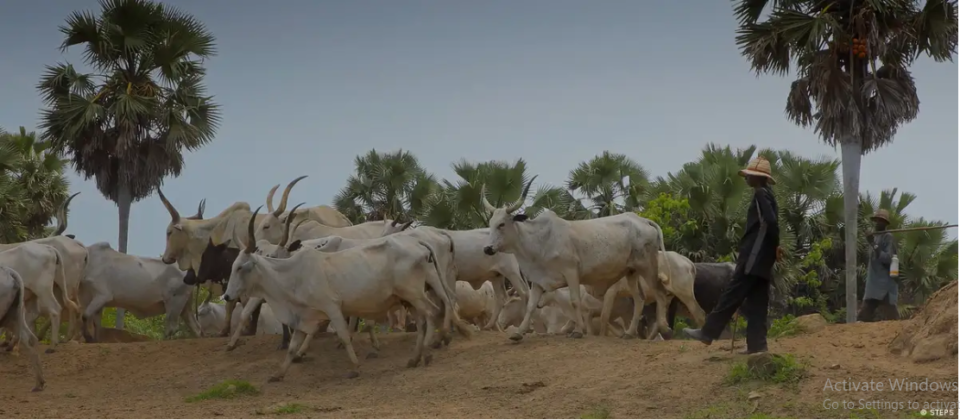
Jihadis operating in the West African sub-region are now resorting to crossing over into Ghana with looted animals for sale.
According to officials in the West African nation, owners of these stolen animals oftentimes trace their cattle to local markets in the north of the country.
One of the popular destinations for the animals is the cattle market in Navrongo, near Ghana's border with Burkina Faso.
"Some of the cattle here are rustled and brought to the market for sale, but we won't know," Kwesi Adumbila, a well-known cattle dealer in the market, told DW.
"Others even cross the borders with the cattle to sell in Ghana. Those who cross the borders have their agents, who they meet in the bush for exchange."
The number of market destinations for these stolen cattle are fast increasing, according to Rev. Fr. Clement Aapengnuo, who works with COGINTA, an EU-supported community peace building NGO.
"When you look at the cattle markets that are coming up especially near border towns — I hear a market has just come up in Banda Nkwanta," Aapengnuo told DW, referring to a town in the center of Ghana.
The rustled cattle attract buyers because of their low sale prices at the markets, according to Aapengnou.
"So, you go there, there are a lot of cattle that they are selling, and people are enjoying, they think this is cheap cattle we can buy and do ABCD, but they don't realize that by buying those cattle they are financing terrorism," he said.

Withdrawal zone for armed groups
A study by Promediation, a French NGO of mediation and negotiation experts, concluded that Ghana's proximity to the Cascades region of neighboring Burkina Faso, as well as Ivory Coast, makes northern Ghana an ideal cross-border withdrawal and control zone for armed groups.
Some of them run into Ghana for refuge, but their activities are mostly linked to arms, drugs, consumer products and cattle rustling.
"They use the money to buy small arms to restock and then to go back to fight," Aapengnuo said. "So, this also feeds into the idea that one of the reasons why Ghana has not been attacked is that Ghana is a refuge for the terrorists."
The Global Initiative Against Transnational Organized crime in its recent report on cattle rustling and Mali's war economy revealed that even looted cattle from Mali are reaching markets in Ghana and other West African nations.
"Cattle rustling cannot be dissociated from instability and conflict dynamics. In fact, it is a strong predicator of instability, as it marks the escalation of conflict and highlights strategies of armed groups and their levels of influence or control over specific areas," the report said.
It added, "as armed groups move towards new territories further south, and towards coastal West African countries, cattle rustling could be a marker of future conflict areas as well as of locations where armed groups need resources."
Tightening border security
Ghana's security forces have moved in to tackle the issue by setting up camps in areas close to its northern borders with Burkina Faso, Togo and Ivory Coast.
They want to control a possible spillover of terrorism, but it is hard to control illicit movement of animals into Ghana due to porous border controls.
Awal Ahmed Kariyam, a security expert whose organization RISE Ghana has been advocating for border security over the years, told DW that the accommodative posture of some Ghanaians is allowing crime to foster and gain grounds.
"We have a culture of highly accommodative nature of our people," he said.
"So, we have people coming from different jurisdictions, we basically do not question them. Some of these people may be violent extremists; however, they are also locals who engage in cattle rustling."
The Global Initiative has recommended that cattle rustling assessments should be "used in early-warning stabilization operations, as is the case with other types of organized crime."
Latest Stories
-
Ghana eyes stronger trade ties as Australia hosts multicultural trade and investment forum
7 minutes -
Margaret-Marie Krakue
10 minutes -
Ayariga announces plans for live broadcast of MMDAs’ meetings on local radio stations
13 minutes -
Mrs Anna Tackie
15 minutes -
Ghana links Afghan heroin and Brazilian cocaine to global drug markets – Global Organised Crime Index
22 minutes -
NHIA launches nationwide inter-school quiz to deepen students’ knowledge of NHIS
29 minutes -
Political protection could be masking Ghana’s cocaine trade – Global Organised Crime Index
34 minutes -
AFCON 2027Q: ‘We have to dissolve the GFA’ – Effia MP after Black Stars lose to Gambia
36 minutes -
NPP announces voting schedule and ID requirements for October 3 national elections
38 minutes -
Lupus can mimic HIV symptoms and damage kidneys if untreated – KNUST expert
41 minutes -
Focus on Sickle Cell Foundation seeks to introduce sickle cell education through comics in Ghanaian schools
47 minutes -
NPP rewrites the campaign playbok as opposition reality shapes National Executive contest
48 minutes -
Road safety education will fail without enforcement – NRSA boss
49 minutes -
Daily Insight for CEOs: Finishing Q3 strong and entering Q4 with purpose
50 minutes -
National Ambulance Service begins ‘Operation Restore Fleet’ to restore grounded ambulances
51 minutes