

Audio By Carbonatix
Youth unemployment remains Ghana’s most pressing economic challenge despite recent signs of macroeconomic stabilisation, economist and CEO of Dalex Finance, Joe Jackson, has said.
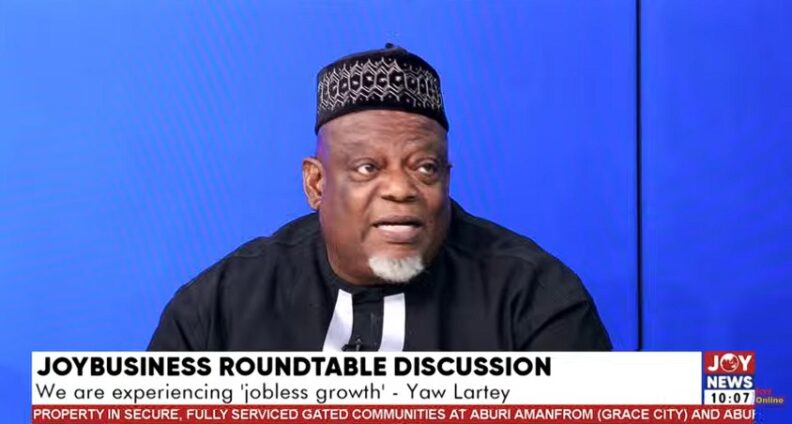
Speaking at the JoyBusiness Roundtable on April 30, Mr Jackson acknowledged that the country has made notable progress in stabilising key economic indicators — a development he said is now broadly accepted across policy and business circles.
However, he cautioned that stabilisation alone is not enough, stressing that it must lead to real improvements in livelihoods.
“Stabilisation is not an end in itself. It must translate into better livelihoods,” he stated.
His remarks come at a time when government officials have been highlighting falling inflation, easing lending rates, and a more stable currency as evidence of economic recovery. But concerns persist about whether these gains are being felt by ordinary Ghanaians, particularly the youth.
Mr Jackson explained that it is normal for economies to take time to move from stabilisation to full transformation. Nonetheless, he argued that there must be clear and deliberate policies to drive that transition.
He urged policymakers and stakeholders to shift the national conversation towards identifying concrete actions that signal a move beyond stabilisation.
Central to his concerns is job creation, which he described as the weakest link in Ghana’s current recovery phase.
“We’re still not creating enough jobs for the young people of this country,” he emphasised, warning that without significant employment growth, the broader economic gains risk losing relevance for many households.
While giving credit to the government for restoring a measure of stability, Mr Jackson maintained that the bigger question now is what comes next.
“The real question is what is being done on transformation, because stabilisation was never the end game,” he added.
His comments reflect a growing consensus among economists and business leaders that Ghana’s recovery will ultimately be judged not just by macroeconomic indicators, but by its ability to generate jobs, boost incomes, and improve living standards.
Latest Stories
-
NDC threatens sanctions over oversized campaign posters, gives aspirants 5 days to comply
53 minutes -
Star Oil paid GH¢2.7bn in taxes, levies in nine months of 2026
1 hour -
Samson’s Take: The rule of law is cheaper before the bulldozer
1 hour -
GRA blames system failure for delay in issuing receipt over passenger’s customs duty
1 hour -
Livestream: Newsfile discusses World Cup visa scandal, beach demolitions, education strikes, BRICS bid
2 hours -
NC-PTAs welcomes end of teachers’ strike, urges parents to prepare children for Monday
2 hours -
Government procures over 2,000 transformers as Ghana’s electricity access hits 89.13% – Energy Minister
2 hours -
UTAG-UG threatens strike on October 19 over unpaid allowance
2 hours -
Let The Constitution direct Chieftaincy to deliver “All Development Is Local”
3 hours -
John Jinapor outlines renewable energy, nuclear power priorities for 2027
4 hours -
Ghana explores centre of excellence for hearing, communication and cochlear implant care
5 hours -
Schizophrenia-related disorders lead mental health cases recorded in Ghana
5 hours -
Dutch authorities enlist Ghana in hunt for fugitive drug lord Bolle Jos
6 hours -
Ghana housing finance conference adopts communiqué to improve affordable housing access
10 hours -
Special Initiatives Minister urges Wa Technical Institute to enrol more girls as EU-backed solar training lab opens
10 hours