

Audio By Carbonatix
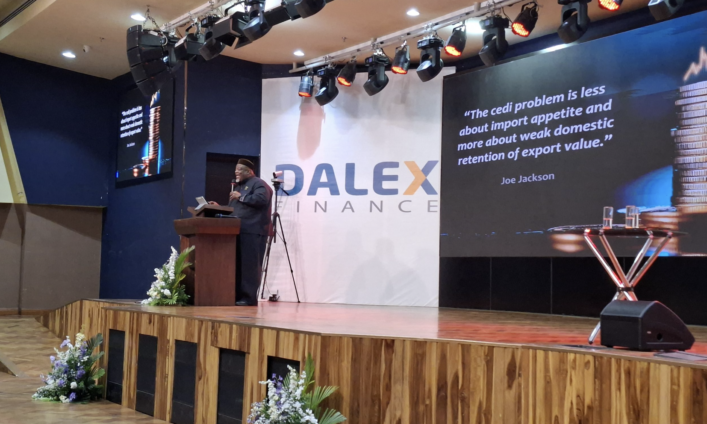
Joe Jackson, the Chief Executive Officer of Dalex Finance, has cautioned that Ghana’s currency will remain under persistent pressure unless the country undertakes bold reforms to increase domestic ownership of resources.
He said the long‑held belief that the Ghana cedi weakened mainly because of excessive imports was misleading, describing it as “an Ananse story that hides the structural challenges confronting the economy.”
Mr Jackson said this at a Chartered Institute of Marketing Ghana (CIMG) public engagement in Accra on Wednesday, on the theme: “Ananse Stories About the Ghanaian Economy,” which forms part of CIMG’s professional development series aimed at deepening public understanding of Ghana’s economic challenges.
He explained that although Ghana recorded a trade surplus of over US$5 billion in 2024, the cedi continued to depreciate because more than half of the value generated from exports did not remain in the local economy.
He said significant foreign exchange leakages through service payments, profit repatriation, debt servicing and capital flight eroded the gains made from merchandise exports.
Mr Jackson noted that the mining sector alone accounted for the largest outflows, noting that while gold exports were valued at about US$11.9 billion in 2024, Ghana retained only 46 per cent of the value.
The remaining amount, he said, was lost through management contracts, technical services and profit repatriation by multinational firms.
“South Africa retains more from its gold exports even though it exports less than Ghana. Botswana has a 50‑50 joint venture model for its diamonds. Nigeria mandates higher domestic participation. Ghana cannot continue taking less than half of the value created from its natural resources,” he said.
He noted that the situation was similar in the oil and gas industry, where Ghana retained about 35 per cent of export value in 2024, resulting in an outflow of over US$2.5 billion.
Those structural leakages, he said, overshadowed positive trade balances and placed continuous pressure on the cedi.
Mr Jackson said the focus should shift from reducing imports to increasing “usable foreign exchange” the portion of export earnings that actually stayed in Ghana to support the economy.
“If forex demand exceeds usable forex, the cedi will remain under pressure. Exporting more will not help if we keep less than half of what we produce,” he added.
He urged policymakers to renegotiate resource contracts, strengthen local value chains and increase Ghanaian equity in extractive industries.
Such measures, he added, would significantly improve foreign exchange retention, and reduce the country’s vulnerability to external shocks.
Mr Jackson also encouraged businesses and citizens to understand that the depreciation of the cedi had rooted in structural weaknesses, not consumer choices.
He cautioned against blaming importers or consumers for purchasing foreign goods, noting that price competitiveness, not patriotism, drove market choices.
Latest Stories
-
Communities affected by the construction of Akosombo Dam urge government to speed up the compensation process
1 minute -
World Cup visa scandal: Sports Ministry not shielding anyone – Sports Minister’s special aide
22 minutes -
World Cup visa scandal: Over 30 people misrepresented as GTA board members to US Embassy – Vincent Assafuah alleges
23 minutes -
Fire destroys wooden structure near Yesu Mo Villa at Bush Road
25 minutes -
NDC threatens sanctions over oversized campaign posters, gives aspirants 5 days to comply
1 hour -
Star Oil paid GH¢2.7bn in taxes, levies in nine months of 2026
2 hours -
Samson’s Take: The rule of law is cheaper before the bulldozer
2 hours -
GRA blames system failure for delay in issuing receipt over passenger’s customs duty
2 hours -
Livestream: Newsfile discusses World Cup visa scandal, beach demolitions, education strikes, BRICS bid
2 hours -
NC-PTAs welcomes end of teachers’ strike, urges parents to prepare children for Monday
2 hours -
Government procures over 2,000 transformers as Ghana’s electricity access hits 89.13% – Energy Minister
3 hours -
UTAG-UG threatens strike on October 19 over unpaid allowance
3 hours -
Let The Constitution direct Chieftaincy to deliver “All Development Is Local”
4 hours -
John Jinapor outlines renewable energy, nuclear power priorities for 2027
4 hours -
Ghana explores centre of excellence for hearing, communication and cochlear implant care
5 hours