

Audio By Carbonatix
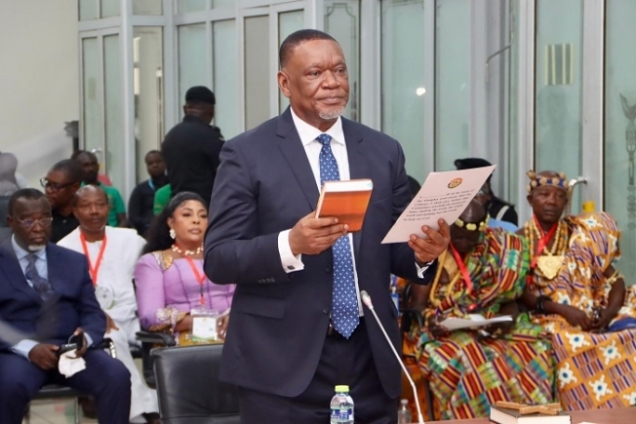
Supreme Court nominee and Court of Appeal Judge, Justice Senyo Dzamefe, has endorsed the use of Artificial Intelligence (AI) and virtual court systems as effective tools to help reduce delays in Ghana’s justice delivery system.
Appearing before Parliament’s Appointments Committee on Monday, 16 June 2025, Justice Dzamefe proposed a combination of judicial reforms and digital innovation to address the growing backlog of cases and ensure faster access to justice.
“We need more courts to spread the workload and make justice faster,” he said, stressing the urgent need for infrastructural and technological expansion across the judiciary.
He recommended the adoption of real-time audio and video recordings in courtrooms, supported by AI, to enable instant transcription of proceedings.
“By the end of a court sitting, records should be ready,” he argued, adding that virtual hearings could reduce transportation costs for litigants, lawyers, and court staff.
Justice Dzamefe also advocated fixed timelines for resolving cases, proposing a maximum of three months for criminal matters and six months for civil cases.
On the matter of property and family disputes, the nominee explained the courts’ responsibility in ensuring fairness during divorce proceedings and inheritance claims.
“Where property is acquired jointly, it is shared equitably. Inheritance matters are handled under PNDC Law 111 or valid wills, ensuring protection for surviving spouses,” he said in response to MP Alhassan Sayibu Suhuyini.
When asked about the relevance of public tribunals, Justice Dzamefe backed the idea of empowering community-level adjudication, highlighting the important role of laypersons in the justice system.
“Law is 20% technical knowledge and 80% wisdom. Lay people bring wisdom to cases and cannot be bullied,” he noted, underscoring the value of practical judgment in grassroots justice.
Justice Dzamefe also addressed the judiciary’s financial dependence on Parliament, calling it a major impediment to judicial independence.
“Judicially and administratively, we are independent. Financially, I don’t think we are, because Parliament allocates our budget,” he stated in response to MP Hassan Tampuli, adding that improved financial autonomy is necessary to enhance judicial efficiency.
With years of judicial experience spanning High Courts in Sekondi, Swedru, and Accra, and having served as President of the Association of Magistrates and Judges, Justice Dzamefe brings substantial courtroom and administrative expertise to the Supreme Court bench, pending his confirmation.
Latest Stories
-
UN housing expert urges Ghana to strengthen Rent Control Department amid housing affordability concerns
6 minutes -
Delta-BCI partnership reaches 166,000 people with breast cancer education
15 minutes -
Power restoration fault suspected in Kumasi Central Market fire
5 hours -
The 7-foot giant of Ngleshie Amanfro: Seven-foot Ghanaian Ephraim Saawa dreams of joining the national basketball team
6 hours -
Government promises support for Kumasi Central Market fire victims
6 hours -
Vibes The Movie: Big Ghun’s Ghanaian film earns five nominations at 2026 REFFA
7 hours -
‘I’m a fulfilled man’—Justice Korbieh on missing out on Supreme Court despite two nominations
7 hours -
MamaCare CEO warns unresolved conflicts among health workers could undermine maternal and neonatal care
7 hours -
Health professionals urged to translate medical knowledge into practice to save mothers
7 hours -
Retired judge Justice Francis Korbieh charges 1,568 new lawyers to uphold integrity
9 hours -
Conflicts among care providers linked to maternal, neonatal deaths – Expert
9 hours -
GIS marks 10th TIME conference, champions improved teaching practices
9 hours -
BRICS Or Balance? What Ghana’s bid really means
9 hours -
Adamus Resources launches breast cancer awareness campaign in Nzema
9 hours -
GPRTU wants full TRAFFITECH-GH implementation to start in 2027
10 hours