

Audio By Carbonatix
Rickety and poorly maintained vehicles on roads across the country remains a major nightmare for commuters.
Despite efforts by the Driver and Vehicle Licensing Authority (DVLA), the Motor Transport and Traffic Department (MTTD) of the Ghana Police Service and other stakeholders to curb the situation, the roads are still full of these vehicles, which cause fatalities.
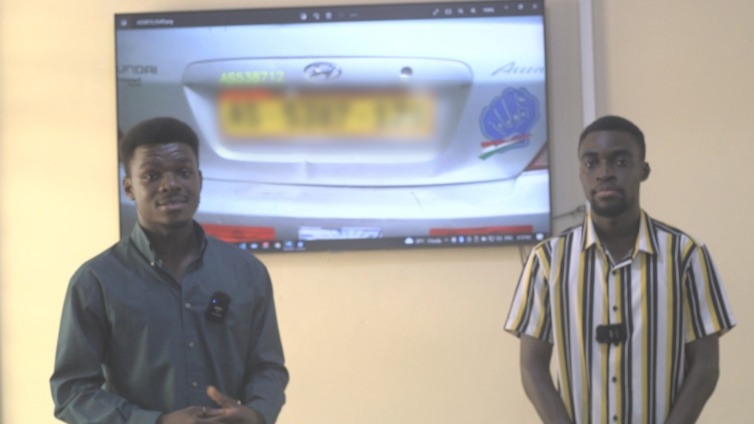
Fortunately, some computer science students of the Kwame Nkrumah University of Science and Technology, Theophilus Botchway and Markin Papa Kofi Korbah are using Number Plate Recognition to determine the road worthiness or otherwise of your vehicle.
Automatic Number Plate Recognition (NPR) has become part of our lives and promises to stay in future.
The system uses advanced computer vision technologies and artificial intelligence algorithms to identify vehicle licenses.
The system achieves approximately 98.22% accuracy on number plate detection and 78% accuracy on number plate recognition.
The project utilizes image processing technology in order to extract and recognize license plate information from an image or video frames.
Based on the extracted texts from the license plate, they are able to fetch information from the database to determine whether your vehicle is roadworthy.
The system is also tested with different condition complexities, such as rainy background, darkness and dimness, and different hues and saturation of images.
How it works
The first step of NPR is image collection. Images may be extracted from a video, collections of images and cameras. Usually, in the research area, image collections are provided from an open dataset.
The second step is detecting the license plate in the images. This phase usually takes place in the object detection step. Edge detection is commonly used for plate detection. In addition to edge detection, many algorithms have been proposed to solve plate detection.
After the plate is detected, the segmentation phase is conducted to divide the region into locations for detecting digits and letters. The last step is recognition of each segmented region into digits and letters to read the license plate.
To learn more about the App and join the waitlist for its release, partners, stakeholders, or investors can visit https://csapps.knust.edu.gh.
Latest Stories
-
Let The Constitution direct Chieftaincy to deliver “All Development Is Local”
8 minutes -
Ghana explores centre of excellence for hearing, communication and cochlear implant care
2 hours -
Schizophrenia-related disorders lead mental health cases recorded in Ghana
2 hours -
Dutch authorities enlist Ghana in hunt for fugitive drug lord Bolle Jos
2 hours -
Ghana housing finance conference adopts communiqué to improve affordable housing access
7 hours -
Special Initiatives Minister urges Wa Technical Institute to enrol more girls as EU-backed solar training lab opens
7 hours -
In the matter of my first year at the Bar
7 hours -
ActionAid Ghana calls for an end to child marriage, greater investment in girls’ rights
7 hours -
Newsfile to tackle World Cup visa scandal, beach demolitions, education strikes, BRICS bid
8 hours -
UK-Ghana Trade & Investment Summit: Trade Resource Centre to help businesses maximise UK-Ghana trade opportunities
8 hours -
Embassy of Denmark celebrates World Maritime Day
8 hours -
Linking LEAP to productive inclusion could cut extreme poverty by 2030 – UNICEF
9 hours -
Trade Ministry backs use of creative arts to rehabilitate prison inmates
9 hours -
Negotiations with government to continue despite strike suspension – GNAT
9 hours -
‘Ghana cannot afford to waste public resources; every cedi has a job’ – Ato Forson
9 hours