

Audio By Carbonatix
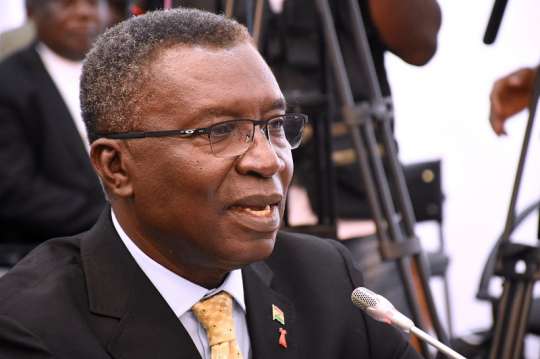
The celebrated heart surgeon and founder of the National Cardiothoracic Center, Professor Frimpong-Boateng has thrown his weight behind Korle-Bu Teaching Hospital's decision to increase the price of dialysis which backfired after public uproar.
According to him, the inputs needed for dialysis are very expensive and without any increase or subsidy, it cannot be sustained.
Even though the one-time presidential aspirant of the governing New Patriotic Party (NPP) admits that most of the patients cannot pay for it, he insisted that without the increment, the service cannot be rendered at all.
He thus offered his support to the hospital, though belated adding that the hospital was not going to make a profit from the retracted increase.

“The hospital is justified in increasing the cost of dialysis. The inputs are very expensive. If it costs about GH¢800 to GH¢1000 to render a service, you can’t charge GH¢380 or GH¢400."
" I must admit that most people cannot afford it, but somebody has to pay for it. It is not the fault of the hospital, they are not going to make a profit out of it,” he said.
In the past week, the conversation on the search for dialysis treatment has been brought to the fore following the Korle-Bu Teaching Hospital’s unsuccessful 100% increment in the cost of dialysis treatment.
The hospital blamed the removal of tax and import duty exemptions as the cause of the price hike.
According to KBTH, if the old charges are maintained, the dialysis facility would have to shut down in a matter of days.
Speaking on Kidney Health Matters on Joy News on Thursday, October 5, Chief Executive Officer of Korle-Bu, Dr. Opoku Ware Ampomah, said, “We have a GH¢4 million deficit, and then if we are to run at full capacity, we will need about GH¢961,000 subsidy every month to be able to maintain the current prices because of the numbers that we are doing. We are doing about 2000 search dialysis.”
Either government provides that subsidy or we are allowed some reasonable increase so that’s the kind of discussions we are having.”
He also said the facility was counting on the benevolence of individuals and corporate Ghana to bear some of the cost.
"We are also looking for other Ghanaians because First Sky Group has done tremendously well by providing free search dialysis by paying for 250 patients to have two sessions of dialysis every week throughout the year free of charge. So, other individuals and corporate Ghana can also join to ease the burden on the government,“ he noted.
Meanwhile, there are only 14 registered dialysis centres in the country, the Health Facilities Regulatory Agency (HeFRA) have said.
Out of the 14, seven are public and seven are privately owned.
Dialysis centres
They are the Riverwoods Medical Equipment and Dialysis Company, the Accra Kidney Clinic Limited, Sahel Health Ghana Limited, the Kidney Specialist Center, LTD, Eastern Regional Hospital, Effia Nkwanta Regional Hospital and Central Dialysis.
The rest are the Komfo Anokye Teaching Hospital, Korle-Bu Teaching Hospital, Tamale Teaching Hospital, Maritime Hospital Ghana Limited, First Dialysis, Sage Medic Center, and Peace & Love Hospitals.
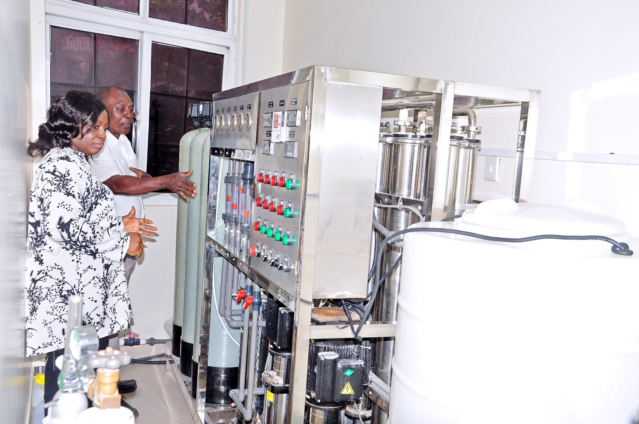
Eight of the facilities are in the Greater Accra Region, three are in the Ashanti, Northern has one, Eastern has one, and Western Region has another.
What is Dialysis?
Dialysis is a treatment process that helps one’s body remove extra fluid and waste products from the blood when the kidneys are not able to.
Patients require dialysis three sessions per week to have a normal life.
Dialysis machines in Ghana
Nationwide, the total number of search dialysis machines is approximately 300, with the majority in the Greater Accra and Ashanti Regions. Four regions do not have a single search dialysis equipment. Citizens in these regions requiring dialysis must commute significant distances to seek care.
The cost of dialysis in Ghana ranges from GH₵300 to GH₵1000 per session. The median cost in government and quasi-government health facilities is GH₵400 (range GH₵300-GH₵600).
The average number of sessions required a week is 3. This means a patient requires approximately GHC1200 each week just to stay alive. If additional routine medication is added on an extra cost of GHC435 is required weekly. This brings the weekly cost to the patient to GHC1635 assuming they have no underlying conditions such as hypertension or diabetes.
This means the annual cost of staying alive is GH₵85,020 or GH₵7,085 a month.
Facts about kidney disease in Ghana
According to a pharmacist and Research Fellow at the Center for Democratic Development, CDD-Ghana, Dr. Kwame Asiedu Sarpong, based on current research, it is estimated that between 13% and 17% of Ghana’s population have some form of renal function impairment. This equates to between 4 million and 5.2 million citizens. Researchers suggest that, from this segment of the population, between 15,000 and 19,500 should be on search dialysis.
The data available suggests that approximately 2,000 people are currently on search dialysis. This means between 13,000 and 17,500 people are without treatment. These people will often seek alternative forms of treatment and access renal care only when the situation is acute. This has an impact on their quality of life and life expectancy.
All research suggests that the prevalence of chronic renal disease in Ghana has approximately doubled in the last 10 years with cases across the entire span of Ghana’s population age profile.
According to the Ministry of Health, Ghana’s outpatient per capita is 1.06, suggesting that on average Ghanaians see a primary care clinician once a year. In proactive health systems, this figure is around 4 (citizens see a clinician once every three months).
The fallout is that for the majority of our population, there is only one chance a year for any diagnosis of renal failure to be made except in an emergency. Whilst in proactive health systems there are at least four chances to identify these patients.
Latest Stories
-
Morocco strike late to overcome 10-man Black Starlets
42 seconds -
Nyaho-Tamakloe calls on Kurt Okraku to resign amid Black Stars struggles
6 minutes -
Societe Generale Group agrees to sell Ghana subsidiary to Attijariwafa Bank
15 minutes -
Accra: Fire breaks out in North Industrial Area at Avenor
21 minutes -
Measure food systems progress not only by productivity but also ability to deliver healthy diets – AGRA
36 minutes -
Black Stars: Seven years of decline while hashtagging love
48 minutes -
Today’s front pages: Thursday, October 1, 2026
49 minutes -
Gov’t to suspend GH¢1 D-Levy on diesel for October and November
1 hour -
Fire destroys belongings in Akweteyman apartment
2 hours -
Baffour Awuah to turn himself in to EOCO today – JoyNews sources
2 hours -
Government identifies payment discrepancy holding up teachers’ strike resolution
2 hours -
BoG signals no FX intermediation for October as GoldBod plans $1bn support for banks
2 hours -
When share ownership becomes personal: The African mindset of the Dangote IPO
2 hours -
Why MFWA Legal Fund matters to Ghana’s democracy
2 hours -
Fuel prices to rise from October 1; diesel could hit GH¢19.60 – COMAC
2 hours