

Audio By Carbonatix
I have been wondering why Okinawans have good health. But going through their dietary pattern, I noticed something interesting about them: the drive to eat local foods is key. Okinawans have nurtured the practice of eating something from the land and the sea every day. Among their “top longevity foods” are bitter melons, tofu, garlic, brown rice, green tea, and shitake mushrooms.
I also found that communities where corn diets are eaten have good eyesight and I was wondering why. However, one study by Kwon et al.( 2007) found that changes in dietary patterns of these populations toward consuming more high-calorie foods, sugar, refined grain flour, and sweetened beverages have resulted in far more health risks than their previous diet based primarily on corn, legumes, rice, and vegetables. This means that our traditional diet made from corn is good for us.
The researchers believe that a return to traditional dietary patterns can help reduce these disease problems because of a better balance of calories and beneficial nutrients. They note that staple crops like corn and legumes have antidiabetic, antioxidant, and anti-hypertension potential. These foods also provide certain protective phenolic phytochemicals that are beneficial for heart health, reversing hypertension as a natural remedy for high blood pressure, and controlling blood sugar levels. This study drew my attention to kpokpoi made from corn.
Kpokpoi
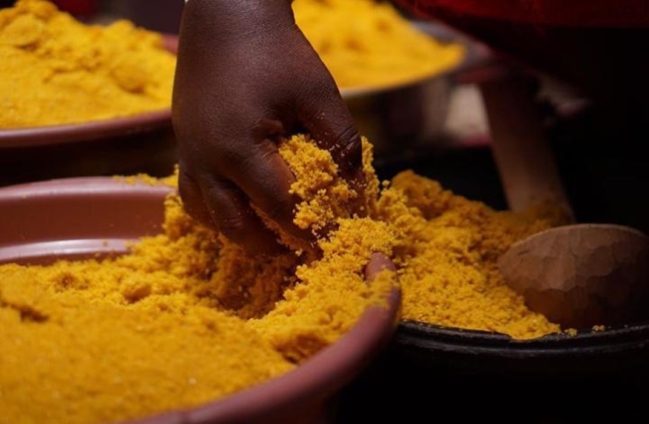
kpokpoi , also referred to as Kpekple is a festive food eaten by the Ga community of Ghana during the celebration of the Homowo festival. It is prepared with the primary ingredients of steamed and fermented corn meal, palm nut soup, and smoked fish or meat. Kpokpoi is eaten during homowo to commemorate a bumper harvest that followed a period of hunger in the history of the Ga community in Ghana.
Homowo, is made up of two morphemes: homo, to jeer at and wo, hunger. Together, the phrase is a thanksgiving festival (Agwuele & Karo, 2021). According to the Ga oral tradition, a severe famine broke out among the people during their migration to present-day Accra. The rains eventually came and the hunger ended with great joy. Kpokpoi is therefore eaten and sprinkled for the gods as a way of hooting at the hunger that stares them in the face as well as to thank the gods for the provision of food (Asimeng-boahen and Mensah, 2018).
To prepare the kpokpoi, corn is soaked overnight, drained, and milled into flour. The milled corn is pressed water sprinkled on it and left to ferment overnight. The fermented corned flour is then flaked and steamed. After steaming, the steamed corn flour is pounded together with salt and palm oil and then sieved to create finer grains which are then served with palmnut soup. Soups are among the food items prepared and eaten during cultural festivals like homowo in the Ga community in Ghana. The ingredients for the soup include boiled, strained pulp extracted from the fleshy mesocarp of the oil palm fruit (Elaeis guineensis). Also, other ingredients like tomatoes, onions, pepper, shrimp, fish or meat, and salt are added for the preparation of this delicious meal. GBC, 2022).
Kpokpoi, Science
The health benefits of kpokpoi are derived from the corn. In this article, I examine the impact of corn on eyesight per science. This is what I found :
Three studies( Abdel-Aal et al. 2013; Moeller et al. 2000; Carpentier et al. 2009) found that dietary consumption of antioxidants, especially carotenoids like zeaxanthin and lutein, could boost eye health.
Another three studies( Kean et al. 2008; Hu et al. 2011; Maiani et al. 2009) found that Lutein and zeaxanthin are the major carotenoids in corn, which are linked up to about 70% of the total carotenoid content. However, their levels are low in white corn. The colored corn is ideal for those with eye problems and looking for eye-health foods.
Additionally, three studies( Bone et al. 1997; Bone et al. 2000; Whitehead et al. 2006) also note that lutein and zeaxanthin are normally called macular pigments, these compounds exist in our retina, the light-sensitive inner surface of our eye, where they protect against oxidative damage caused by blue light.
Furthermore, three studies( Karppi et al. 2012; Dherani et al. 2008; Delcourt et al. 2006) found that high levels of these carotenoids in our blood are strongly linked to a decreased risk of both macular degeneration and cataracts.
Three observational studies( Vu et al. 2006; Seddon et al. 1994; Cho et al. 2008)found that high dietary intake of lutein and zeaxanthin may be protective, but not all studies agreed with this proposition.
However, one old study by Seddon et al. (1994) in 356 middle-aged and older adults found a 43% reduction in the risk of macular degeneration in those with the highest intake of carotenoids, especially lutein and zeaxanthin, compared to those with the lowest intake. This means eating a corn-related diet such as kpokpoi is good for your eye health.
Lutein and zeaxanthin
The scientific name of corn Zea mays was derived from the antioxidant in corn called zeaxanthin. Lutein and zeaxanthin can help protect your eyes from harmful high-energy light waves like ultraviolet rays in sunlight. Gammone et al(2015) explained they are both similar with just a slight difference in the arrangement of their atoms. Lutein and zeaxanthin are the only dietary carotenoids that accumulate in the retina, particularly the macula region, which is located at the back of your eye.
Studies suggest that a high level of both in eye tissue is linked with better vision, especially in dim light or where glare is a problem. Roberts and Dennison(2015) explained that Lutein and zeaxanthin also act as a natural sunblock by absorbing excess light energy. They’re thought to especially protect your eyes from harmful blue light.
Diets rich in these two nutrients may help hold off age-related eye diseases. For example, one study found that people who ate foods rich in zeaxanthin -- think “green veggies” like spinach, kale, and broccoli -- may be half as likely to get cataracts. Another showed that if you have macular degeneration, which causes damage to the middle of your retina and can take away your central vision, supplements with lutein and zeaxanthin can slow its progress.
A recent study by Li et al.(2022) found that consumption of lutein and zeaxanthin may protect against Age-related macular degeneration (AMD) progression to blindness.
My only concern is that kpokpoi is a seasonal food. However, we can still benefit from other corn diets to improve our eyesight.
Conclusion
The take-home message is that studies have established that consumption of corn-related diets such as kpokpoi improves eye health and longevity. For instance, three studies ( Abdel-Aal et al. 2013; Moeller et al. 2000; Carpentier et al. 2009) found that dietary consumption of antioxidants, especially carotenoids like zeaxanthin and lutein, could boost eye health.
Three studies( Kean et al. 2008; Hu et al. 2011; Maiani et al. 2009) found that Lutein and zeaxanthin are the major carotenoids in corn, which are linked up to about 70% of the total carotenoid content. Three studies ( Bone et al. 1997; Bone et al. 2000; Whitehead et al. 2006) also note that lutein and zeaxanthin are normally called macular pigments, these compounds exist in our retina, the light-sensitive inner surface of our eye, where they protect against oxidative damage caused by blue light.
This is why pharmaceutical companies are formulating supplements with lutein and zeaxanthin to support our eyesight.
Finally, on longevity, Si et al.(2014) found that a corn-related, intake improves the health and longevity of aging mice. Though more human studies are needed, they provide the importance of eating corn-related foods such as kpokpoi.
NB:
Prof. Nyarkotey has strict sourcing guidelines and relies on peer-reviewed studies, academic research institutions, and medical associations to justify his write-ups. My articles are for educational purposes and do not serve as Medical advice for Treatment. I aim to educate the public about evidence-based scientific Naturopathic Therapies.
The author is a Professor of Naturopathic Healthcare and President of Nyarkotey College of Holistic Medicine & Technology (NUCHMT)/African Naturopathic Foundation. E-mail: collegeofholisticmedicine@gmail.com.
Latest Stories
-
Ghana ranked joint 6th in 2026 Absa Africa Financial Markets Index
55 minutes -
Demand and savings deposits decreased in August 2026, but currency outside banks increased by 4%
1 hour -
Fiscal policy implementation poses downside risk to inflation – BoG
2 hours -
Organised Labour should seek fair adjustment, not excessive pay rise – Labour consultant
2 hours -
BoG maintains medium-term inflation target of 8 ± 2%
2 hours -
Sammi Awuku urges NPP Germany to unite ahead of 2028 elections
3 hours -
The Inconvenient Truth: We cannot pray for the cure while protecting the disease
3 hours -
MTN Ghana trains civil society organisations on artificial intelligence
4 hours -
GoldBod FX framework aims to make dollar supply predictable – Acheampong
5 hours -
How does a Ghanaian team make it to the BAL?
5 hours -
Ghana’s investment climate presents opportunities for industrial growth and job creation.
5 hours -
‘I paid thousands to a company for jobs that never came’
5 hours -
SSNIT intensifies informal sector enrolment drive with Techiman float
5 hours -
Ghana seeks long-term mining investments that benefit local communities – Armah-Kofi Buah
5 hours -
GHATOF demands compensation for 85 businesses affected by La Pleasure Beach demolition
6 hours