

Audio By Carbonatix
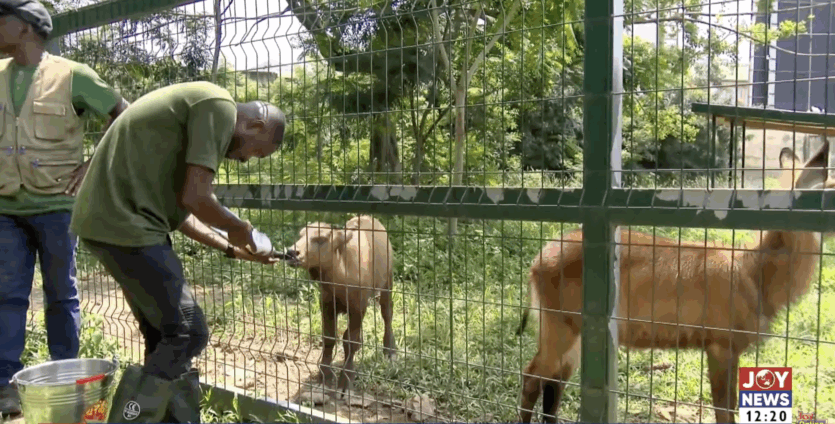
The Kumasi Zoo has appealed to the public to respect Ghana’s wildlife closed season after rescuing two orphaned animals, a buffalo calf and a young waterbuck, believed to have lost their mothers to illegal hunting.
Zoo officials say the incident highlights ongoing disregard for conservation laws meant to protect wildlife during their breeding period.
The two animals were brought in from the Savannah and Bono East Regions and are currently under intensive care.
However, the Zoo says caring for the calves has become costly because they require special feeding and medical support.
Dr Meyir Ziekah, Manager of the Kumasi Zoo, expressed concern over the frequent arrival of orphaned wildlife during the procreation season.
“These are calves that were still being nursed by their mothers, and unfortunately, the mothers have been killed,” he said.
“Feeding them is not easy. We are currently spending about GH¢800 a day on fresh cow milk for the buffalo calf alone because we cannot dilute it and risk infection.”
The buffalo calf, named Larabanga, and the waterbuck are being kept in a protected enclosure where they are gradually adapting to care from wildlife staff. The Zoo is therefore appealing to the public and corporate bodies to support its adoption and wildlife care programmes.
“We are using this medium to appeal to individuals who are touched by this story to come and adopt these young animals. Any support will go a long way,” Dr Ziekah added.
The Wildlife Division of the Forestry Commission declared the 2025 wildlife closed season effective August 1 to December 1, banning the hunting, capturing, trading, or transporting of wild animals nationwide.
The closed season is meant to allow animal populations to reproduce and replenish.
However, conservationists warn that illegal hunting continues in some rural communities, threatening biodiversity and pushing certain species closer to endangerment.
The Wildlife Division is calling on community leaders and local authorities to help enforce the ban and educate the public about the long-term harm caused by indiscriminate hunting.
“As a country, we need to protect our wildlife for future generations,” Dr Ziekah said. “Once they are gone, we cannot get them back.”
Latest Stories
-
GNAT pushes for clear implementation procedures of teachers’ conditions of service
3 minutes -
Recurrent strikes threaten quality of education and academic calendars – Prof Bokpin
7 minutes -
‘Cockroach’ group leaders among hundreds detained in Delhi protest
10 minutes -
Don’t let speed of information become your judgement – CJ tells new lawyers
48 minutes -
World Cup visa scandal: People have leveraged public office to facilitate fraud – Senyo Hosi
53 minutes -
Glut! Farmers count losses as prices crash, customers happy
1 hour -
GSA postpones auction of unserviceable vehicles
2 hours -
Man charged with attempted murder after stabbing
2 hours -
World Cup visa scandal: Senyo Hosi says issue goes beyond calls for Sports Minister’s resignation
2 hours -
Yaw Ampofo Ankrah hasn’t taken or received any money to facilitate visas – Lawyer insists
2 hours -
World Cup visa scandal: Senyo Hosi urges focus on constitutional accountability
2 hours -
La Beach demolition: Senyo Hosi condemns lack of consultation
2 hours -
Russian glide bomb attack on Zaporizhzhia kills at least 15 people
2 hours -
Jinapor warns underperforming energy sector CEOs of consequences, says no protection for failure
2 hours -
Fire destroys head of tipper truck on Lower Volta Bridge
2 hours