

Audio By Carbonatix
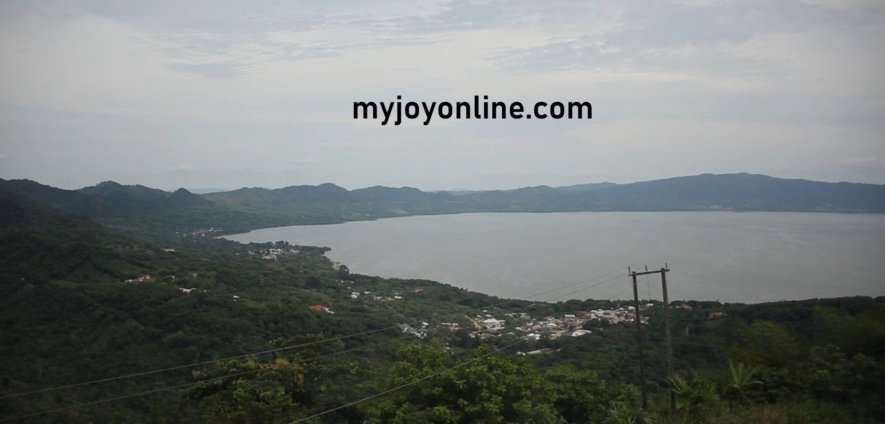
The resilience of Lake Bosomtwe, the biggest natural lake in West Africa, is seriously threatened as a result of climate change and other human activities, according to research by scientists from the University of Energy and Natural Resource (UENR).
Based on a 1986 baseline study, their research discovered that the lake is drying up, as it has receded 35 metres from its shoreline since 2005, recording sharp decline in water levels, reduction in size of the lake and decline in fish population.

In this Special feature, I discovered that residents along the lake are worried over the findings of the researchers and want immediate actions to save the lake.
Believed to have been formed by a falling meteorite some 1.2 million years ago, Lake Bosomtwe measures about 8 kilometers in diameter, covering a surface area of about 52 kilometers.
But over time, the lake has since 1.2 million years ago seen its depth decreased from 800 metres to 78 meters maximum currently with the surface area reduced from 52 kilometers in 1986 to 46 kilometers in 2020.

Fish stock has over the years reduced, resulting in few catches for communities along the lake whose mainstay is fishing.
The development has forced many residents to divert to crop farming, which involves clearing the lake’s forest cover. The use of weedicides and pesticides also pollute the lake’s environs.
Seventy-seven-year-old Patrick Elliot Ofosu, who is born and bred and has lived all his live at Abono, is one of the worried residents seeking answers to the warming and shrinking Lake Bosomtwe.

“Some years back, about 25-years ago, the whole of this area was part of the Lake. As you see it yourself, the Lake is going back; it’s receding,” a worried Patrick Ofosu lamented.
Sediments, including inorganic matter and silt associated with human activities and erosion, are said to have built up underneath the biggest natural lake in West Africa.

Dubbed “Building Resilience of Lake Bosomtwe to Climate Change (RELAB)”, scientists from the University of Energy and Natural Resource (UENR) in partnership with their overseas counterparts from three institutions are seeking to build the lake’s resilience to climate change.
It is based on Goal 2 of the Sustainable Development Goals of the United Nations. It envisions the world could end hunger whilst achieving food security, improving nutrition and promoting agriculture.
The project deployed automated measuring systems, limnologic sampling, and laboratory analyses to collect historical data and new high-frequency of in-crater meteorology measurements, among others to study the resilience of the lake to climate change.
“We know that the Lake is drying up”

The researchers discovered the size of the lake is shrinking, with the surface area decreasing from 52 km2 to 47.17 km2. There has also been an unprecedented decline in the water levels, fish catch and forest cover of the lake as a result of human activities since 1986.
The use of harmful agricultural inputs by farmers in their quest to feed their families has been identified as one of the negative practices impacting Lake Bosomtwe.

Dr. Peter Sanful is the Project Coordinator of UENR-Relab, who says “From what we have gathered so far, we know that the Lake is drying up.”
“Its mainly because of climate change from 2005, we have seen that there’s a rapid loss of water; rapid recession of the water mark from the shoreline to the water mark.”
Dr. Sanful says there could be dire consequences if no action is taken.

“The Lake is not behaving the way that it used to be in the past. Fish catch has been going down, the people’s livelihood has been affected and their agricultural activities have been intensified as a result of as a result of their quest to support their livelihoods from farming.”
The team continues to research the impact human activities and climate change could have on Lake Bosomtwe as both closed and opened forest cover of the lake are targeted.
In helping finding solutions and response to some concerns raised especially by residents in affected communities, Dr. Sanful observed , “Our responsibility is to conduct the research and generate the data and to engage, transfer this data to policy makers who then have to incorporate that data into action plan.”
Residents of Abono and other communities surrounding Lake Bosomtwe, including Mr. Ofosu, want to see the integrity of the lake protected and preserved for future generations.
“The whole of this place was waterlogged some years back. But look at the speed of receding. So something must be done,” 77-year old native of Abono, Patrick Elliot Frimpong has appealed.
Latest Stories
-
Power restoration fault suspected in Kumasi Central Market fire
29 minutes -
The 7-foot giant of Ngleshie Amanfro: Seven-foot Ghanaian Ephraim Saawa dreams of joining the national basketball team
1 hour -
Government promises support for Kumasi Central Market fire victims
1 hour -
Vibes The Movie: Big Ghun’s Ghanaian film earns five nominations at 2026 REFFA
2 hours -
MamaCare CEO warns unresolved conflicts among health workers could undermine maternal and neonatal care
2 hours -
Health professionals urged to translate medical knowledge into practice to save mothers
2 hours -
Conflicts among care providers linked to maternal, neonatal deaths – Expert
4 hours -
GIS marks 10th TIME conference, champions improved teaching practices
4 hours -
BRICS Or Balance? What Ghana’s bid really means
4 hours -
GPRTU wants full TRAFFITECH-GH implementation to start in 2027
5 hours -
Mahama announces plans to import electric wheelchairs for PWDs
5 hours -
KGL U17 Colts 2026: Western beat Prempeh Elite Academy to set up final final with Greater Accra Region
5 hours -
Late Solanke strike salvages 10-man Spurs draw at Man United
5 hours -
Gender Ministry to monitor welfare of Nana Akua Addo’s children amid domestic violence case
5 hours -
Benedict Okyere Yeboah: Ghana’s football problem goes beyond sacking a coach
6 hours