

Audio By Carbonatix
From secret love children to beloved pets - when a celebrity dies, everyone wants a piece of the estate.
In many cases, the ensuing court drama becomes as much a part of a celebrity's legacy as anything they did while they were alive.
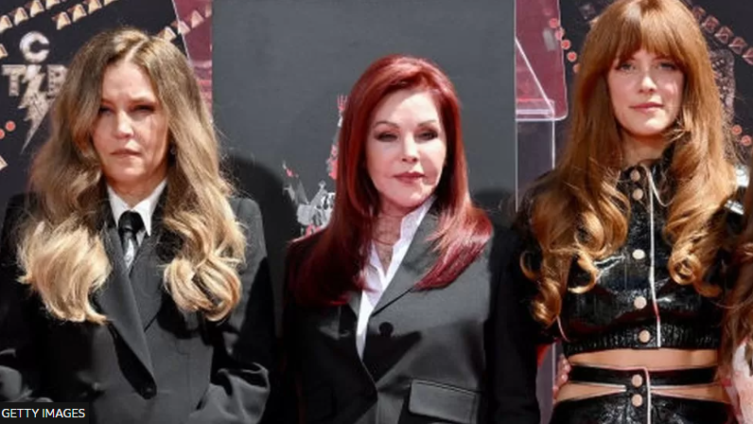
The death of Lisa Marie, Elvis Presley's daughter, appears to be no exception.
On Monday, her mother Priscilla Presley filed a legal challenge to the validity of Lisa Marie's will. Ms Presley is disputing an amendment that replaced her as trustee, and gave control of her assets to Lisa Marie's children.
It is heading for the courts, the latest example of the kind of family feud that can erupt when someone in the public eye dies.
When model Anna Nicole Smith's billionaire nonagenarian husband died 13 months after they wed, she battled his son for a share of the estate, taking it all the way to the US Supreme Court.
When '70s hitmaker Sonny Bono died without a will, his ex-wife Cher sued for money she said was owed to her from their divorce, while a man who claimed to be Bono's illegitimate son also sued to be an heir before eventually dropping his claim.
Miami socialite Gail Posner left a $3m (£2.5m) trust fund to her chihuahuas, prompting her son to fight the pooches in court.
"In this country, you know, where there's a will there's a way," said Adam Streisand, a top Hollywood trial lawyer at Sheppard Mullin who has been in court for some of the biggest celebrity battles to date, including those surrounding the estates of Michael Jackson and Hugh Hefner.
With celebrity estates sometimes worth hundreds of millions of dollars, a lot of money is at stake.
But Mr Streisand said that many disputes are as much about emotion as about money.
Most people, not just celebrities, have at least one bitter family story about a relative who got left out of a will. At the heart of many of these disagreements can be decades-old grievances.
Sometimes, people fight to claim an inheritance because they are trying to create a close relationship they never had with that person while living, he said.
As a distant relative of Barbra Streisand, Mr Streisand said he understands why people can sometimes imagine connections that do not exist.
Growing up, he said people would always ask him about The Way We Were singer, which meant that even though he did not have a relationship with her, she was, in some ways, a part of his identity.
"Now imagine if you are the child of a pop sensation, rock superstar or a movie star," he said.
"And so when the person passes, the ability to try and establish a connection that you couldn't establish during a person's life intensifies."
The added sting of perceived slights can make settling an estate especially rancorous.
"The money involved is almost secondary," he said. "People do fight over smaller estates.
"And they fight over the most ridiculous nonsense, [like] pots and pans."
Add to that the high stakes of a high-profile figure, and you have a recipe for bitterness.
Lisa Marie's estate includes ownership of Graceland, Elvis' former mansion in Tennessee, which is now open to the public.
That means that, to an extent, whoever controls her estate will also have control over the legacy of an American rock'n'roll icon.
Jonathan Forster, a private wealth lawyer at Weinstock Manion, said that when it comes down to it, a lot of disputes arise because some people feel entitled to a wealth and legacy that was never theirs.
"They feel that because they are related to the celebrity, that they should be entitled to something whether or not the document says that," he said.
Another challenge with celebrity wills is that with large estates, the deceased can have had many different advisers, and sometimes multiple versions of a will. Others, such as Aretha Franklin and Prince, left no will at all.
When Prince died in 2016 without a will, he left over $156m in assets. His estate was not settled until this year.
The two most common ways to dispute a will are to argue that a person lacked capacity to make changes to their estate, such as if they suffered from dementia, or if a person was subjected to undue influence, such as if a caregiver pressuring them to sign a document.
But proving those claims is not cheap or easy.
Challenging a will in court can cost hundreds of thousands, if not millions, of dollars in lawyers fees, although some lawyers will work based off of a percentage of the settlement.
With large estates, sometimes lawyers will offer to sue, knowing there is no legitimate claim, simply to pressure a quick settlement and get a cut of the deal.
"It's kind of like free money," said Mr Forster. "One thing I say to clients all the time - you can really sue for anything in this country."
Latest Stories
-
Landfilling waste management creates no value, it’s an economic waste
5 minutes -
Photos: Speaker Bagbin Commissions MPs constituency office under parliamentary decentralisation programme
20 minutes -
Black Stars technical advisor Winfried Schäfer sacked as GFA shakes up backroom staff
25 minutes -
Wenchi water project almost complete, critical to gov’t agenda – GWL MD
41 minutes -
Anti-LGBTQ+ bill not part of government’s legislative agenda – Inusah Fuseini
43 minutes -
Anti-LGBTQ Bill: Forget the rumour mongers, I’m a man of action, and will pass the bill – Speaker
1 hour -
Women and children among those killed in Sudanese army shelling of wedding celebration
2 hours -
President Mahama is not sincere with Ghanaians on LGBTQ bill matter – Hassan Tampuli
2 hours -
Gov’t to establish Prison Industrial Hub to equip inmates with income-generating skills – Prison Service boss
2 hours -
Alhassan Tampuli donates cement, roofing sheets to support storm victims in Gushegu
2 hours -
Alhassan Tampuli appeals for urgent support for storm victims in Gushegu
2 hours -
The hypocrisy must stop; pass Anti-LGBTQ+ Bill now – Alhassan Tampuli to Mahama
2 hours -
Imprisonment should be rehabilitative, not punitive – Ghana Prisons boss at UNGA
3 hours -
Ga Adangbe traditional priests petition Mahama over McDan aviation licence revocation
3 hours -
Anti-LGBTQ Bill: NDC’s arrogance is worrying – Hassan Tampuli
3 hours