

Audio By Carbonatix
Some residents of communities affected by the Athletic lithium Company’s explorations in the Central Region have demanded fair compensation, clear resettlement plans and a seat at the negotiating table for mutual gain.
The communities include Awoyaa, Afrangua, Krofu, Abonko, Ansadzie, Krampakrom and Abura Dunkwa.
They cited deep mistrust in their entrusted committee leaders to steer affairs on their behalf, particularly some traditional leaders they alleged withheld critical information about the ongoing company and communities’ negotiations.
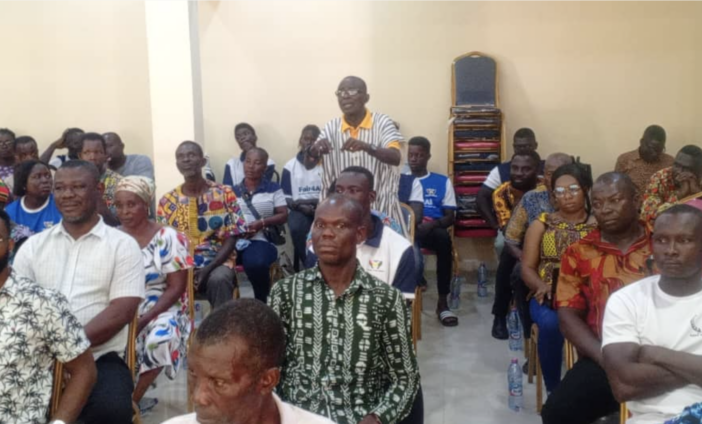
Speaking at a forum to discuss limitations of mining regulations in Ghana at Saltpond in the Mfantseman Municipality on Wednesday, they claimed lack of information about resettlement plans and designs, and access to critical social amenities like utilities, schools, police station, hospitals, and telecommunication.
The forum was arranged by three environmentally inclined civil society groups including Friends of the Nation, Natural Resource Governments Institute and Centre for Social Impact Studies.
The engagement was aimed at soliciting the views of community members affected by the exploration works of Atlantic Lithium Company to help fine-tune the country’s mining regulations for mutual gains.
Mr Kwame Essel, a Linguist at Mankessim described having woke-up one day to find his farmland cordoned off, crops partly destroyed, and ancestral lands rendered inaccessible without due compensation.
“We’ve farmed on our lands since our grandparents’ time. “Now, it is like our hands are tied behind our backs; we cannot farm, nor are they doing anything on the land.
“We the farmers are apprehensive, frustrated and confused,” Mr Essel said, stressing the company’s silence on resettlement locations and social infrastructure like schools, hospitals and
police stations had deepened fears of displacement without safety nets.
Madam Grace Essen, a resident of Ewoyaa, lamented many cracked buildings and collapsed structures caused by frequent blasting from nearby mining operations and heavy-duty vehicle movements.
“Our houses we have spent years of our sweat to build are seriously shook daily, weakening some of them but no one is ready to explain anything to us, or compensate us for the damages as we hover around dangerously.
“The lack of transparency has bred distrust, with many affected residents questioning whether traditional leaders are prioritising corporate interests over community welfare,” she said as tears rolled down her face.
Many others in an interview with the Ghana News Agency sounded alarms over water pollution risks to the Ochi-Amissah River and disrupted livelihoods, while youth migration to gold-mining regions intensified due to limited local job opportunities.
Residents also expressed the fear that lithium mining will contaminate the Ochi-Amissah River, a critical water source, and destroy biodiversity through habitat destruction.
Nonetheless, Mr Raymond Sarfo, Assistant Programme Officer with the Environmental Protection Agency (EPA) in the region, allayed all fears of environmental concerns assuring that his outfit was in-charge.
However, he identified weak enforcement mechanisms as a key gap in Ghana’s mining sector, despite robust laws like the Minerals and Mining Act (Act 703) and EPA Act (Act 1124).
While these frameworks mandated environmental compliance, he said systemic issues persist in curbing illegal mining (galamsey) and artisanal operations due to corruption, resource constraints, and inter-agency conflicts and ineffective collaboration.
Latest Stories
-
Tamale Child Deaths: Vehicle owner arrested as IGP deploys homicide team
9 minutes -
From ShattaFest to MoMo Fest: Entertainment takes centre stage in youth engagement
15 minutes -
Nigerian military aircraft crashes, killing 32
20 minutes -
MTN encourages Ghanaians to use MoMo for saving, investing and financial planning
20 minutes -
Absa Bank Ghana names Stephen Ato Frimpong as Board Chair
28 minutes -
Pickford ‘almost caused crash’ with careless driving
30 minutes -
Author and former politician Jeffrey Archer dies aged 86
41 minutes -
No education reform can succeed without teachers – Education Ministry
50 minutes -
Gauff condemns racist abuse after China Open win
1 hour -
Medvedev disqualified for hitting spectator with ball
1 hour -
Oliseh scores twice in late comeback win for France
1 hour -
Pentagon stops using Anthropic AI tools after blacklisting company, BBC told
2 hours -
From despair to dance: Family of nurse Salomey Baffoe rejoices after GH¢100k bail granted
2 hours -
Kejetia Phase III pricing talks loom as government moves to restart stalled works
3 hours -
Nchiraa Yam festival: Two killed, 14 injured as police restore calm
3 hours