

Audio By Carbonatix
President John Dramani Mahama has emphasised the importance of implementing smart, enforceable, and future-oriented local content policies that not only attract investment but also foster long-term, sustainable competitiveness.
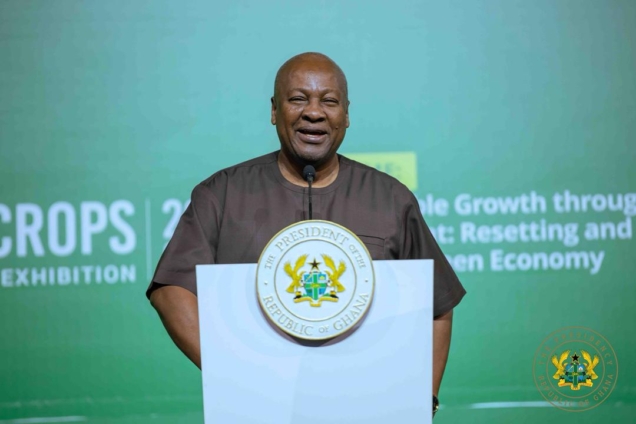
Speaking at the Local Content Summit 2026 in Takoradi on Wednesday, February 18, Mahama drew on international examples to illustrate how countries can use their natural resources strategically to benefit their economies and citizens.
In his keynote address, Mahama highlighted the successes of Botswana, Chile, and Indonesia, showcasing how these nations have leveraged their resource wealth to create domestic value, drive technological advancements, and position themselves as key players in global industries.
Mahama began by referencing Botswana's approach to its diamond sector, noting how the country has successfully established strategic partnerships to ensure value retention and meaningful citizen participation.
Botswana’s collaboration with global partners has enabled it to keep a significant portion of the economic benefits from its diamond mining industry within the country, which has had a positive impact on its economy and local communities.
“Botswana has leveraged strategic partnerships to ensure value retention and citizen participation in their diamond sector. This has not only benefited their economy but also created long-term opportunities for local communities,” Mahama stated.
This model, Mahama pointed out, demonstrates how countries can manage their natural resources in a way that benefits both their economies and their people.
The President also turned his attention to Chile, which has transformed its copper wealth into a thriving technology ecosystem focused on gold mining.
By leveraging its expertise in copper extraction and refining, Chile has positioned itself at the forefront of mining technology, particularly in gold extraction.
Mahama commended Chile for turning its natural resource advantage into an innovative sector that goes beyond simple extraction to include technology development, which has bolstered its economic growth and created new job opportunities.
"In Chile, they have taken their copper wealth and transformed it into a gold-mining technology ecosystem. This has enabled the country to create an entire industry around gold mining technology, turning a natural resource advantage into an innovation hub," Mahama explained.
Another key example Mahama shared was Indonesia, which has mandated the domestic processing of nickel, a decision that has positioned the country at the heart of the global electric vehicle (EV) battery supply chain.
Indonesia's strategy to process its nickel locally rather than exporting raw materials has attracted significant foreign investment and allowed the country to capitalise on the growing demand for EV batteries.
By creating a robust domestic processing industry, Indonesia has gained a competitive edge in the global green economy, which is increasingly centred around sustainable technologies.
"Indonesia’s domestic processing of nickel has placed them at the forefront of the electric vehicle battery industry, a critical sector that is only going to grow in importance in the years ahead," Mahama said.
Drawing lessons from these countries, Mahama argued that the key to successful local content policies lies in balance.
He stressed that such policies must be both ambitious and practical, firm but performance-based, with a clear focus on measurable capacity development outcomes.
Mahama explained that smart local content policies do not deter investment; rather, they create sustainable competitiveness by developing local capacity and ensuring that the benefits of resource extraction are shared with the wider population.
"The key is balance. Smart local content policies must be ambitious, but they must also be practical and rooted in measurable capacity development outcomes," Mahama said. “They must be firm but also allow for performance-based evaluation. It is not enough to simply set percentage targets; the real goal should be to measure the tangible impact of these policies on local capacity development."
Mahama cautioned against focusing solely on achieving numerical targets, such as quotas for local content, as the primary measure of success.
Instead, he called for policies that prioritise the development of local capacity, skills, and technological expertise, which are critical to ensuring long-term, sustainable growth.
He argued that the real goal should be to create an ecosystem where local businesses, entrepreneurs, and workers can thrive and contribute meaningfully to the country’s economic development.
Latest Stories
-
Be careful with cross-border lending, foreign currency exposures – BoG to financial institutions
2 hours -
GPL 2026/27: Medeama go three clear as Hearts of Oak recover and Bechem stage stunning comeback
2 hours -
Ntiamoah Foundation launches “BEYOND 20” anniversary campaign
2 hours -
Credit Risk Management Directive: BoG to begin implementation for banks, others from July 1, 2027
2 hours -
Ghana Brands Awards 2026: Leading brands, business trailblazers to shine on November 20
3 hours -
T-bills auction: Demand improves as government exceeds target by about 76%; interest rates soften
3 hours -
Ziope undertakes initiative to build a technologically inclined community, commissions self-help ICT lab
3 hours -
ECG announces power outage in parts of Tema, Central Region due to network fault, maintenance
4 hours -
When the Gospel Becomes a Weapon: The church, blackmail and the abuse of faith
4 hours -
JoyNews’ Jacqueline Ansomah Yeboah selected for UK Media Excellence for Emerging Technologies Fellowship
4 hours -
Mental Health Alliance urges government to operationalise Mental Health Fund
5 hours -
Ghana–Holy See agreement heads to Parliament after Cabinet approval
5 hours -
Luv FM Corporate Games 2026: Kumasi Central Prisons, Amanfiman Bank win big amid fun
5 hours -
WAFU B U17: Ghana top Group A after win over Togo
5 hours -
Ho Central Mosque reopens amid unresolved leadership dispute that led to closure
7 hours