

Audio By Carbonatix
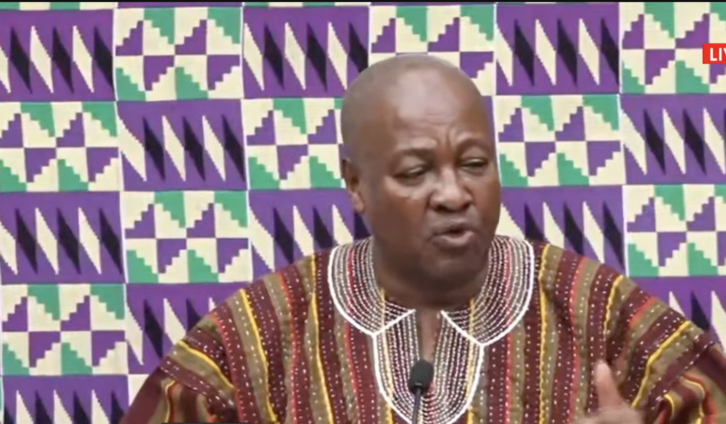
President John Mahama is proposing new legislation to criminalise the destruction of cash crops like cocoa for mining purposes.
According to him, it is economically prudent to cultivate cocoa, which can generate income all year-round, compared to mining, which leaves the land barren once the gold is extracted.
Speaking after a courtesy call from the Ghana Cocoa, Coffee, and Sheanut Farmers Association, he noted that preserving cocoa production is vital for the country’s economy.
“We have to ensure that people are not cutting down cocoa trees to mine gold. Once the land is mined out, it becomes useless, whereas cocoa trees can yield revenue for 30 years or more. It makes more sense to preserve cocoa farms than to mine the land and render it barren for future generations,” Mahama stated.
“We are exploring legislative measures to prevent cocoa farm destruction for mining,” he added.
President Mahama also declared the year 2025 as the "Year of Correction" to bring the cocoa sector back on track.
He criticised the Ghana Cocoa Board under the previous administration for its management of the industry, specifically calling out the spending of GH₵3.4 billion last year, which he says was largely used for administrative and headquarters expenses.
“COCOBOD's total debt today is GH₵ 3.2 billion, and GH₵9 million must be paid by September. This is money that should have gone to farmers but is now being used to service debts,” he lamented.
“Production has declined, yet COCOBOD’s staff numbers have increased, which is counterproductive. In business, when production and revenue decrease, workforce adjustments are made. However, under the previous administration, employment at COCOBOD increased while production dwindled.”
President Mahama emphasised that the key to sustaining cocoa production is ensuring fair pricing for farmers.
He criticised previous policies that saw producer prices fall below 40% and advocated for a minimum of 70% to incentivise farmers.
“In the first four years of the past administration, there was virtually no increase in producer prices, despite currency depreciation. This year will be a year of correction to address these issues and restore the industry to a strong footing,” he noted.
Latest Stories
-
Ibrahim Mahama urges Ghanaians to overcome fear and venture into business
3 minutes -
2026 U-17 WWC: Black Maidens lose to China in pre-tournament friendly
7 minutes -
Who gave Gbande the EOCO remote control?
28 minutes -
Ghana begins review of 1999 National Land Policy, targets new framework by 2027
1 hour -
Tiptoe Lane’s tech takeover: The story behind Ghana’s booming informal phone market
3 hours -
Abanga vows to use social media to counter NDC messaging ahead of 2028 elections
3 hours -
Okai Mintah seeks Sabah Zita Benson’s support for NDC National Youth Organiser bid
3 hours -
Okai Mintah vows to strengthen NDC campaign machinery ahead of 2028
3 hours -
Mother of four and Jasikan teacher among new Telecel M’ahitti Promo winners
3 hours -
International Youth Shakers Conclave 2026 set to bring global young leaders to London
3 hours -
Gov’t is committed to addressing teachers’ conditions of service, deprived-area allowance – Education Minister
3 hours -
GoldBod’s structure encouraging galamsey – Afenyo-Markin
3 hours -
Tullow starts selling Jubilee, TEN crude to Ghanaian refineries
3 hours -
Local Government Service authorises rationalisation, redistribution of staff
3 hours -
PURC assures consumers of working to ensure quality services in Northern Region
3 hours