

Audio By Carbonatix
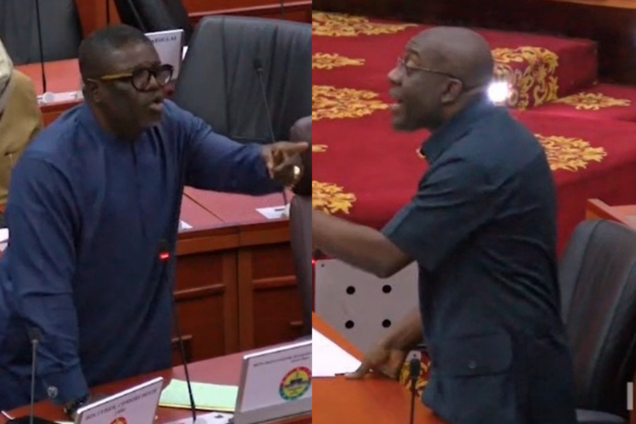
A report on the government's proposed 24-hour Economy and Accelerated Export Development Programme triggered exchanges in Parliament on Tuesday, July 14, with the Majority and Minority accusing each other of spending public funds without delivering the promised results.
The debate centred on the implementation of the government's flagship 24-hour economy policy, with the Minority questioning why the programme has yet to take off despite Parliament approving substantial budget allocations for government expenditure over the past two years.
Speaking during the debate, the Ranking Member on Parliament's Economy and Development Committee, Kojo Oppong Nkrumah, said that the government had failed to fulfil one of its key campaign promises.
He recalled that the policy was marketed around a system in which jobs would be organised into three shifts to enable round-the-clock economic activity.
"The promise of the 24-hour economy was clear: one job, three people, three shifts," Mr Oppong Nkrumah said.
He said that nearly two years into the government's term, Parliament had approved about GH¢650 billion through the 2025 and 2026 budgets for government operations, yet no public institution had adopted the proposed model.
"This government has been in office for almost two years. And in these two years, they have appropriated about GH¢650 billion. That's what this House has appropriated for the government to work with," he said.
"Almost two years on, you cannot find one government agency that is applying one-three-three. For all the stories that we were told, for all the analogies that were given, two years on, after appropriating about GH¢650 billion, you cannot find one agency that is operating one-three-three."
According to him, this was evidence that the programme had not delivered what Ghanaians were promised.
"That is the biggest testimony of the fact that this entire 24-hour economy programme that was so well marketed... at the end of the day, it is not delivering on what it was promised," he said.
Mr Nkrumah also criticised the pace at which the government was developing incentives expected to encourage private sector participation in the initiative.
He said while the government had moved quickly on other priorities, businesses were still waiting for the measures needed to make the 24-hour economy operational.
"When it comes to the incentives that will now allow the private sector to possibly even work for 24 hours, assuming your model will work, the government tells us when we go for a committee meeting that they are now working on those incentives," he said.
"We think it betrays their priorities, and we think that they need to speed up if indeed some incentives will be brought which will give life to the 24-hour economy."
However, the Majority dismissed the criticism and instead turned to the previous New Patriotic Party (NPP) administration.
Responding to the debate, Majority Chief Whip, Rockson-Nelson Dafeamekpor accused the former government of failing to deliver results after securing US$600 million for a cocoa sector programme.
According to him, the loan, obtained from the African Development Bank, was intended to expand cocoa farms, plant new trees, survey farms, build warehouses, and increase cocoa production.
"The NPP government... came to this House to secure US$600 million from the African Development Bank. The purpose was to expand cocoa farms, plant new trees, survey the farms, build warehouses, and increase yield," he said.
Mr Dafeamekpor said that the objectives of the programme were never achieved, claiming cocoa production fell significantly under the previous administration.
"It wasn't done. At the end of 2024, in December, our cocoa yield plummeted from one million metric tonnes a year to 450,000," he said.
He further claimed that the decline in production affected employment across the cocoa value chain.
"Jobs were not created. People lost jobs. In the supply chain, a lot of businesses lost out. They chopped the money," he said.
Latest Stories
-
NPP’s new leadership offers no renewal after ‘micro minority’ defeat – NDC’s Abeiku Hayford
25 seconds -
Blackstar Experience to hold fashion show and summit in November
44 seconds -
Prof Mike Oquaye backs Kojo Bamba’s call for stronger ballot protection
11 minutes -
If police won’t protect you, you’ll protect yourself – Prof Mike Oquaye backs Kojo Bamba’s election
11 minutes -
Spotify makes fandom the ticket with debut Surround Sound experience in Lagos
22 minutes -
Deputy Interior Minister calls for joint action to strengthen Ghana’s cybercrime response
32 minutes -
Gov’t announces plans to create 20,000 jobs in waste management, circular economy
37 minutes -
T-bills auction: Government exceeds target by 30%, but demand to remain relatively soft at next auction
38 minutes -
Election Watch Ghana raises concern over low female representation in NPP leadership
45 minutes -
Four drinks that help manage blood sugar
45 minutes -
Ray Michael Djan Jr puts Ghanaian creativity on global stage with Chelsea anthem
55 minutes -
Matilda Dibloni Kokar elected USAG president after two-year dormancy
58 minutes -
NPP delegates wanted youthful energy with Kojo Bamba’s election – Political scientist
1 hour -
Zenith Bank supports Childhood Cancer Unit at Greater Accra Regional Hospital
1 hour -
KMA empowers 64 persons with disabilities; Mayor unveils plan for sustainable skills centre
1 hour