

Audio By Carbonatix
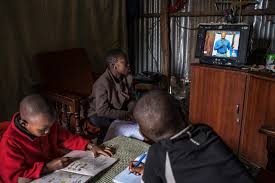
Five-year-old Kenyan student Miguel Munene sits between his parents, holding their hands as he watches cartoon characters teaching him to pronounce “fish”.
The television has replaced Munene’s teachers and classmates after the government shut schools indefinitely in March to curb the spread of the novel coronavirus. They are closed until at least January.
Many children don’t have the option to learn online - the United Nations children’s agency UNICEF says at least half of sub-Saharan Africa’s schoolchildren do not have internet access.
So some, like Munene, watch a cartoon made by Tanzanian non-profit organisation Ubongo, which offers television and radio content for free to African broadcasters.
“Other programmes are just for fun, but Ubongo is helping children,” Miguel’s mother Celestine Wanjiru told Reuters.
“He can now differentiate a lot of shapes and colours, both in English and Swahili.”
In March, programmes by Ubongo - the Kiswahili word for brain - were broadcast to an area covering about 12 million households in nine countries, said Iman Lipumba, Ubongo’s head of communications. That rose to 17 million in 20 countries by August.
“The COVID-19 pandemic has really forced us to rapidly grow,” Lipumba said.
A group of artists, innovators and educators set up Ubongo TV in Tanzania in 2014. It has received around $4 million in grants since, and earned $700,000 from YouTube, product sales, character licensing, and co-production of programmes.
For Munene and other schoolchildren, programmes like Ubongo’s are their only option to learn for now.
Kenya’s education ministry says schools can only reopen when the number of COVID-19 cases drops substantially.
Kenya has had over 36,000 confirmed cases and more than 620 deaths, health ministry data showed.
“You have the kid with you all the time so when you have such programmes, they are a big help,” Patrick Nyaga, Miguel’s father, a security guard, told Reuters.
But television cannot completely replace teaching.
“The way the children learn through programmes is different (from) the way they interact with others and teachers,” Nyaga said. “We are hoping that they open soon.”
Latest Stories
-
Landfilling waste management creates no value, it’s an economic waste
20 minutes -
Photos: Speaker Bagbin Commissions MPs constituency office under parliamentary decentralisation programme
36 minutes -
Black Stars technical advisor Winfried Schäfer sacked as GFA shakes up backroom staff
41 minutes -
Wenchi water project almost complete, critical to gov’t agenda – GWL MD
57 minutes -
Anti-LGBTQ+ bill not part of government’s legislative agenda – Inusah Fuseini
59 minutes -
Anti-LGBTQ Bill: Forget the rumour mongers, I’m a man of action, and will pass the bill – Speaker
2 hours -
Women and children among those killed in Sudanese army shelling of wedding celebration
2 hours -
President Mahama is not sincere with Ghanaians on LGBTQ bill matter – Hassan Tampuli
2 hours -
Gov’t to establish Prison Industrial Hub to equip inmates with income-generating skills – Prison Service boss
2 hours -
Alhassan Tampuli donates cement, roofing sheets to support storm victims in Gushegu
2 hours -
Alhassan Tampuli appeals for urgent support for storm victims in Gushegu
2 hours -
The hypocrisy must stop; pass Anti-LGBTQ+ Bill now – Alhassan Tampuli to Mahama
3 hours -
Imprisonment should be rehabilitative, not punitive – Ghana Prisons boss at UNGA
3 hours -
Ga Adangbe traditional priests petition Mahama over McDan aviation licence revocation
3 hours -
Anti-LGBTQ Bill: NDC’s arrogance is worrying – Hassan Tampuli
3 hours