

Audio By Carbonatix
The Minerals Commission has strongly defended the revocation of the mining lease of Adamus Resources Limited, insisting that the decision was taken in the national interest following what it describes as “systemic and flagrant violations” of Ghana’s mining laws.
The Commission maintains that the company engaged in unlawful mining activities, including the unauthorised assignment of parts of its concession and operations carried out without the necessary regulatory approvals. It has further indicated that the company could face prosecution if found culpable.
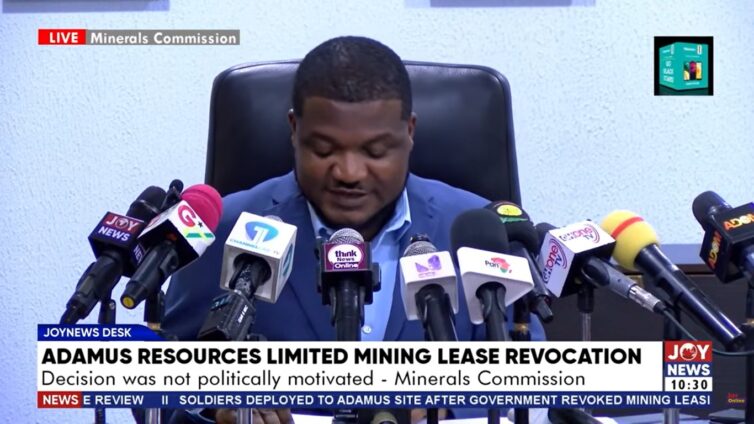
Speaking at a press briefing in Accra, the Chief Executive Officer of the Minerals Commission, Isaac Tandoh, stressed that the decision was grounded in law and evidence gathered during investigations.
“This decision was neither arbitrarily nor politically motivated. It was a lawful evidence-based action taken to protect Ghana's natural resources, environment, and public interest,” he said.
Mr Tandoh disclosed that the Commission would collaborate with the Attorney General to pursue legal action where necessary, adding, “The Commission will work with the Attorney General to prosecute these perpetrators.”
According to the Commission, investigations uncovered multiple breaches that left regulators with no option but to halt the company’s operations.
The development follows the Minister for Lands and Natural Resources’ decision to revoke the Akango, Salman and Nkroful mining leases previously held by Adamus Resources Limited. A statement issued on Sunday, April 26, said the move was based on findings from the Minerals Commission, which identified several instances of illegal and unauthorised mining activities.
READ ALSO: Government revokes Adamus Resources Limited’s mining leases for illegal activities
The Minister’s directive and the Commission’s enforcement action form part of broader efforts to tighten regulatory oversight of Ghana’s mining sector, particularly in response to persistent concerns over illegal mining activities and environmental degradation.
In recent years, Ghana has intensified its crackdown on unauthorised mining operations—commonly referred to as galamsey—due to their impact on water bodies, forest reserves and local livelihoods. Authorities have repeatedly pledged stronger enforcement of mining laws to ensure responsible resource extraction and protect the environment.
The latest revocation is expected to add to the ongoing national debate over compliance in the extractive sector and the balance between investment and environmental protection.
Latest Stories
-
Trump says he is considering firing US ambassador to Greece
4 hours -
Man City bananas ‘brought fun back’, says Varadi
4 hours -
Meta releases Muse Wonder AI models to challenge Anthropic and OpenAI
4 hours -
Daily Insight for CEOs: The CEO as Chief Decision Maker
4 hours -
Burnham had formal meeting with Man City chair while mayor
5 hours -
Is Ghana producing too many lawyers? What is the best lawyer-to-citizen ratio?
5 hours -
NDC sinking Ghana’s democracy with Emelia Agbenyo’s appointment – Miracles Aboagye
5 hours -
Seedorf back in football as Corinthians head coach
5 hours -
Hincapié and Zubimendi injured in post-match training session
5 hours -
Fridges in French supermarkets hit by cyberattack
5 hours -
Qantas flight grounded after bedbug outbreak
5 hours -
Reality Zone with Vicky Wireko: International Day of the Girl, shaping today’s girl for tomorrow’s future – ZONTA Clubs lead the way
6 hours -
Global health must be led by countries, not designed for them – Mintah Akandoh
7 hours -
Mahama honoured at 2026 World Health Summit in Berlin for global health leadership
7 hours -
Breast cancer is not a death sentence – Besease Kontire Obaapanin, Magmina Foundation lead awareness campaign
7 hours