

Audio By Carbonatix
The Minority caucus in Parliament has launched a blistering critique of the Bank of Ghana (BoG) following the release of its 2025 audited financial statements.
The caucus declared that the central bank’s true financial condition has been deliberately obscured and warned that the institution is now facing what they describe as “policy insolvency.”
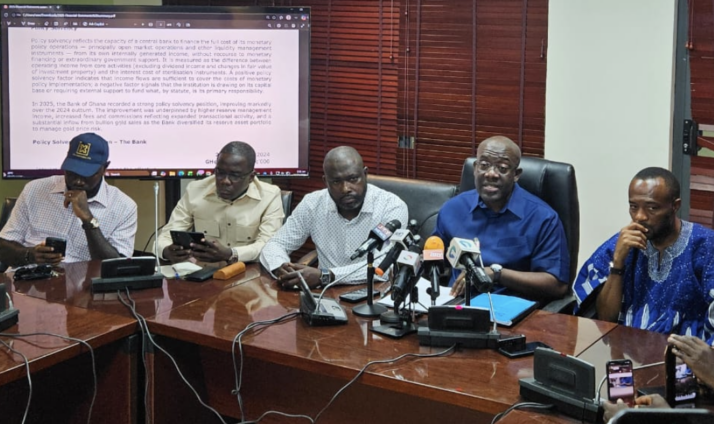
Addressing a packed press conference in Parliament, led by the Ranking Member on the Economy and Development Committee, Kojo Oppong Nkrumah, the Minority said its analysis of the Bank’s 136-page report confirms long-standing concerns it had raised about the trajectory of the central bank under the current administration.
“We have come here not to gloat about the things we forewarned,” Mr Oppong Nkrumah stated, “but to share with the Ghanaian people the numbers that the government wanted to hide and the worrying implications those numbers reveal.”Clash Over Pre-Release ‘Spin’
The Minority’s address follows an earlier press briefing by the Majority Caucus—fronted by Atta Issah—which sought to defend the anticipated losses even before the official accounts were released.
That move has been heavily criticised by the Minority as both unlawful and a politicisation of the central bank.
Citing Section 58 of the Bank of Ghana Act, the Minority argued that the law requires the Bank to submit its audited accounts to the Finance Minister, who must then present them to Parliament—not to political parties for public briefings.
“What happened was not only irregular but a blatant attempt to politicise the Bank of Ghana and shape public opinion before the facts were known,” the Minority asserted.
‘Policy Insolvency’ Claim
At the core of the Minority’s argument is its claim that the Bank of Ghana has become “policy insolvent”—meaning it can no longer finance its core monetary operations from its own income.
According to the Caucus, while the Bank reported operational income of GH¢22.2 billion against open market operation (OMO) costs of GH¢16.7 billion, this apparent surplus is misleading because it includes a one-off gain of GH¢9.6 billion from gold sales.
Stripping out that non-recurring income, the Minority argued, reduces operational income to GH¢12.7 billion, resulting in a deficit of about GH¢4 billion, which places the Bank in a negative policy solvency position.
“A central bank that needs to sell gold to avoid insolvency is operating on borrowed time,” Mr. Oppong Nkrumah warned.
Dispute Over ‘True Loss’ Figures
The Minority further challenged the widely reported GH¢15.6 billion headline loss, insisting that the real loss is significantly higher when all components are considered.
They pointed to an additional GH¢19.3 billion recorded under Other Comprehensive Income (OCI), bringing total losses to approximately GH¢34.9 billion.
When adjusted for the gold sale proceeds, they estimate the underlying loss could be as high as GH¢44 billion.
“This is the figure they did not want Ghanaians to see,” the Minority said, accusing the government of using accounting treatments and asset sales to reduce the headline loss.
Accounting Standards Under Scrutiny
The press conference also drew attention to concerns raised by auditors regarding the basis of accounting used in the financial statements.
According to the Minority, the accounts were not prepared in accordance with the full International Financial Reporting Standards (IFRS) but rather under the Bank’s internal accounting policies—a position flagged by auditors and acknowledged by the Bank’s directors.
This, they argued, allowed significant losses—particularly foreign exchange revaluation losses—to be moved into OCI, thereby reducing the reported headline deficit.
Reversal Of Recovery Trend
The Minority painted a broader picture of deterioration, noting that the Bank had been on a recovery path before 2025.
They cited official figures showing:
2023 loss: GH¢13.23 billion
2024 loss: GH¢9.49 billion
2025 loss: GH¢15.63 billion
According to them, the improvement recorded in 2024 has been reversed, with losses and negative equity worsening significantly in 2025.
“The central bank was healing. Now it is deteriorating,” Mr. Oppong Nkrumah said.
Policy Decisions Blamed
The Minority attributed the situation to specific policy reversals, including:
The abandonment of a dynamic Cash Reserve Ratio system, which had helped sterilise liquidity at a lower cost
Changes to foreign currency reserve requirements for banks
Alterations to the gold purchase programme, which they claim shifted costs onto the Bank of Ghana, while other entities reported profits
These decisions, they argue, led to a surge in sterilisation costs, with outstanding central bank bills rising sharply and interest payments to commercial banks exceeding GH¢14 billion.
‘Wealth Transfer’ To Banks
One of the most striking claims from the Minority was that the Bank’s operations effectively resulted in a transfer of public funds to commercial banks, which earned record profits largely from holding central bank instruments.
“This is not monetary policy; this is a wealth transfer from the public balance sheet to private balance sheets,” the Minority said.
They warned that this dynamic has constrained credit to the private sector, particularly for small businesses and young entrepreneurs.
Impact On The Real Economy
Beyond the financial statements, the Minority argued that macroeconomic stability has not translated into improved living conditions.
They cited:
Tight liquidity in the economy
Weak private sector credit growth
High cost of living
Rising youth unemployment
Challenges faced by farmers, teachers, and healthcare workers
“Stability of numbers is not the same as stability of livelihoods,” Mr. Oppong Nkrumah stressed.
Political Contrast With NDC’s Past Position
The Minority also highlighted what it described as a contradiction in the NDC’s position, recalling that in 2023, the then-opposition had labelled the Bank of Ghana a “crime scene” and demanded accountability over smaller losses.
“By their own standards, what should be said today?” the Minority questioned.
Call For Reforms
Despite the sharp tone, the Minority said its intention was not to celebrate being right but to push for urgent reforms to stabilise the central bank.
They announced plans to present a set of policy alternatives later in the week to restore the Bank’s financial health and safeguard its independence.
“There is no triumph in being right when your country is bleeding,” Mr Oppong Nkrumah concluded. “What matters now is that we act to prevent further damage.”
A Defining Economic Debate
The Minority’s latest intervention sets the stage for an intensifying national debate over the true state of the Bank of Ghana, the cost of economic stabilisation, and the balance between policy choices and financial sustainability.
Latest Stories
-
Total expenditure as of July 2026 amounted to GH¢147.07bn, 16% below target – BoG
1 hour -
Total revenue & grants stood at GH¢144.5bn in July 2026, slightly below target – BoG
2 hours -
Ghana Sports Fund urges sports federations to submit credible proposals and measurable targets
2 hours -
Sally Rooney books withdrawn in UK over Palestine Action support
2 hours -
Musk says US government may be behind slowdown of Ukraine drone speeds
2 hours -
Picking Chief Justices nearing retirement could give Mahama immense power – Bentil
2 hours -
Netflix to shed 1,000 jobs in steepest cuts since 2022
2 hours -
Burnham had two hospitality dinners with Man City chairman, deleted records show
3 hours -
Semenyo ‘froze’ after alleged racist abuse, court told
3 hours -
‘Shameless’ – Mourinho critical of Vinicius Jr ban timing
3 hours -
Loyalty can outweigh competence in Chief Justice selection – Bentil
3 hours -
Man City suffer as PSG masterclass sets up Champions League win
4 hours -
Customer Service Africa CEO urges business leaders to observe staff and customer interactions
4 hours -
On night of mayhem for Liverpool, Barcola arrives in style
4 hours -
Muzic Mensah finds healing and renewed love in new single ‘WayƐ Late’
4 hours