

Audio By Carbonatix
The Minority in Parliament has called on the Public Utilities Regulatory Commission (PURC) to fully disclose the factors behind its latest decision to increase electricity and water tariffs, saying that the move contradicts the government's claims of improving economic conditions.
Effective 1 July 2026, electricity tariffs will increase by 3.49 per cent, while water tariffs will rise by 0.85 per cent.
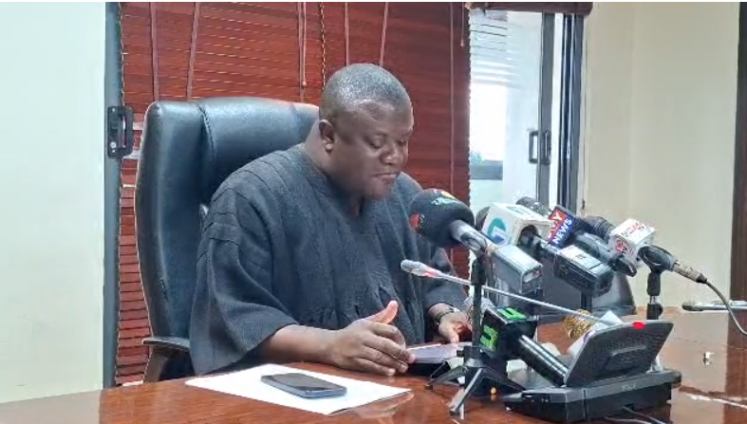
Addressing a press briefing in Parliament on Thursday, June 25, Deputy Ranking Member on the Energy Committee, Collins Adomako Mensah, questioned why utility prices continue to rise despite what government officials describe as significant economic gains.
According to him, the government has consistently highlighted the appreciation of the cedi, falling inflation and lower interest rates as proof that the economy is recovering.
"Government has repeatedly pointed to the appreciation of the cedi, declining inflation and lower interest rates as evidence that the economy has turned the corner. If those gains are genuine, Ghanaians should be experiencing them in their daily lives," he said.
Mr Adomako Mensah said that the electricity sector relies heavily on thermal power generation, which depends on imported crude oil and natural gas that are purchased in foreign currencies.
"The electricity sector depends heavily on thermal generation, whose principal inputs, imported crude oil and imported natural gas, are priced in foreign currency. A cedi that has appreciated by nearly 40 per cent should significantly reduce the domestic cost of these inputs," he stated.
He added that lower inflation and easing interest rates should also reduce operational costs across the economy.
"Falling inflation and easing interest rates should further reduce cost pressures across the economy. Yet, PURC is increasing electricity tariffs once again," he noted.
The Minority said the situation raises serious questions that require immediate answers from both the regulator and the government.
"This contradiction demands answers. If the strength of the cedi is real, if the decline in inflation is real, and if the reduction in interest rates reflects genuine macroeconomic improvements, why are utility tariffs continuing to rise? What exactly is driving these increases?" Mr Adomako Mensah asked.
He stressed that Ghanaians deserve transparency regarding the variables and calculations used by PURC in arriving at the new tariffs.
"The Ghanaian people deserve more than broad economic headlines. They deserve full transparency," he said.
The Minority further argued that until a detailed explanation is provided, many citizens would continue to question whether the reported economic gains are translating into real benefits for households and businesses.
"Until that explanation is provided, Ghanaians will be justified in asking whether the celebrated economic gains are being artificially sustained while households and businesses continue to bear the burden of rising utility costs," he stated.
The Minority maintained that any genuine economic improvement should ordinarily lead to lower utility tariffs rather than increases.
They also criticised the government for celebrating previous reductions in tariffs while remaining silent on the latest adjustment.
"We therefore say to President Mahama and the NDC government plainly, you cannot celebrate a 4.81 per cent reduction in April and remain silent when a 3.49 per cent increase follows in July," Mr Adomako Mensah said.
He said that the government bears responsibility for the current tariff regime because it appoints the leadership of the PURC and sets the policy environment within which the regulator operates.
"You own this tariff regime. You appointed the leadership of PURC to set the policy environment. You are accountable for every pesewa increase on every electricity bill in Ghana," he added.
The Minority pledged to continue scrutinising tariff adjustments and holding both the government and the regulator accountable.
"The Minority will continue to hold this government and the PURC accountable for every unjustified tariff increase imposed on the Ghanaian people," he declared.
They also called on civil society organisations, trade unions, industry associations and citizens to demand what it described as transparent, fair and evidence-based utility regulation.
"We call on all citizens, civil society organisations, trade unions, industry associates, and other colleagues on both sides of the aisle to demand transparent, fair, and evidence-based utility regulation."
"The 2028 elections are not far away, and Ghanaians will remember. The people of Ghana deserve better. We will ensure they get it. You cannot keep increasing the pressure on the tap and hand Ghanaians a basket to fetch the water. This tariff regime needs more than it delivers," they added.
In addition, the Minority urged the PURC to ensure that future tariff adjustments are linked to measurable improvements in service delivery.
It cited concerns including the prepaid meter depletion controversy, recurring power outages and alleged billing irregularities by the Electricity Company of Ghana (ECG).
"Ensure that any future tariff adjustment is accompanied by a verifiable improvement in service quality, particularly in addressing the prepaid meter depletion scandal, the persistent power outages and ECG's billing irregularities," Mr Adomako Mensah said.
Latest Stories
-
Mahama urges African governments to treat healthcare as an investment, not budget cost
13 minutes -
Bawumia congratulates John Boadu and new NPP executives, pledges support ahead of 2028
14 minutes -
‘No talent should be left out’ – Bawumia pledges inclusive NPP campaign for 2028
20 minutes -
Prof. Mike Oquaye recounts how he blocked Special Prosecutor’s attempt to arrest Bawku Central MP
36 minutes -
Make health sovereignty a priority for Africa – Mahama
47 minutes -
Dorimon Naa, Wa West DCE lead massive clean-up exercise; threaten sanctions against recalcitrant residents
1 hour -
Photos From Adom FM Y2K Jam
1 hour -
Praye Tiatia steals the show at Adom FM Y2K Jam [Watch]
1 hour -
Boakye Agyarko congratulates John Boadu, pledges support for NPP leadership
1 hour -
Antwi HiMight thrills fans with Antwi ne Antwi hits at Adom FM’s Y2K Jam [Video]
2 hours -
Amb. Edward Boateng congratulates Boadu, Kodua on election wins
2 hours -
John Boadu pledges to rebuild NPP from grassroots and restore ‘winning machinery’
2 hours -
Ashaiman Assembly deploys monitoring system to curb dumping in storm drain
2 hours -
John Boadu must rebuild, unite NPP for 2028 – Edward Boateng
2 hours -
Executive intimidation of opposition undermines separation of powers – Prof Oquaye
2 hours