

Audio By Carbonatix
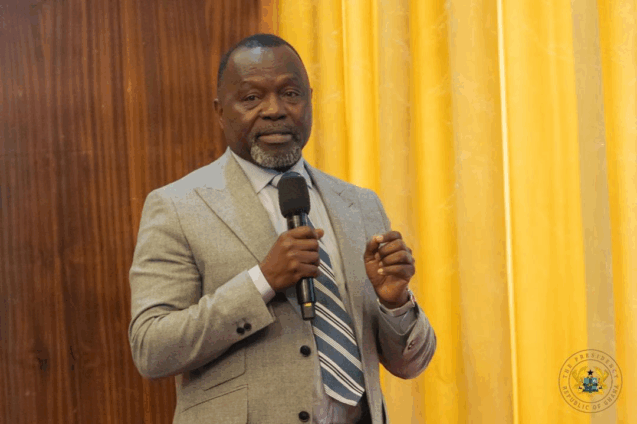
Attorney-General and Minister for Justice, Dominic Ayine, has defended the government’s position on free speech, insisting that freedom of expression must be exercised responsibly and within the confines of the law.
Speaking in an interview with journalists, Dr Ayine rejected claims by the Minority that the government was attempting to suppress free speech in the country.
“I think that the Minority is exaggerating a lot with respect to the question of gagging of free speech,” he said.
According to him, although Ghana’s Constitution guarantees freedom of speech and other fundamental rights, there are legal limitations, particularly where public order and national security are concerned.
He explained that Chapter Five of the Constitution, especially Article 21, guarantees freedoms such as free speech and the right to demonstrate, but noted that those rights are not absolute.
“There are limits. You can limit free speech if, for instance, it is something that can undermine public order, public morals, or for law enforcement reasons,” he said.
Dr Ayine further argued that the government could not remain passive when individuals use public platforms to spread messages capable of inciting division or violence.
“So if someone, for instance, is inciting hatred in our society, we do not expect that the Minority will say that we should sit down idly as a government and allow that person to go on,” he stated.
The Attorney-General drew comparisons with the 1994 Rwanda genocide, arguing that dangerous speech and media propaganda played a major role in the violence that claimed thousands of lives.
“Those are some of the things that led to wars in countries such as Rwanda,” he said.
“It was the use of the media that incited the genocide that eventually took place in Rwanda.”
Dr Ayine maintained that the current government remains committed to protecting democratic freedoms.
He described President John Dramani Mahama as “one of the staunchest supporters of free speech”, noting that the President’s communication background gives him a deep appreciation of the role of free expression in a democracy.
“He understands the importance of free speech in a democratic society,” Dr Ayine said.
The Attorney-General also stressed his personal commitment to democratic values, insisting he would never support attempts to deny citizens the right to express themselves freely.
“As Attorney General, I do understand the importance of free speech in a democratic society, and I would be the last person to want to undermine the rights of citizens to freely express themselves,” he said.
However, he cautioned against abuse of freedom of expression, particularly in ways that threaten peace and public order.
Dr Ayine declined to comment extensively on a specific matter currently before the courts, stating that it would be inappropriate to do so while proceedings were ongoing.
“But I should also not be the person who will sit idle when citizens are taking matters into their own hands when it comes to free expression. So, I don't want to comment specifically on the subject matter because it is pending in court.”
“But I believe that this government would uphold the freedom of every Ghanaian to freely express themselves,” he added.
The comments follow recent remarks by the National Youth Organiser of the opposition New Patriotic Party (NPP), Salam Mustapha, who warned that the party could adopt drastic measures that may destabilise governance if what he described as ongoing harassment and intimidation of its members did not stop.
Speaking to journalists on Tuesday, 19 May, during a courtesy visit by NPP officials to the Dean of the Diplomatic Corps, Mr Mustapha said the party would not remain passive while its members were allegedly being targeted.
The development follows the remand of the Bono Regional Chairman of the NPP, Kwame Baffoe, popularly known as Abronye DC, who was remanded for two weeks on Wednesday, 13 May 2026, over alleged offensive conduct likely to breach the peace and publication of false statements against a judge.
Latest Stories
-
Two Invitations, Three Interrogations: Did Baffour Awuah tell the whole story?
6 minutes -
Drug cartels may be seeing Ghana as easy route – Lenin Anane Agyei
59 minutes -
Ghana risks gaining notoriety as drug-trafficking hub – Bobby Banson
1 hour -
Government dismissed my drug trafficking warning, then tried to arrest me – Ntim Fordjour
1 hour -
Day Two: 3rd Republic Bank-JoyNews Habitat Fair Clinic underway at Junction Mall
1 hour -
NACOC addressing inherited gaps in fight against drug trafficking – Deputy Director-General
1 hour -
Taekwondo goes to school as GTF launches five-region youth campaign
1 hour -
The issues Mourinho is struggling to fix at Real Madrid
2 hours -
Hundreds throng EducationUSA College Fair in Kumasi in pursuit of abroad studies
2 hours -
Drug bust: NACOC should be part of port inspection team – Twum-Barimah
2 hours -
Ward appointed Liverpool’s sporting director
2 hours -
This isn’t the first cocaine bust; NPP must stop the politicisation – NACOC deputy boss
2 hours -
Drug bust case: Only Customs officers, MPS officials in scanning room – NACOC
3 hours -
I don’t mind being insulted; I have a crocodile skin – President Mahama
3 hours -
Samson’s Take: Verify the badge – and verify the story
3 hours