

Audio By Carbonatix
In many parts of Ghana, conversations about climate change are increasingly tied to everyday survival, whether it is fisherfolk watching the sea swallow portions of their communities, farmers struggling to predict rainfall patterns, or urban residents navigating floods after a few hours of rain.
These experiences are shaping how many young people understand the climate crisis: not as a distant environmental issue, but as a social and economic reality affecting jobs, food systems, migration, public health and community security.
Yet despite living through these challenges, many young people rarely have the opportunity to shape national conversations on climate change or influence how their stories are told.
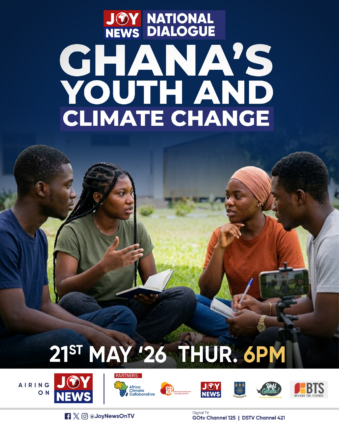
That is expected to change tomorrow as JoyNews hosts the Youth Climate Reporters National Dialogue, a live national broadcast aimed at placing youth voices at the centre of Ghana’s climate conversation.
The event will take place on Thursday, May 21, at Silicon House, Tesano from 6:00 pm to 8:00 pm.
It is being organised in partnership with the Africa Climate Collaborative at University of Ghana, Climate and Development Knowledge Network Ghana, Beyond the Science and YEFL-Ghana.
Held on the theme, “Amplifying Ghanaian Youth Voices through Community Storytelling,” the dialogue will provide a national platform for young people to share firsthand accounts of climate change from their communities while engaging policymakers, researchers, development partners, media practitioners and the wider public.
The event marks the culmination of the Youth Climate Reporters Programme, an initiative designed to equip young people with the tools, skills and mentorship needed to produce evidence-based and community-driven climate stories.
Under the programme, more than 200 young people between the ages of 18 and 35 have been trained as Youth Climate Reporters.
Over the past several months, participants have documented climate-related experiences from communities across the country, highlighting issues such as tidal flooding in Chorkor, erratic rainfall affecting farming in Atebubu, recurrent flooding around Odawna, climate vulnerabilities in Takoradi, and changing water levels along the Tano River and White Volta.
Their reporting has also spotlighted the recurring impact of the annual devastating flooding and displacement of communities across flood-prone areas of the country.
Organisers say the initiative was created to bridge the gap between community-level climate experiences and broader national climate discussions.
While climate change remains a major topic in policy conversations, many local stories of resilience, adaptation and vulnerability often receive limited national attention.
Tomorrow’s dialogue seeks to address that challenge by creating a national platform for listening, learning and engagement.
Beyond showcasing youth-produced stories, the event aims to position young people as active contributors to climate action and policy conversations.
The programme also seeks to strengthen engagement between youth reporters and key stakeholders while generating recommendations for scaling youth-led climate communication in Ghana.
As part of the event, outstanding Youth Climate Reporters will be recognised for excellence in storytelling, creativity, inclusivity and evidence-based reporting.
Awards will be presented in categories including social media storytelling, television, radio, editorial writing, best use of evidence in climate reporting and best human-interest climate story.
Designed as a hybrid live studio engagement, the programme will feature expert discussions, youth storytelling sessions and an awards presentation, with live television and digital broadcasts.
One of the key highlights will be the screening of selected climate stories from communities across Ghana, showcasing the diverse ways climate change is affecting lives nationwide.
The event is expected to bring together 50 selected Youth Climate Reporters, media mentors, academics, development partners and representatives from institutions working to strengthen climate literacy and public engagement.
Organisers hope the dialogue will deepen public understanding of climate risks, adaptation and local solutions while strengthening collaboration among media, academia, policymakers and youth-led networks.
At its core, the dialogue seeks to shift the climate narrative by recognising young people not merely as beneficiaries of climate interventions, but as storytellers, advocates and agenda-setters helping shape Ghana’s climate response.
As climate pressures continue to intensify, the event is expected to reinforce the message that meaningful climate action must begin with listening to the voices of those experiencing its effects most directly.
The Youth Climate Reporters National Dialogue will air live on JoyNews television and digital platforms.
Latest Stories
-
Henderson scores twice as Chelsea thumb Bournemouth
5 minutes -
Photos: Mentapulse Africa convenes health and labour summit to address talent retention
17 minutes -
Mahama inspects Nkokɔ Nketenkete plant, eyes Bechem as chicken capital
24 minutes -
Ghana not seeking full BRICS membership, applying as Partner Country – Ablakwa
25 minutes -
Woman injures three people in third Poland school knife attack in a week
26 minutes -
Ghana should join BRICS as partner, not member – NPP Bono East Regional Secretary
27 minutes -
Ghana High Commission warns nationals in South Africa over protests in Johannesburg, Durban
27 minutes -
Mahama praises Roads Minister for keeping Big Push contractors on their toes
33 minutes -
World Cup Visa Scandal: ‘My client has not collected money for visas’ – Ampofo Ankrah’s lawyer
45 minutes -
US immigration officials defend ICE agents who shot man in same car as child
54 minutes -
Commentator Katie Zacharia picked as new White House press secretary
57 minutes -
Drone strike by Sudan paramilitary kills 41 near Ethiopian border, rights group says
1 hour -
King warns malicious online actors are evolving tactics
1 hour -
Several injured as Saudi capital airport reportedly hit again
1 hour -
Christa Pike discharged from hospital and returned to prison, her lawyers say
1 hour