

Audio By Carbonatix
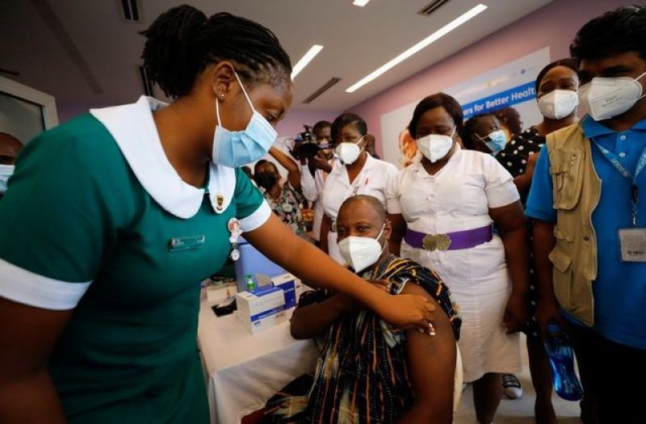
More than 100,000 people have received their second dose of the AstraZeneca Covid-19 vaccine as of Sunday, May 23, data from the Ghana Health Service (GHS) has shown.
The exercise, which began on May 19, is expected to inoculate about 360,000 persons who received their first jab from March 1 to 9, this year.
Dr Franklin Asiedu-Boeko, Director of Public Health at the GHS, said those who received their first jab from March 10, would have their second dose in the next phase.
He told the Ghana News Agency (GNA) in an interview in Accra that 380,000 doses of vaccine had been specifically allocated to those in the first phase and said the exercise would not end on May 26 as stated earlier.
Dr Asiedu-Boeko described the exercise as impressive despite the failure of an online application introduced to make the exercise more effective.
“We are happy about the process so far because, despite complaints about the side effects of the vaccine, people are still interested in getting inoculated," he said.
Dr Asiedu-Boeko assured the public that government was still making efforts to acquire more vaccines to get more people vaccinated.
He assured the public that the plan to vaccinate 20 million Ghanaians before the end of the year was on course.
Dr Asiedu-Boeko reiterated the need for the public to keep adhering to the COVID-19 safety protocols by wearing facemasks, using alcohol-based hand sanitizers, coughing or sneezing into tissues, and washing of hands with soap under running water.
Ghana, on Tuesday, March 2, kicked off its mass COVID-19 vaccination exercise in 42 selected districts in the Greater Accra, Kumasi, and Western regions.
As of Friday, April 30, a total of 849,527 AstraZeneca vaccines had been administered to the public.
Ghana recorded its first case of Covid-19 on March 12, 2020. So far 92,513 cases have been confirmed with 783 deaths. There are 1583 confirmed cases.
The novel coronavirus was first recorded in the Wuhan city of China in December 2019.
Coronaviruses are a large group of viruses that are common among animals. In rare cases, they are what scientists call zoonotic, meaning they can be transmitted from animals to humans, according to the US Centers for Disease Control and Prevention.
It has an incubation period of four to six days and fatal, especially for those with a weakened immune system – the elderly and the very young. It could also result in pneumonia and bronchitis.
Latest Stories
-
Christian Council calls for protection of mission schools’ religious identity
10 minutes -
Mahama holds discussions with India’s External Affairs Minister
16 minutes -
Even when you cough, they come after you — Abanga accuses Mahama govt of criminalising free speech
22 minutes -
Mahama Ayariga proposes bank-adopted streets as part of stronger public-private partnership
30 minutes -
NPP will impose $500m bail bond on NDC offenders if we return to power — Abanga
37 minutes -
Gov’t begins 175-hectare Anunuso irrigation project to raise rice production
48 minutes -
Mahama Ayariga urges banks to take responsibility for beautifying public spaces
55 minutes -
I plan to secure 70 ‘orphan’ parliamentary seats for NPP — Abanga
1 hour -
Annoh-Dompreh brokers talks as Zoomlion pledges support for Adipa communities
1 hour -
Account for the old economy before selling us a new one
1 hour -
Abanga sets 4 million youth-vote target for Bawumia ahead of 2028 election
2 hours -
Gold edges lower with focus on Fed minutes, rate path clues
2 hours -
Oil prices rise as storms and air strikes threaten supply
2 hours -
Nigeria nears 2,000 repatriations from South Africa after latest evacuation flight
2 hours -
‘How can an office…close at 5pm?’ – Abanga questions 24-Hour Economy
2 hours