


Audio By Carbonatix
The first resident of Tafeghaghte we met offered a blunt assessment of the devastation caused by Morocco's earthquake.
"People in this village are either in hospital or dead," they said.
As we clambered up to the top of the rubble we understood how no one could have escaped unscathed.
The bricks and stones of their traditional houses were no match for the size of this quake.
Ninety of the 200 residents here are confirmed dead and many more are missing.
"They didn't have the chance to get away. They didn't have time to save themselves," says Hassan, who's also made his way up the rubble.
Hassan says that his uncle is still buried beneath the rubble. There is no hope he will be dug out.
No one here has the machinery to do it and outside expertise has not arrived.
"Allah brought this and we thank Allah for everything. But now we need the help of our government. They are late, very late in coming to help people," he says.
Hassan adds that the Moroccan authorities should accept all offers of international assistance, but fears pride may prevent that happening.
On the other side of this tiny community, we see that everyone seems to be comforting one man in particular.
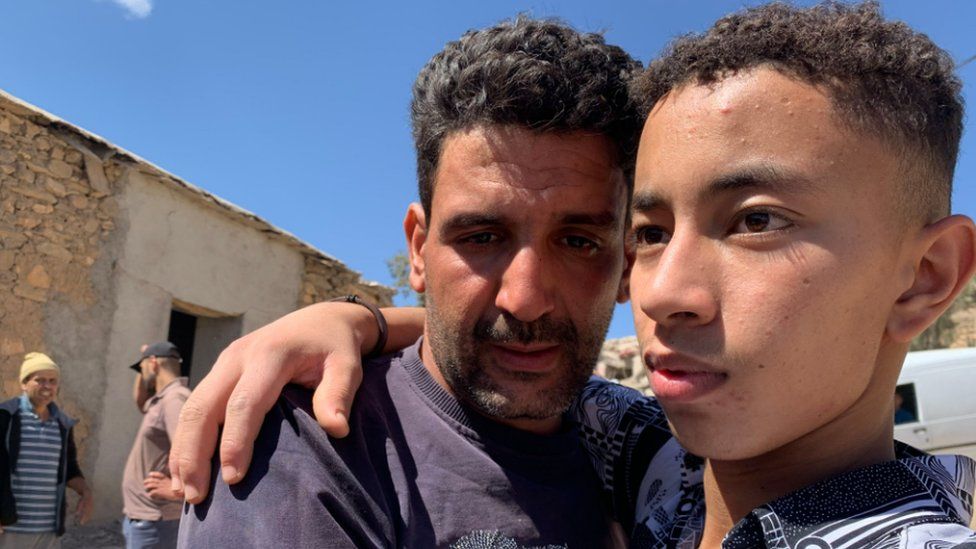
We discover his name is Abdou Rahman. He has lost his wife and his three boys.
"Our house was up there," he says pointing to the area where it once stood. It is now just part of an expanse of debris.
"You can see the white blankets and the furniture too. Everything else has gone."
Abdou Rahman says he ran 3km (1.9 miles) home from the petrol station where he worked after the earthquake hit.
He says he instinctively began calling out for his children, his shouts joining a din of others doing the same. There was no reply for him.
"We buried them yesterday," he says.
"When we found them, they were all huddled together. The three boys were asleep. They went down with the earthquake."
In a large tent just off the winding mountain road that connects the village to the outside world, dozens of families are sitting together.
There is inconsolable crying coming from every direction.
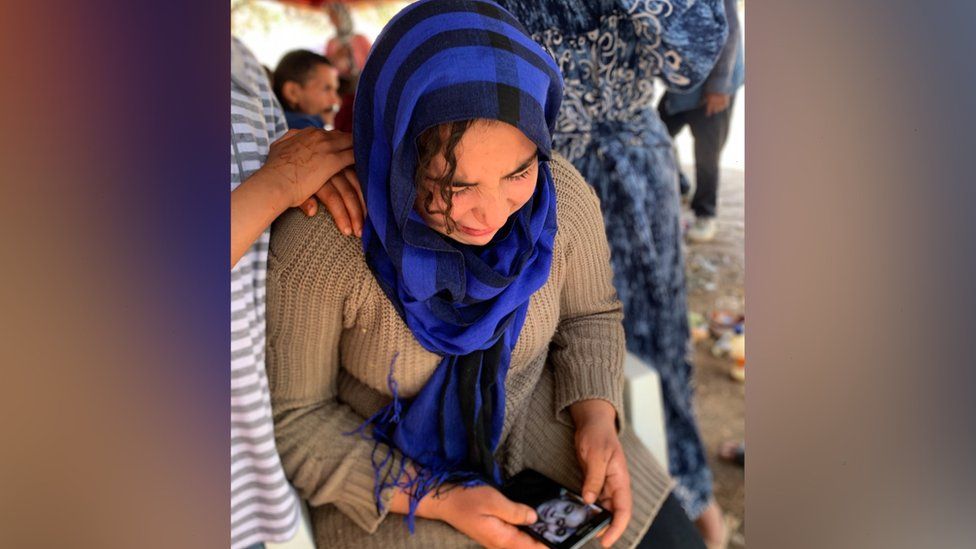
This latest wave of grief has been prompted by the body of a 10-year-old girl, Khalifa, being pulled from the debris.
This is grief in its rawest form. One woman faints, and another slumps into her chair and wails.
Morocco's tragedy is that this scene is being played out in village after village across the Atlas Mountains.
Traditional communities may have been content to be separate from some of the pressures of the modern world, but now, more than ever, they need outside help. Desperately so - and as quickly as possible.
Latest Stories
-
Hawa Koomson pledges experienced and mature leadership of NPP women’s wing
47 minutes -
Young woman found dead at Kasoa Peace Town
1 hour -
Playback: The Law examined lawful arrest in Ghana
2 hours -
Mahama urges African governments to treat healthcare as an investment, not budget cost
2 hours -
Bawumia congratulates John Boadu and new NPP executives, pledges support ahead of 2028
2 hours -
‘No talent should be left out’ – Bawumia pledges inclusive NPP campaign for 2028
2 hours -
Prof. Mike Oquaye recounts how he blocked the Special Prosecutor’s attempt to arrest Bawku Central MP
3 hours -
Make health sovereignty a priority for Africa – Mahama
3 hours -
Dorimon Naa, Wa West DCE lead massive clean-up exercise; threaten sanctions against recalcitrant residents
3 hours -
Photos from Adom FM Y2K Jam
3 hours -
Praye Tiatia steals the show at Adom FM Y2K Jam [Watch]
3 hours -
Boakye Agyarko congratulates John Boadu, pledges support for NPP leadership
4 hours -
Antwi HiMight thrills fans with Antwi ne Antwi hits at Adom FM’s Y2K Jam [Video]
4 hours -
Amb. Edward Boateng congratulates Boadu, Kodua on election wins
4 hours -
John Boadu pledges to rebuild NPP from grassroots and restore ‘winning machinery’
4 hours