

Audio By Carbonatix
Muslims across the world are celebrating Eid-ul-Adha to commemorate Prophet Ibrahim’s devotion to Allah (SWT) and his readiness to sacrifice his son, Ismail.
The celebrations, also known as the “Festival of Sacrifice” is the second of the two Islamic festivities, which is celebrated annually worldwide.
Muslims approach God on this day by sacrificing a sheep, a cow, or a camel and distributing the meat to the poor. They unite to pray together with family and friends and show love.
Eid-ul-Adha falls on the tenth day in the twelfth month of the Islamic Lunar Calendar; Dhul-Hijjah, which allows families, loved ones, and communities to fraternise, and is dependent on a legitimate sighting of the moon, following the completion of the annual Holy Pilgrimage of Hajj – which is an obligation for all Muslims.
The command from Allah (SWT) is a test of Prophet Ibrahim’s willingness and commitment to obey his Lord’s command, without question.
At the point of sacrifice, Allah (SWT) replaced Ismail with a ram, which was to be slaughtered in place of his son.
So, during the celebration, the sacrificial animal must be a sheep, lamb, goat, cow, bull, or a camel; the sheep, lamb or goat consist of one share, whereas a bull, cow or camel consist of seven shares per animal. The animal must be in good health and over a certain age to be slaughtered, in a “halal” friendly, Islamic way.
The meat can then be divided into three equal portions per share; one-third for the owner and family, one-third for friends, and the final third to be donated to those in need.
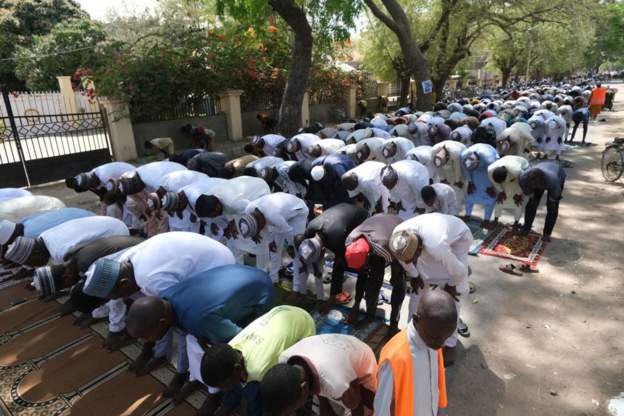
The act of the sacrifice is usually carried out after Eid Prayers, which are performed in congregation at the nearest Mosque on the morning of Eid.
The celebration of Eid-ul-Adha is to last for three days. Traditionally, the day is spent celebrating with family, friends and loved ones, often wearing new attire and the giving of gifts.
Some Muslims, the Ghana News Agency spoke to ahead of the celebrations, thanked Allah for seeing them through the year and prayed that their supplications, together with those who were able to embark on the journey to Hajj, would be answered. Some were excited about the celebration, saying though the prices of animals for sacrifice were high due to the outbreak of Anthrax in Bolgatanga, and the current economic situation, they would still enjoy the celebration.
Latest Stories
-
Conflicts among care providers linked to maternal, neonatal deaths – Expert
32 minutes -
GIS marks 10th TIME conference, champions improved teaching practices
39 minutes -
BRICS Or Balance? What Ghana’s bid really means
1 hour -
GPRTU wants full TRAFFITECH-GH implementation to start in 2027
1 hour -
Mahama announces plans to import electric wheelchairs for PWDs
1 hour -
KGL U17 Colts 2026: Western beat Prempeh Elite Academy to set up final final with Greater Accra Region
2 hours -
Late Solanke strike salvages 10-man Spurs draw at Man United
2 hours -
Gender Ministry to monitor welfare of Nana Akua Addo’s children amid domestic violence case
2 hours -
Benedict Okyere Yeboah: Ghana’s football problem goes beyond sacking a coach
2 hours -
GPL 2026/27: Darkwah Wiafe’s winner sees All Blacks beat Kotoko
2 hours -
ITF World Tour : Patel Wins Boys’ Singles Final at J100 Accra
3 hours -
Ghana must pursue BRICS partnership if it brings economic benefits – Kpebu
3 hours -
Success and Wright Claims J100 Accra Girls’ Doubles Championship
3 hours -
ITF J100: America’s Wright wins J100 Accra Girls’ Singles Title
3 hours -
Expedition hopes to find aviator Amelia Earhart’s plane on remote island
3 hours